Shop
All 294 tools
The whole catalogue. Every tool opens on Etsy, where the checkout and the download happen.
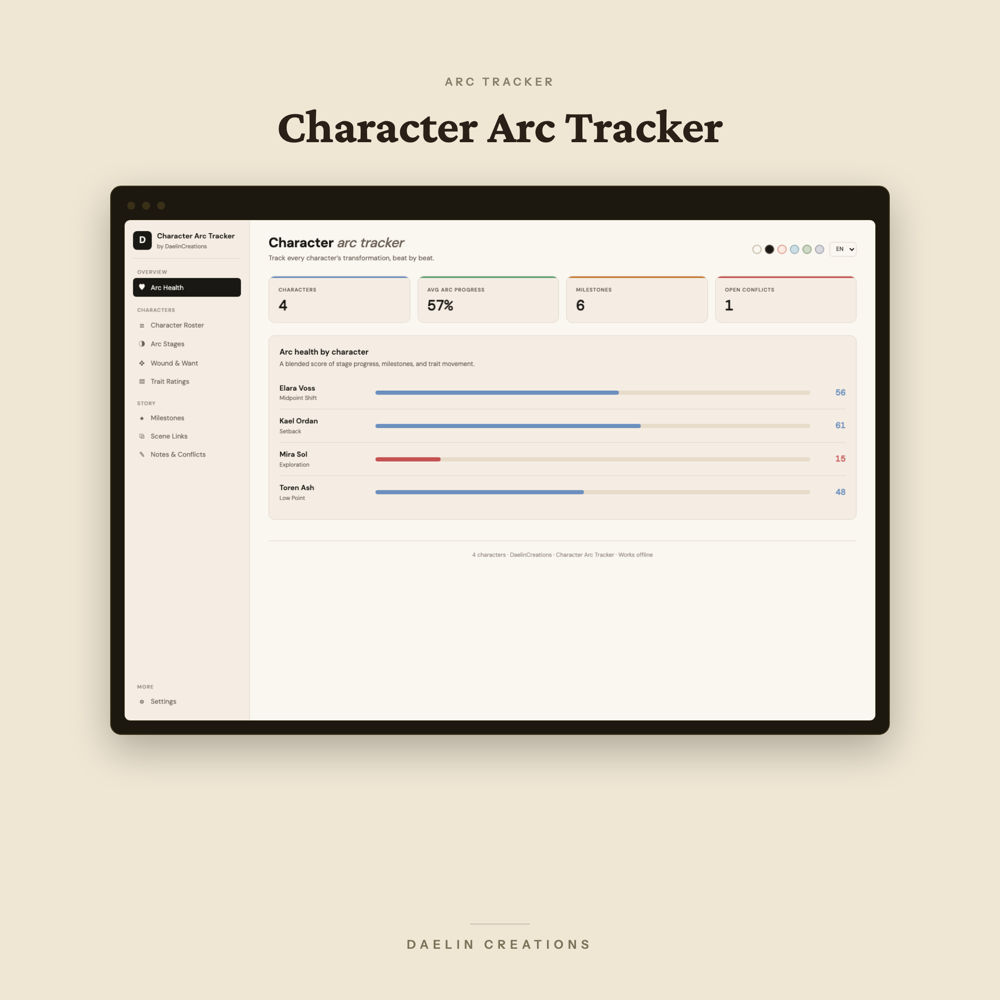
Character Arc Tracker
Finally know exactly where every character stands — emotionally, morally, and narratively — at any point in your story.
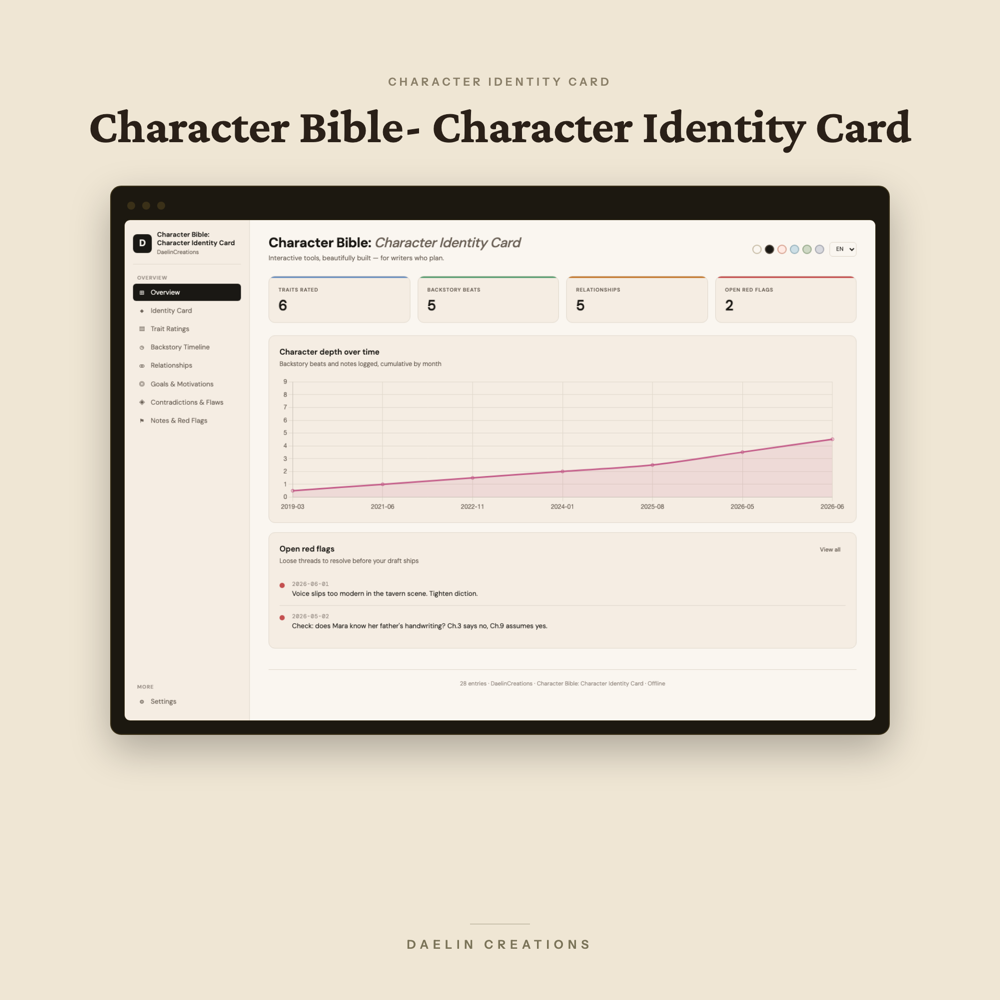
Character Identity Card
Map every layer of your character — identity, psychology, history, and contradictions — in one interactive dashboard that thinks the way writers think.
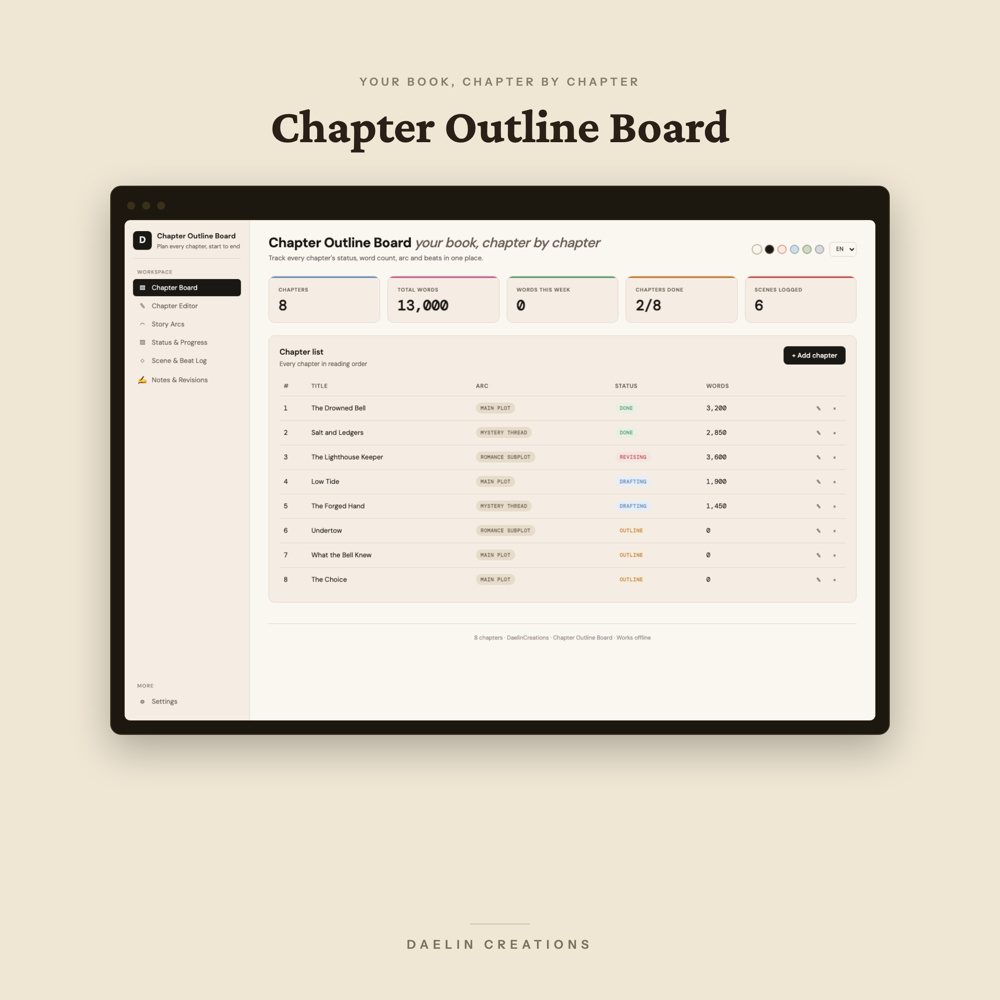
Chapter Outline Board
Stop losing track of your chapters.
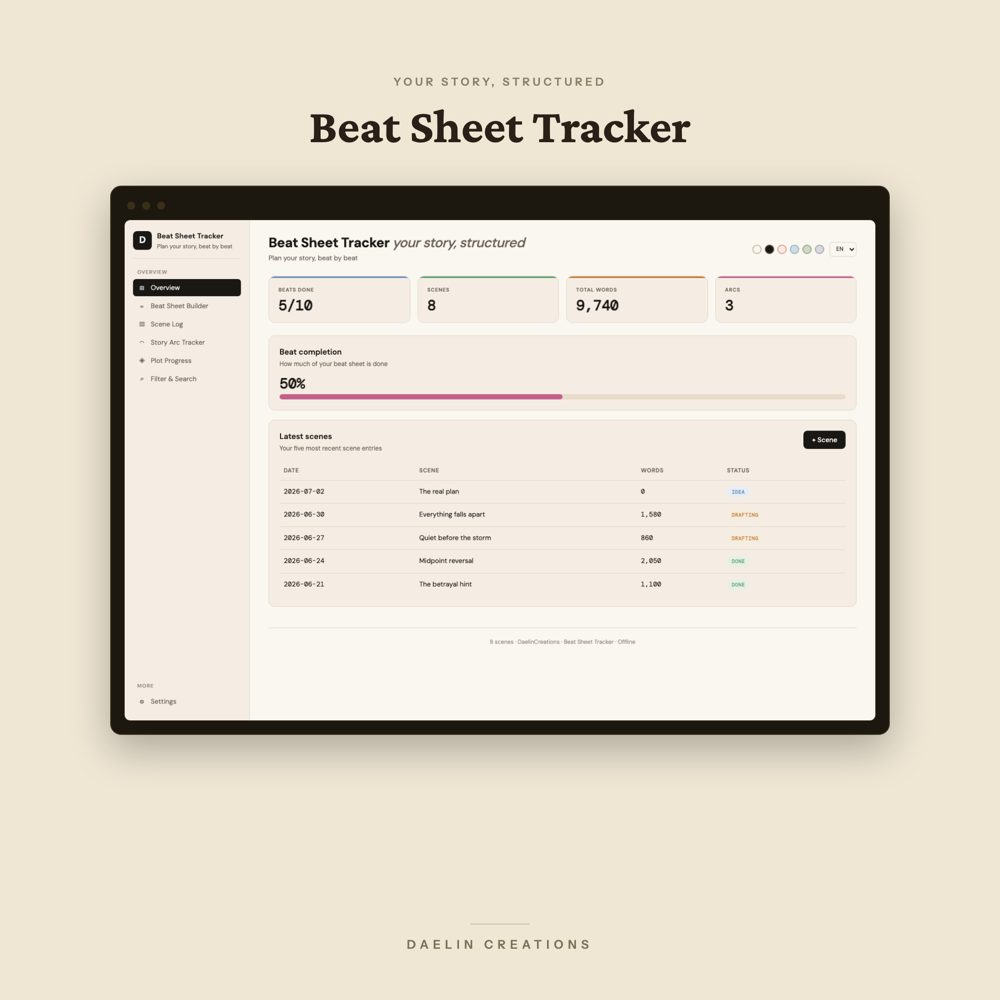
Plot & Beat Sheet Tracker
Map your entire novel's plot in one browser tab — no app, no subscription, no data leaving your computer.
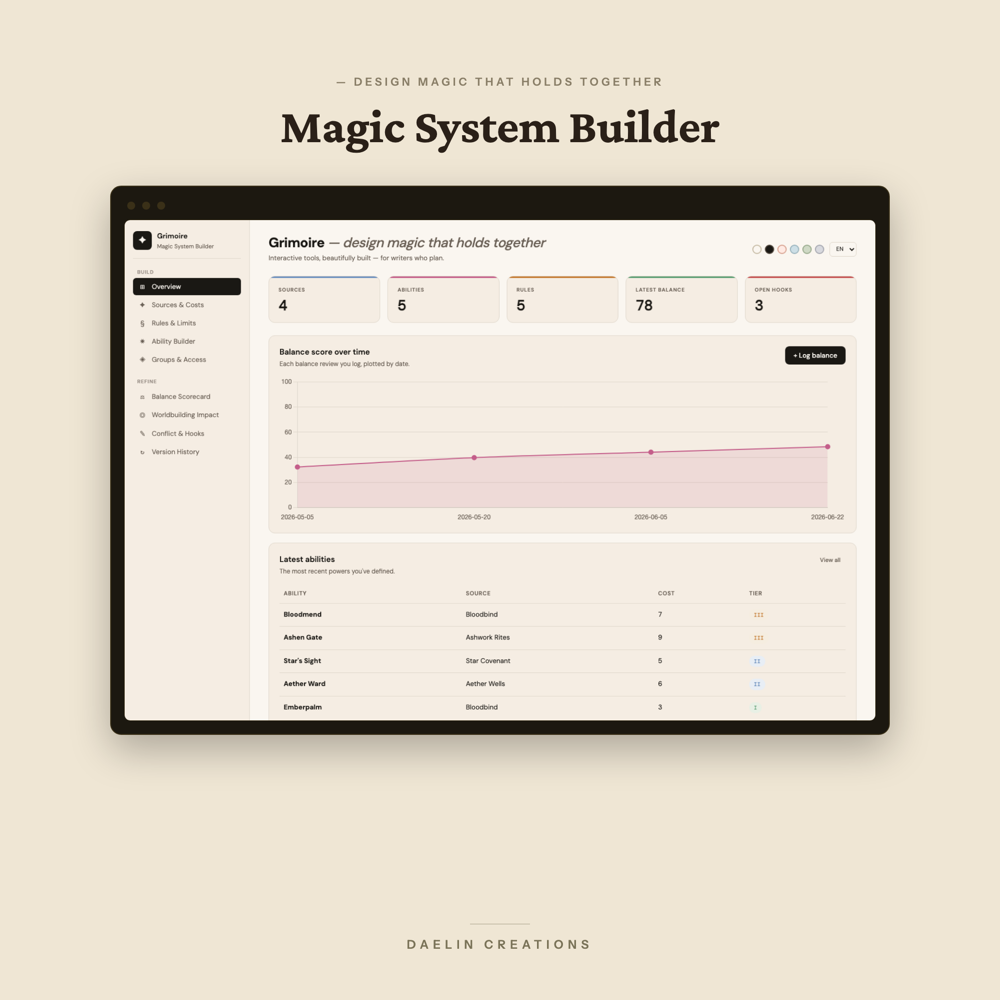
Magic System Builder
Design airtight, immersive magic systems — right inside your browser, no app or subscription required.
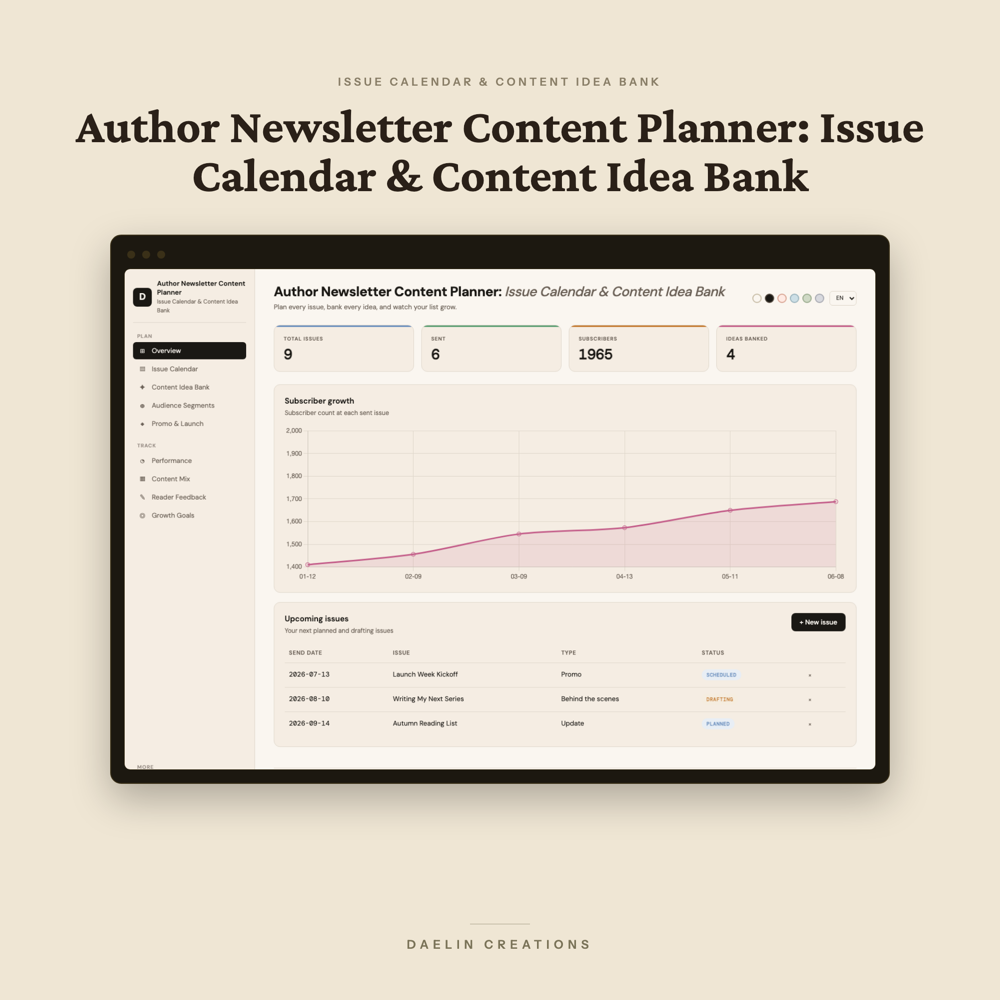
Author Newsletter Content Planner: Issue Calendar & Content Idea Bank
Stop guessing what to send — plan every issue, track what resonates, and grow your list with intention. This interactive HTML dashboard gives authors a complete newsletter command center: from mapping out your editorial calendar to logging reader feedback, measuring content performance, and planning book launches, all in one private, offline-ready file.
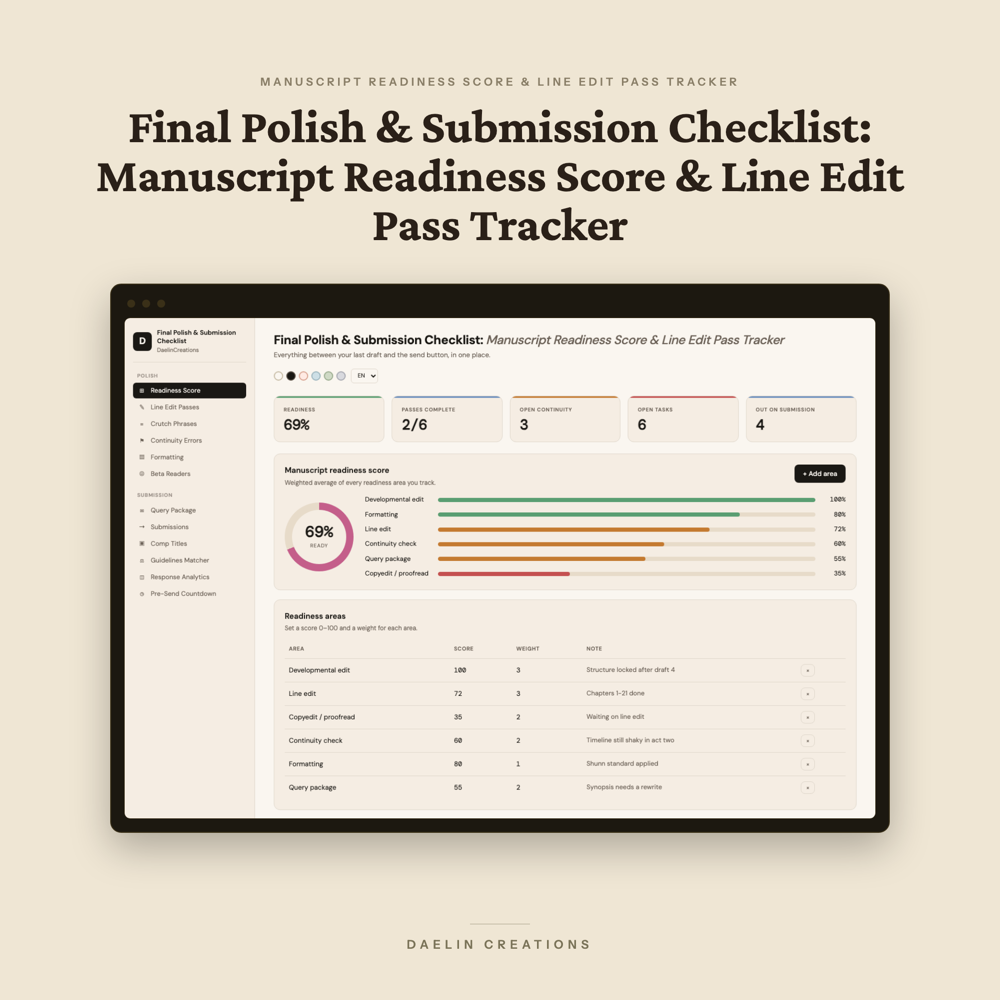
Final Polish & Submission Checklist: Manuscript Readiness Score & Line Edit Pass Tracker
Your draft is done. Now comes the part nobody prepares you for: the last twelve percent. The crutch words you cannot unsee, the character whose eyes changed color in chapter nine, the eighteen agents with eighteen different formatting rules, and the quiet panic of hitting send. This dashboard turns that scattered mess into one honest, measurable readiness score so you know exactly what is polished, what is still soft, and whether this manuscript is truly ready to leave your hands.
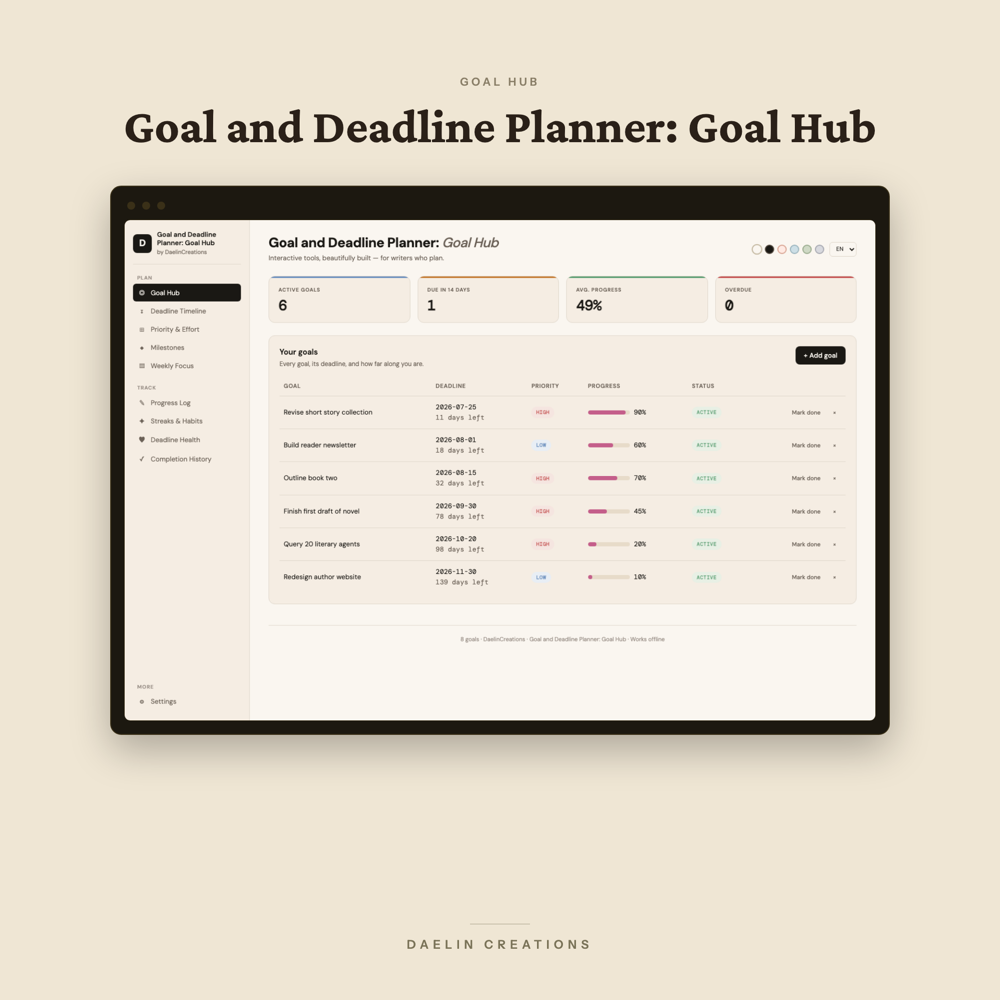
Goal and Deadline Planner: Goal Hub
Track every goal, deadline, and daily streak in one offline HTML file — no subscription, no login, your data stays yours.
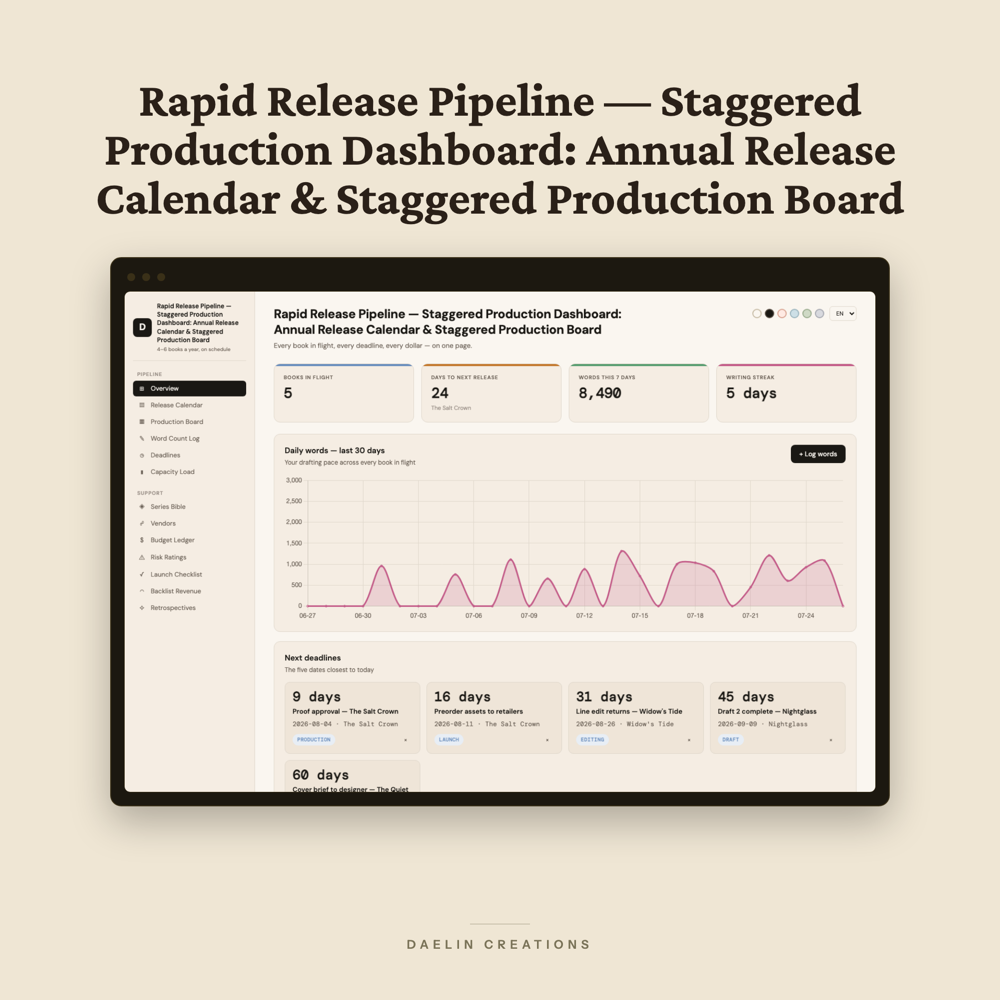
Rapid Release Pipeline
Publishing four to six books a year does not fail because you write too slowly. It fails because three books are in three different stages at once and nobody is holding the whole map. This dashboard holds the map.
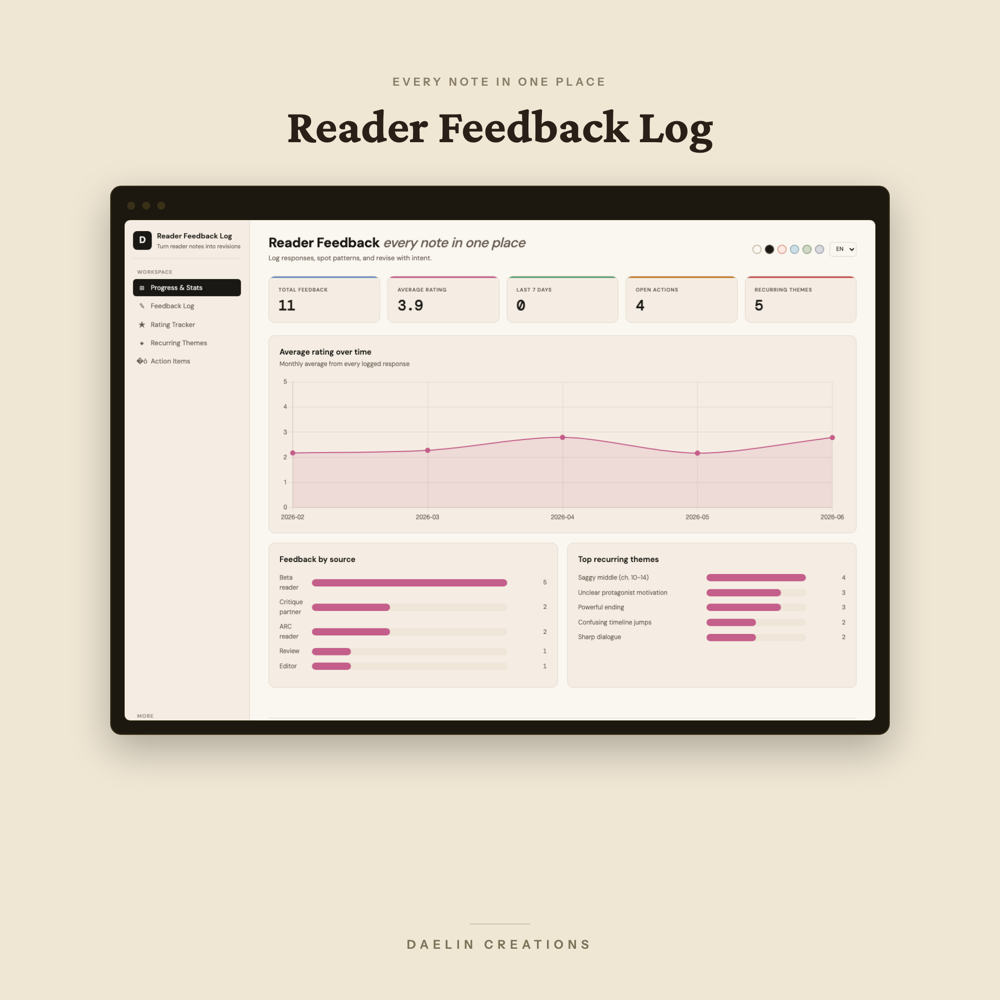
Reader Feedback Log Dashboard
Stop losing track of what your readers actually said — and start turning their feedback into a stronger story.
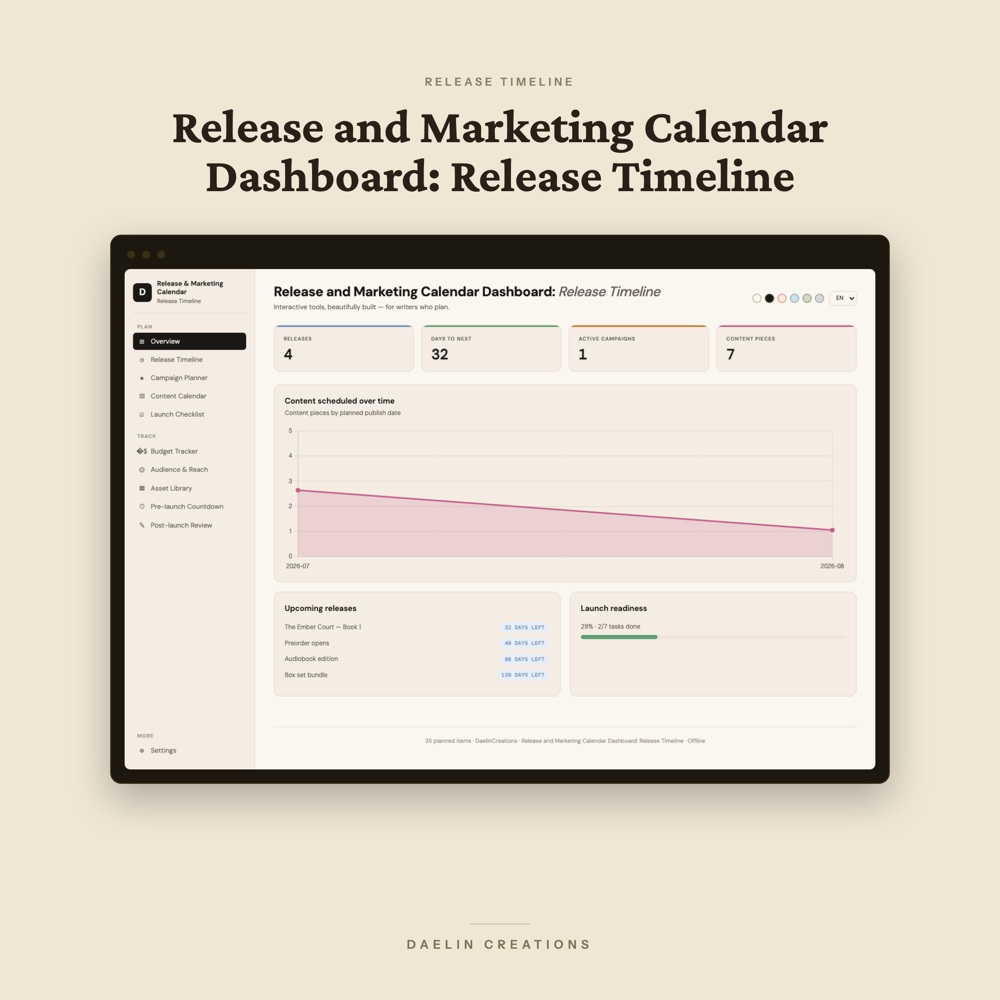
Release and Marketing Calendar Dashboard: Release Timeline, Launch Planner & Budget Tracker
Plan every launch phase from first draft to post-release review — all in one offline HTML file, no subscriptions, no accounts, no data leaks.
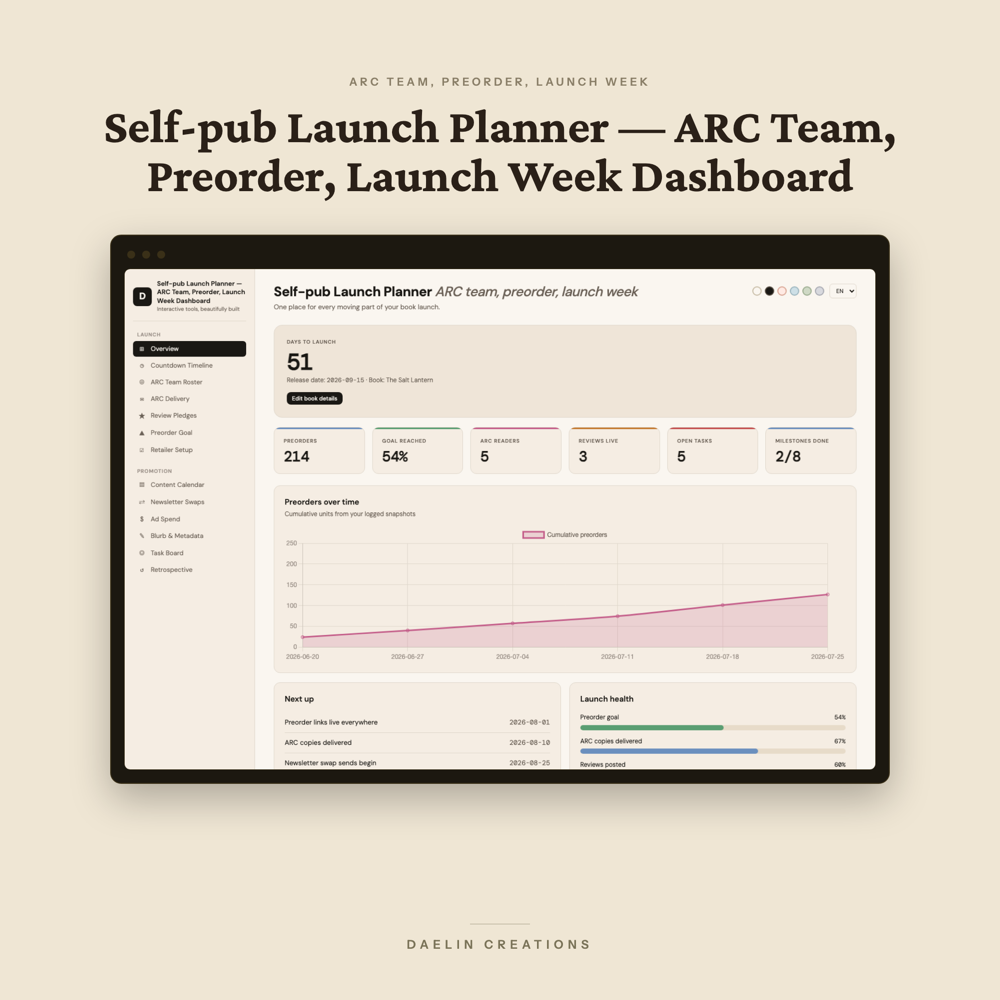
Self-pub Launch Planner
Run your whole book launch from one screen
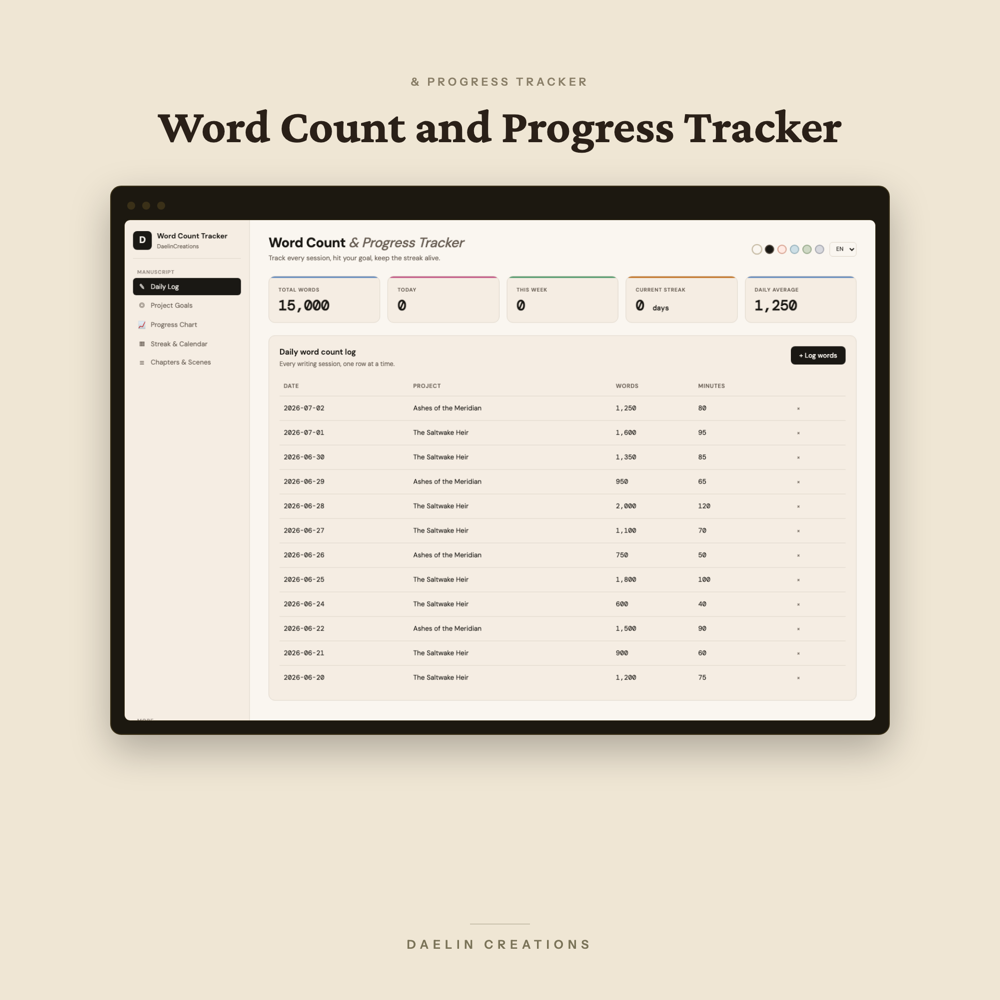
Word Count Progress Tracker – Interactive HTML Dashboard for Writers
Hit your writing goals and finally see your progress — one word at a time.
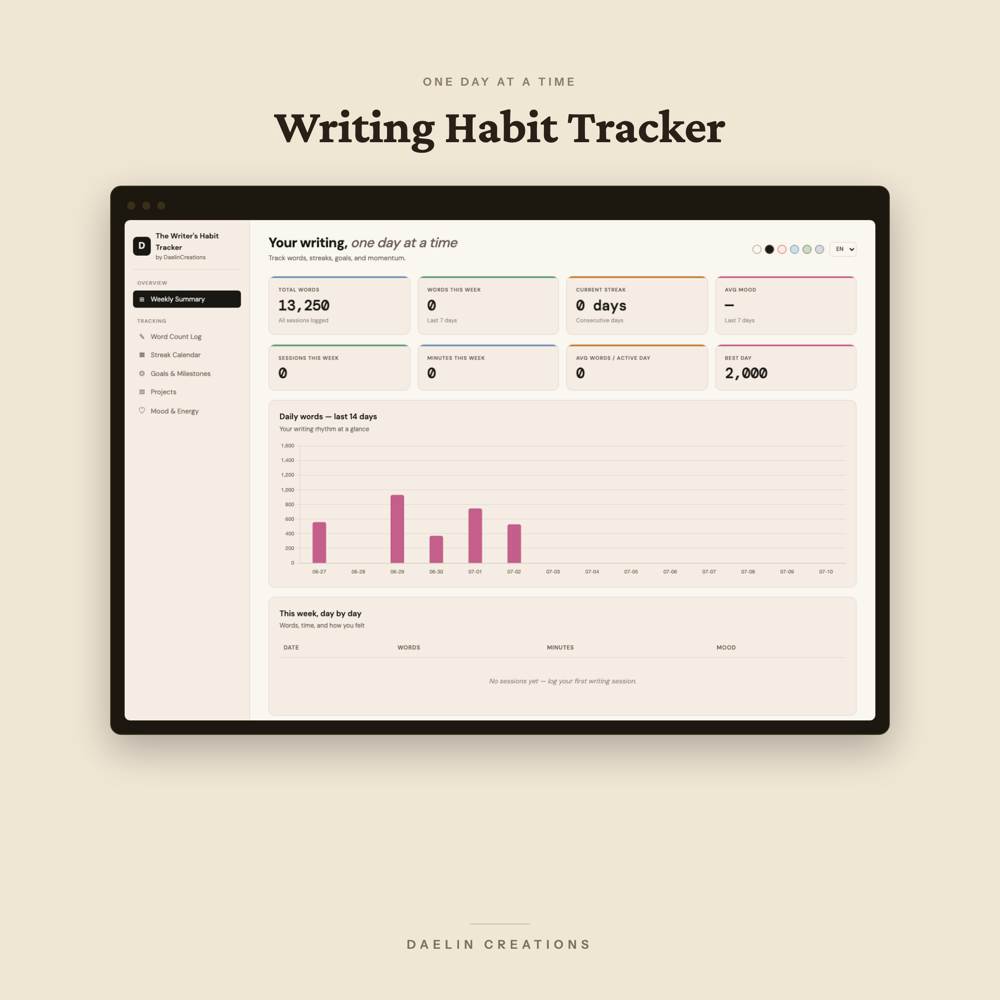
Writing Habit Tracker
Build a rock-solid writing habit — one day at a time.
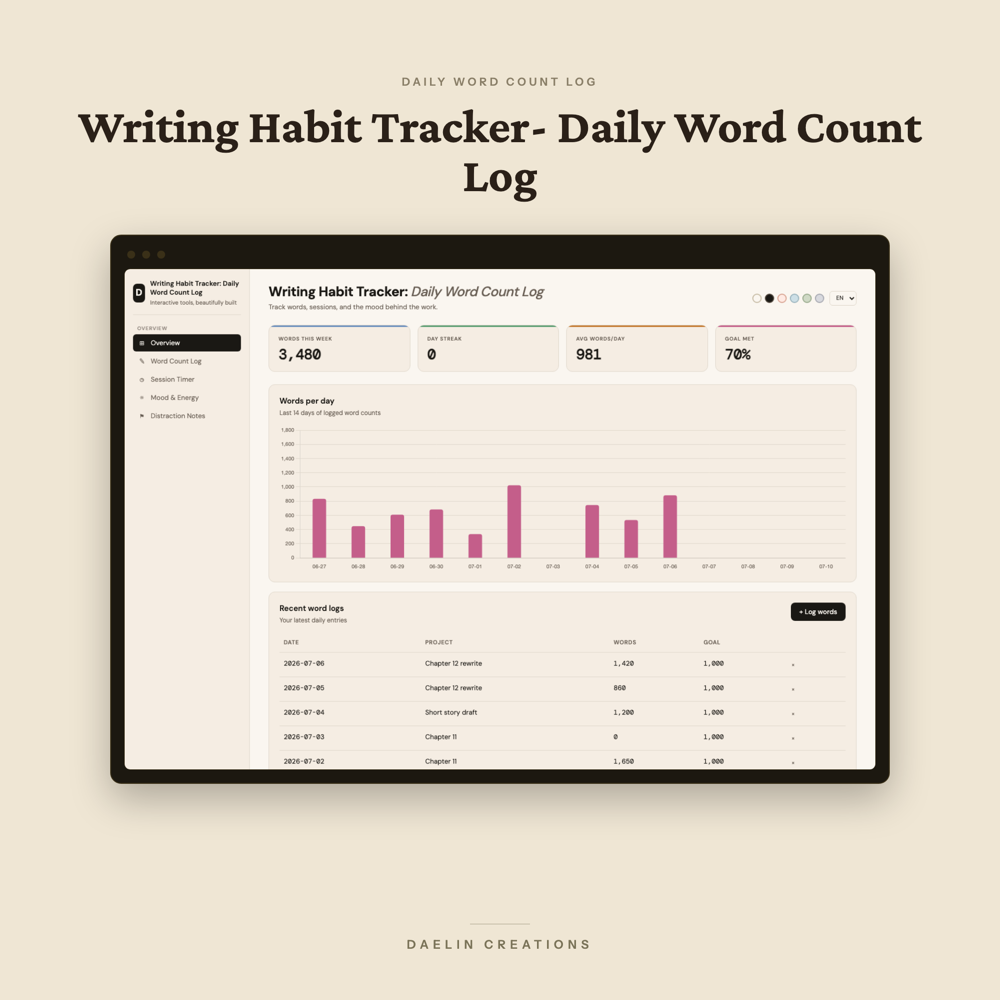
Writing Habit Tracker: Daily Word Count Log
Track every word, every session, and every mood shift — this interactive HTML dashboard turns your writing habit into a data-driven ritual you can actually see growing.
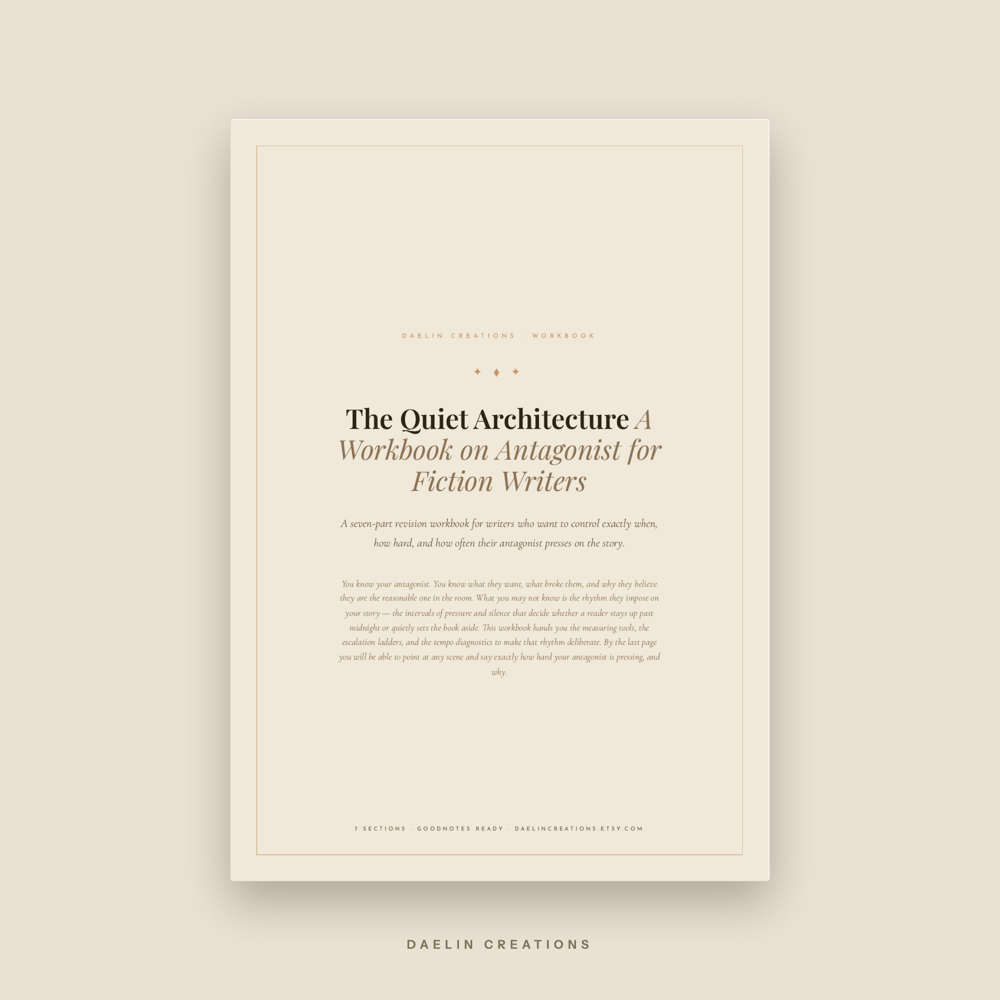
Antagonist Rhythm Workbook for Fiction Writers
Build an antagonist your reader can feel on every page, even the ones your antagonist never appears on.
Backstory Without Info-Dumps Workbook
Stop stopping your story to explain the past. This printable PDF workbook teaches fiction writers how to weave backstory into forward-moving prose with precision, sensory grounding, and genuine craft — no info-dumps required.
Between the Lines
Everything your characters *mean* but never quite say — finally mapped, named, and made usable.
Character Arc Workbook for Fiction Writers
You love tropes. You also know exactly where they ache — the beats that feel too familiar, the character choices that follow the script a little too obediently, the endings that satisfy without quite surprising. This printable workbook was built for that exact tension.
Character Arc Workbook for Fiction Writers — Transformation Prompts, Scene
This printable workbook guides fiction writers through the complete architecture of a transformative character arc — from the hidden wound that drives your character's every choice to the irreversible act that makes the old self impossible, and finally to the new self tested under pressure.
Character Death Workbook for Fiction Writers
Does your character's death land with the weight it deserves — or does it feel like a plot convenience your readers see through? This printable workbook for fiction writers gives you a rigorous, scene-by-scene framework for writing character deaths that earn their grief.
Character Interiority Workbook
Writing complex, psychologically rich characters requires more than backstory — it requires mapping the living interior of a mind: its values, its self-deceptions, its desires, its wounds. This printable workbook gives fiction writers a structured, seven-section framework for developing character interiority with precision and depth.
Character Pitfalls Fix-It Guide
Struggling with characters who feel flat, forgettable, or just *wrong*? This printable reference guide targets the four most common character mistakes that trip up beginner and intermediate fiction writers — and shows you exactly how to fix them.
Character Voice & Dialect Quick Reference Guide
Give every character a voice so distinct a reader could cover the attribution tag and still know exactly who is speaking.
Character Voice & Dialect Writer's Reference Guide
Give every character a voice so distinct your readers could identify them by a single line of dialogue — no dialogue tag required.
Civil War Romance Writing Guide
**Your war-backdrop love story deserves more than a cannon in the distance.**
Clothing & Costume Reference Guide for Fiction Writers
Stop second-guessing every garment your characters wear. This practical reference guide gives fiction writers the tools to describe clothing, fabric, and costume with confidence — whether you're writing high fantasy, historical romance, contemporary literary fiction, or dystopian sci-fi.
Dialogue & Subtext Reference Guide for Romance Writers
For writers who know something is missing — but can't yet name it.
Dialogue Tags Writer's Vocabulary Guide
Tired of reaching for 'said' and coming up empty when a scene demands more? This printable writer's vocabulary guide collects rare, precise dialogue tags organized by emotional register — confrontation, deception, tenderness, hesitation, and more — so you always have the exact word your scene is asking for.
Emotion & Body Language Writer's Reference Guide
Struggling to show emotion without telling your reader what to feel? This quick-reference guide is the physical vocabulary every fiction writer needs.
Enemies to Lovers Writing Workbook
You know how this story ends. What this workbook gives you is how it happens — beat by beat, from the inside out.
Expository Dialogue Workbook for Fiction Writers
Does your dialogue slow down every time your characters need to explain something? This printable workbook tackles one of fiction's most persistent craft challenges — expository dialogue — with 21 targeted exercises designed to transform information dumps into living, pressurised scenes.
Face as Voice – Facial Expressions Craft Guide for Fiction Writers
Stop writing expressions your readers skim past — start writing faces they *feel*.
Facial Expressions Quick-Reference Guide for Fiction Writers
Stop reaching for the same tired expressions. This writer's quick-reference guide gives you precise, emotionally vivid facial details for every scene — so your characters' inner lives land on the page exactly as you imagined them.
Fated Mates & Bonds Romantasy Writing Workbook
If you have ever loved the fated mates trope and suspected it could do more — this workbook was built for you. Fated Mates & Bonds is a 7-section printable PDF workbook designed for romantasy and fantasy romance writers who want their predetermined love story to feel genuinely earned rather than conveniently delivered.
Fiction Writing Workbook
Does your character introduction fall flat the moment it hits the page? Signal and Noise is a printable craft workbook for fiction writers who want readers to *feel* a character before they understand them — built around seven focused sections that take you from entrance signature to status dynamics, desire lines, reader verdicts, and pressure-testing your best draft.
Fiction Writing Workbook
Most writers map their character relationships — few map what those relationships *mean*. The Hidden Layer is a seven-section printable workbook that guides fiction writers from naming a single thematic spine, through casting and annotating a full relationship web, to reading the opening and closing shapes of that web as a complete thematic argument.
Fiction Writing Workbook — Genre Conventions Character Workbook for Writers
Master the unspoken rules of genre fiction with this beautifully designed, printable PDF workbook — built for writers who want to move beyond formula and craft characters who make every genre convention feel inevitable.
First Chapter Red Flags
Is your first chapter quietly turning readers away? This beautifully designed reference guide pinpoints the four most common opening mistakes — the wake-up scene, the weather opening, the prologue trap, and the backstory dump — and shows you exactly how to fix each one.
Flirting & Banter Writing Guide
Struggling to write flirting that actually crackles on the page? This craft reference guide teaches romance writers how to build verbal tension scene by scene — from the first loaded exchange to the line that finally breaks the slow burn wide open.
From Story Idea to First Draft
You have a story idea. Not a plot, not a cast, not an outline: an idea that keeps coming back and refuses to become anything. Every planning tool you own assumes you've already turned it into something. This workbook is for the stretch before that.
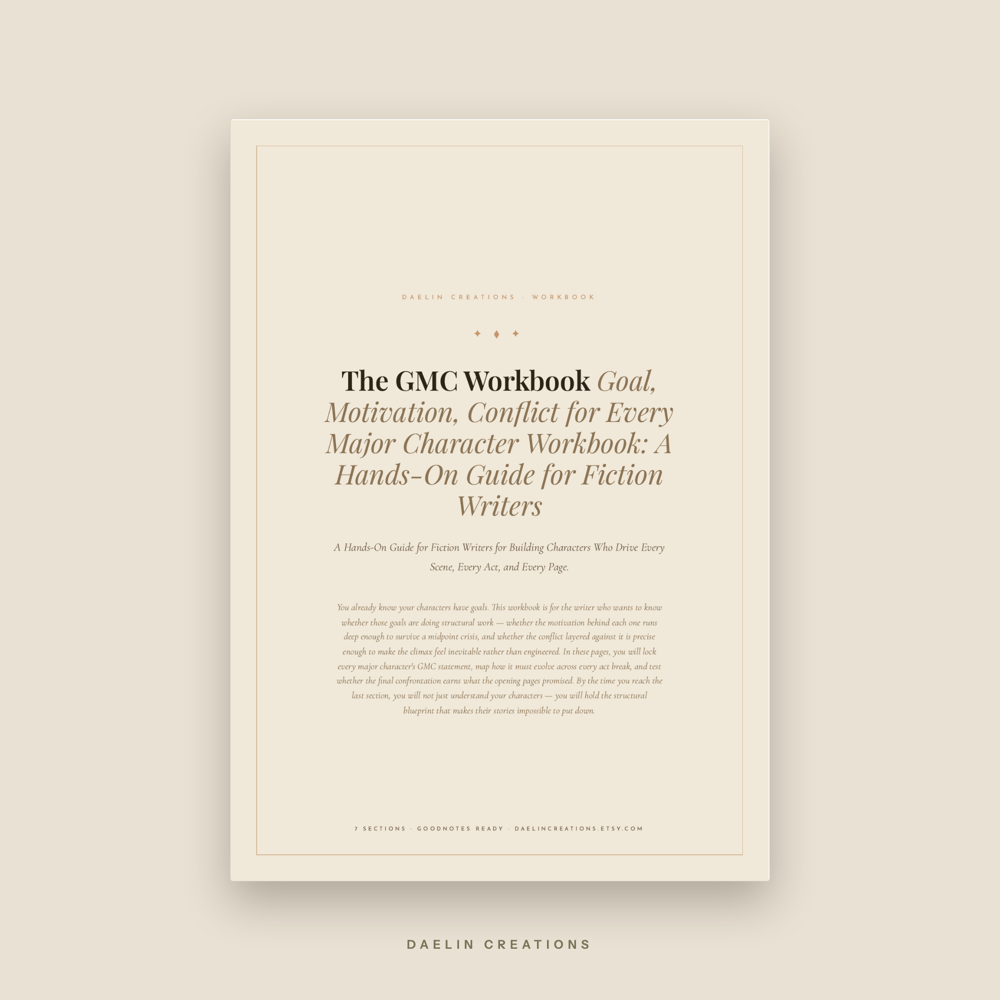
GMC Workbook for Fiction Writers
Build characters who drive every scene — with this structured, hands-on GMC workbook designed for serious fiction writers. Goal, Motivation, and Conflict are the three structural pillars that determine whether your story generates its own momentum or stalls between plot events. This printable PDF workbook takes you through seven focused sections — from locking your core GMC statements and mapping internal versus external goal layers, to running motivation archaeology on every major character and stress-testing your climax with the Convergence Test. Every exercise is specific to the craft of character-driven fiction: no generic fill-in-the-blank prompts, no filler content. You will build GMC Evolution Charts for protagonist and antagonist, audit your act breaks for flat conflict beats, map secondary characters to their structural roles, and confirm that your resolution is earned rather than given. Designed for A4 pages with generous ruled lines and GoodNotes compatibility. Works at any stage of the writing process — discovery drafters and plotters alike will find structural clarity on every page.
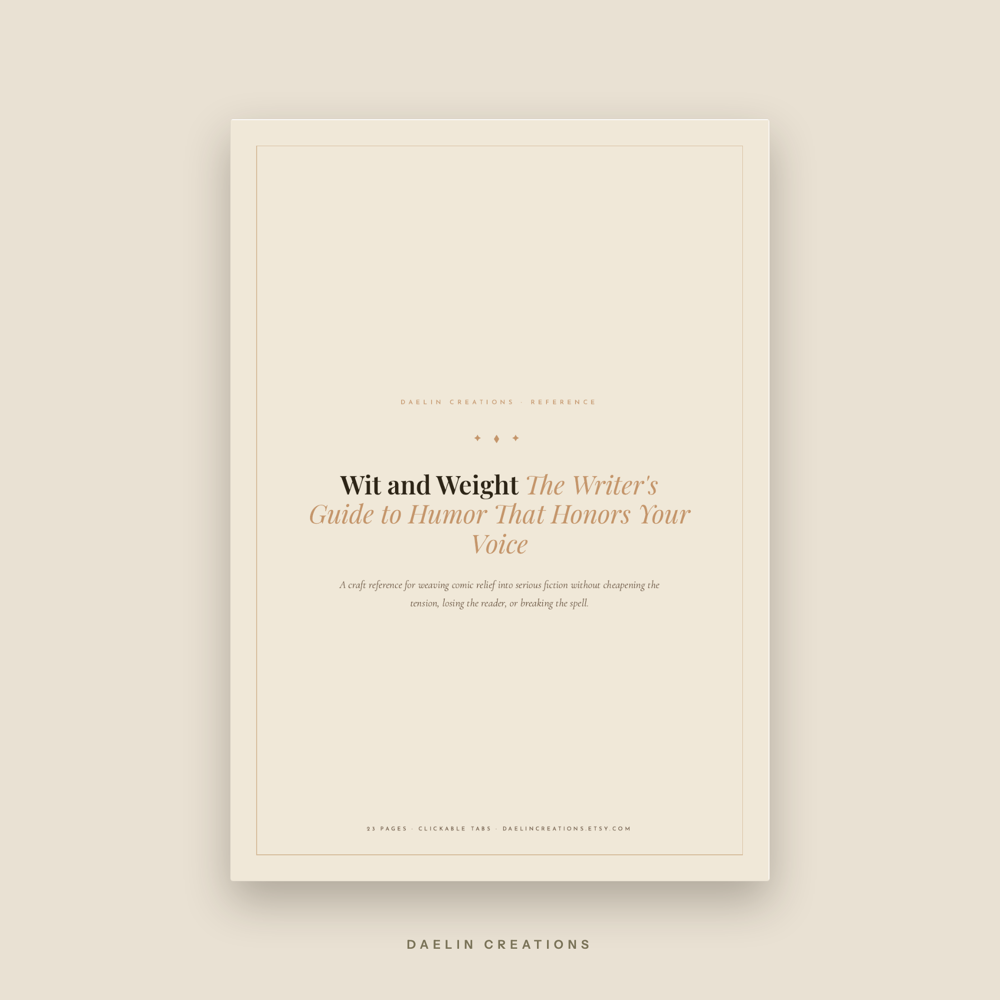
Humor & Levity Writing Guide
Humor is one of fiction's sharpest tools — and one of its easiest to mishandle. A misplaced joke can shatter hard-won tension; a perfectly timed one can crack a reader's heart wide open.
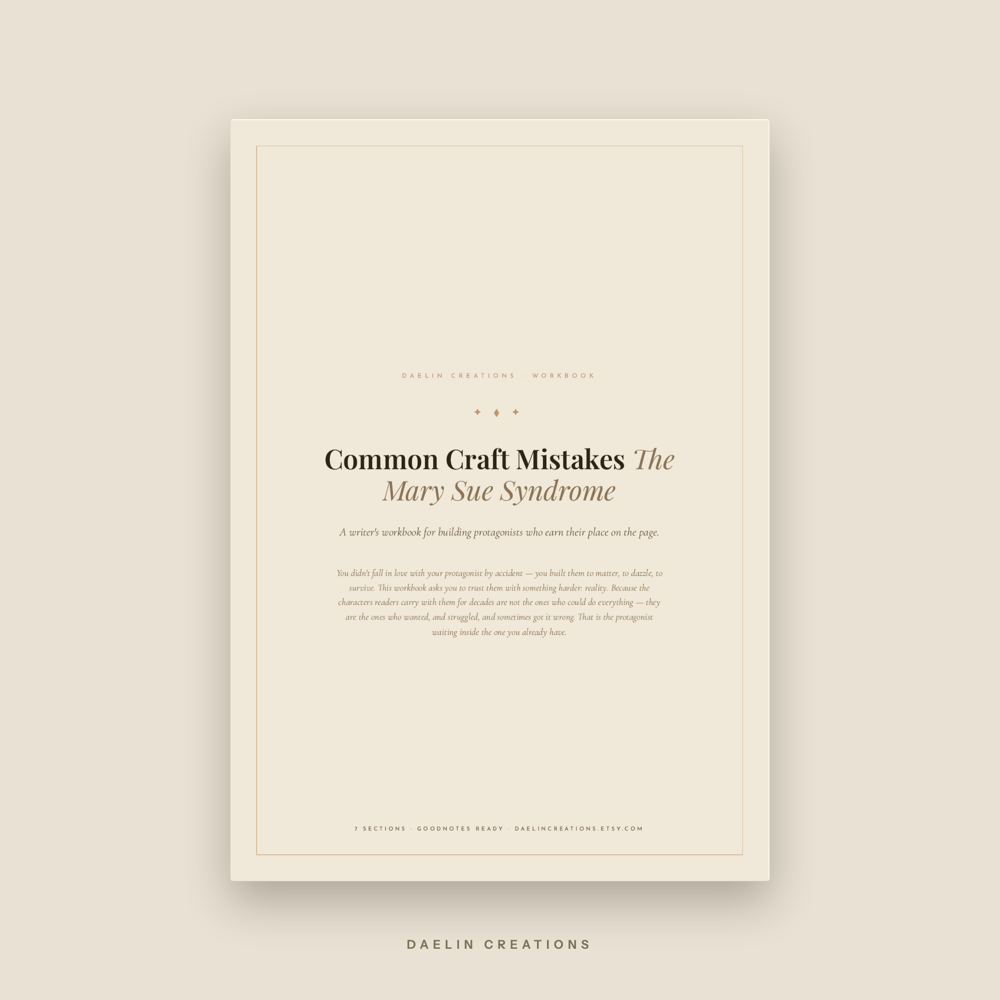
Mary Sue Syndrome Workbook
Does your protagonist feel a little too capable, a little too admired — even to you? This printable workbook guides fiction writers through the craft of diagnosing and transforming a Mary Sue character into a fully dimensional, structurally essential protagonist.
Mentor and Rival Dynamics Workbook
Build mentor and rival relationships that hold your novel up
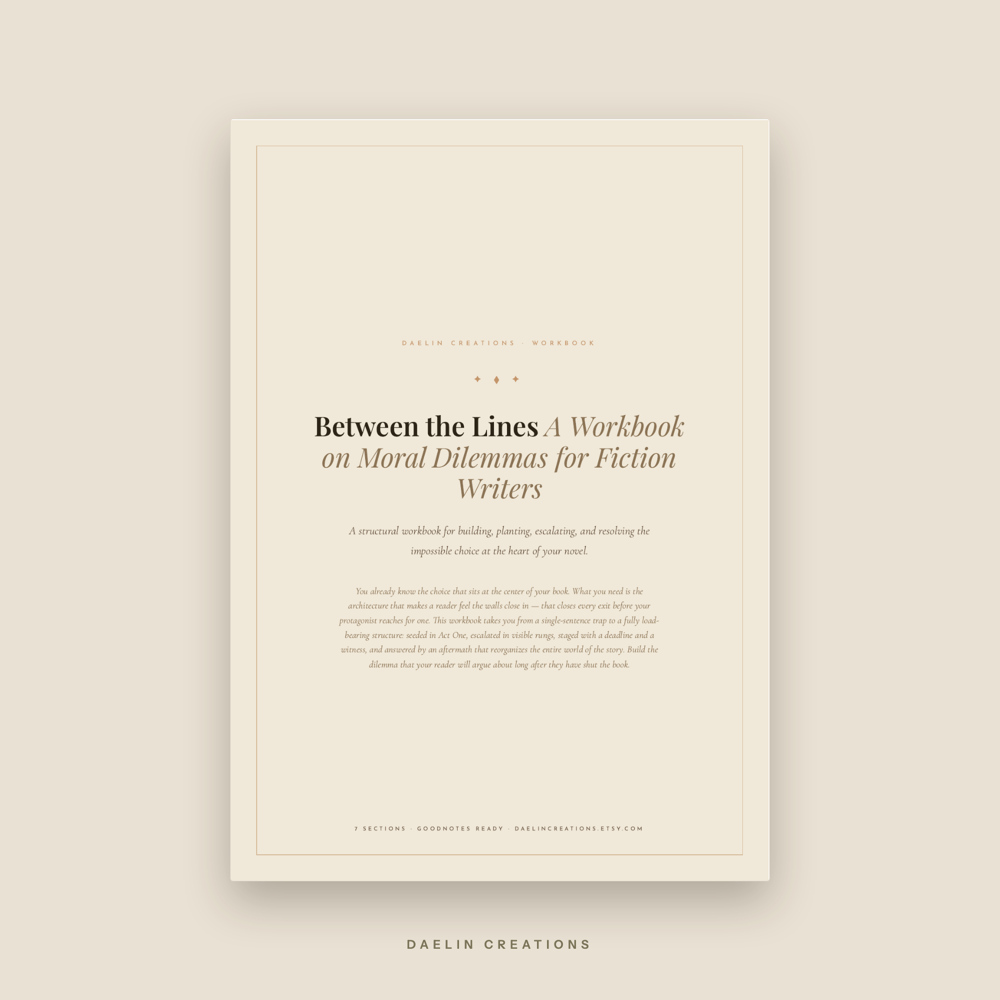
Moral Dilemmas Writing Workbook
Between the Lines is a printable workbook for novelists who want the impossible choice at the center of their story to hold real structural weight. It treats the moral dilemma as something you engineer: built, seeded, escalated, staged, and stress-tested before it ever reaches the page.
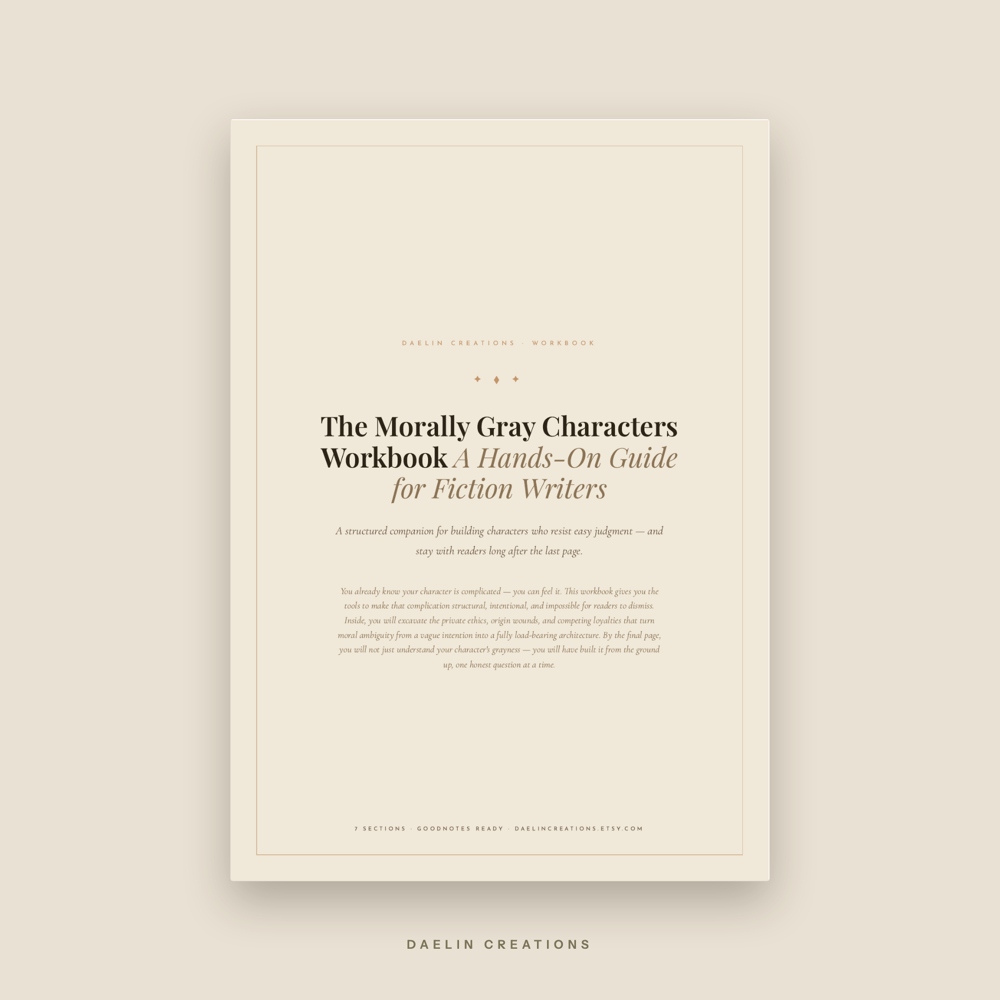
Morally Gray Characters Workbook
Your most complicated characters deserve more than good intentions — they deserve a process. This printable workbook guides fiction writers through seven structured sections designed to build morally gray characters from the inside out: the private code of ethics they actually live by, the origin wound that made clean hands impossible, the competing loyalties that force impossible choices, the craft techniques that keep readers genuinely split, the compounding costs that make consequences feel real, the foil relationships that define their ethics by contrast, and finally, an ending built on earned clarity rather than convenient resolution.
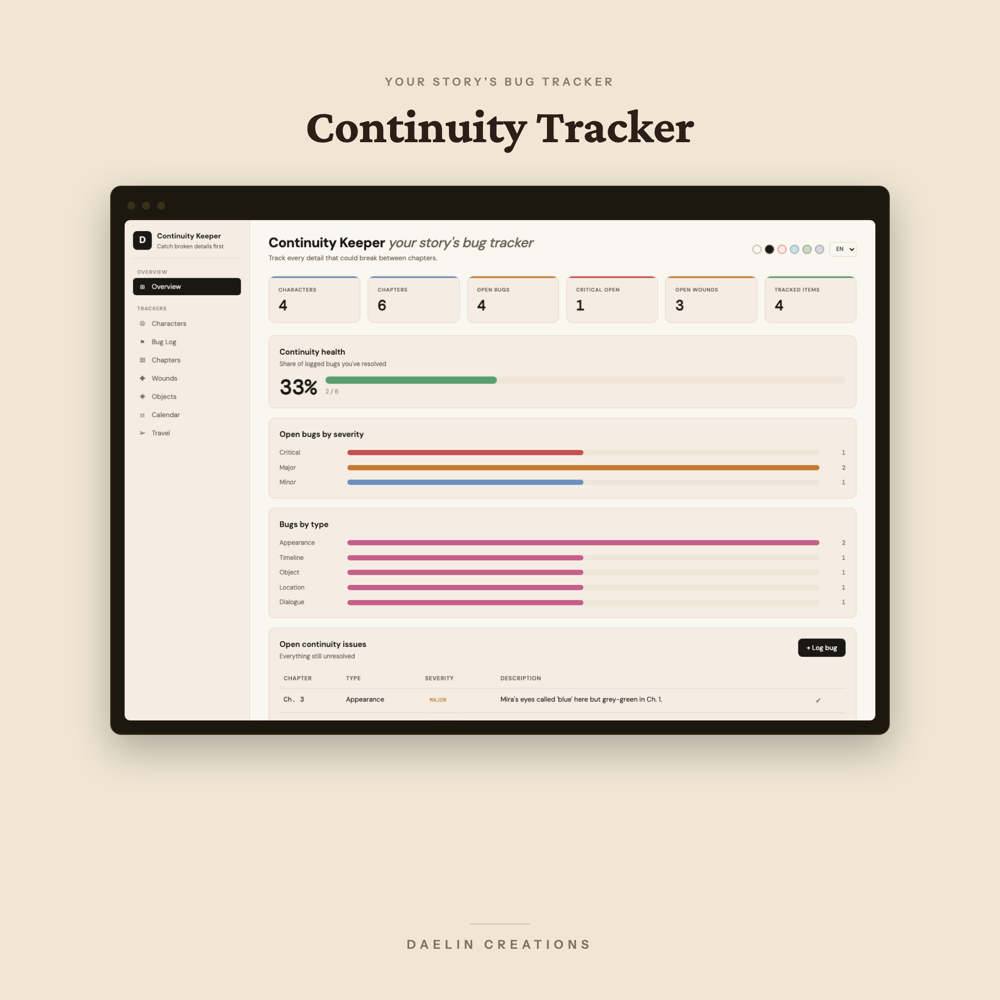
Novel Continuity Tracker HTML Dashboard
Never let a plot hole slip through again.
Parallel Lives: Writing Alternate Selves & Forking Paths
Parallel Lives is a craft reference for literary novelists writing alternate selves, divergent timelines, and the roads a character almost traveled. It treats the parallel world as a mirror for character, not a machine for plot.
Redemption Arc Workbook for Fiction Writers
Does your redemption arc feel earned — or are you hoping readers won't notice the math doesn't add up? This printable workbook gives fiction writers the structural tools to build character change that readers will believe and forgiveness that feels genuinely won.
Regional Voice Lab
Struggling to write Southern Gothic atmosphere without the magnolia-and-moonshine clichés? Reaching for a Scottish brogue and landing in parody? **Regional Voice Lab** is the craft reference guide fiction writers reach for when place needs to *breathe* on the page without becoming a costume.
Relationship Web Workbook for Fiction Writers
Built for dark romance and literary fiction writers who are ready to move beyond instinct and learn to build atmosphere deliberately — scene by scene, sense by sense, silence by silence.
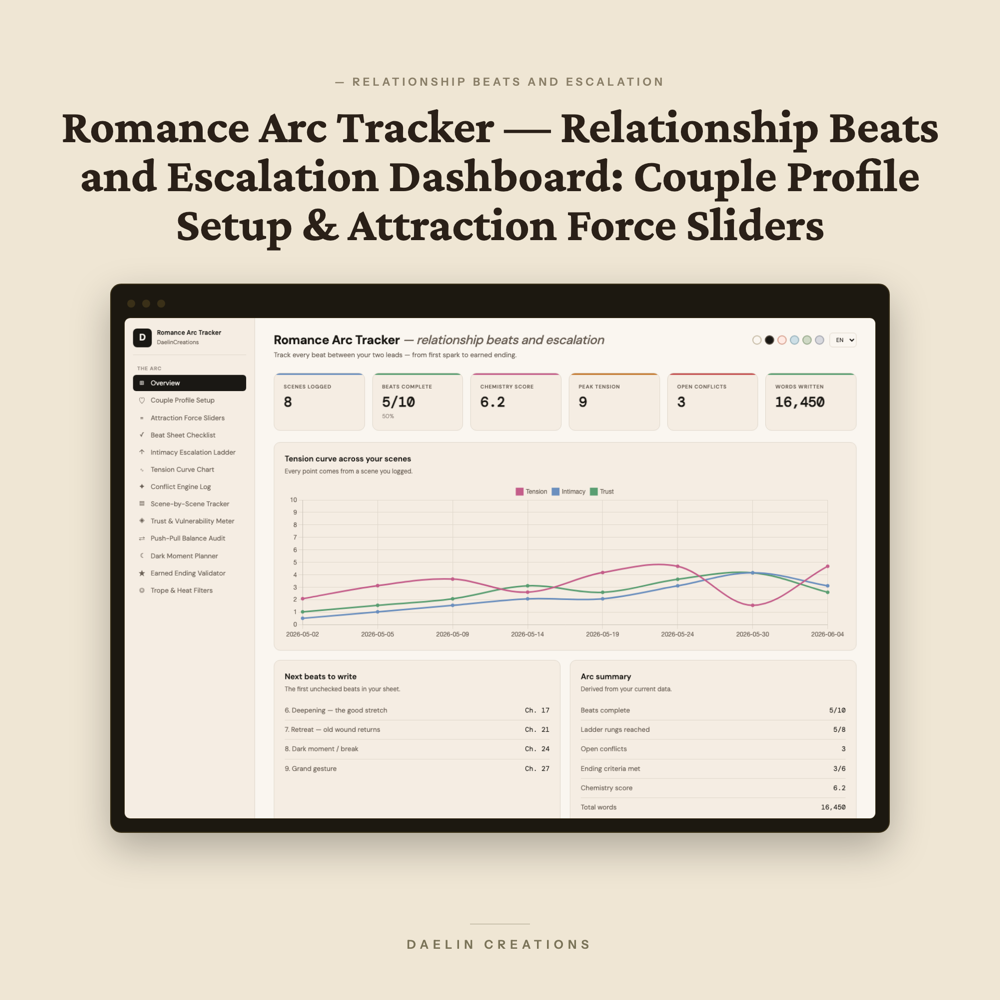
Romance Arc Tracker
Stop guessing why your love story feels flat in the middle. This dashboard treats a romance like a force system: two people with specific pulls toward each other, specific reasons to resist, and a measurable rise in heat, trust, and risk from first glance to earned ending.
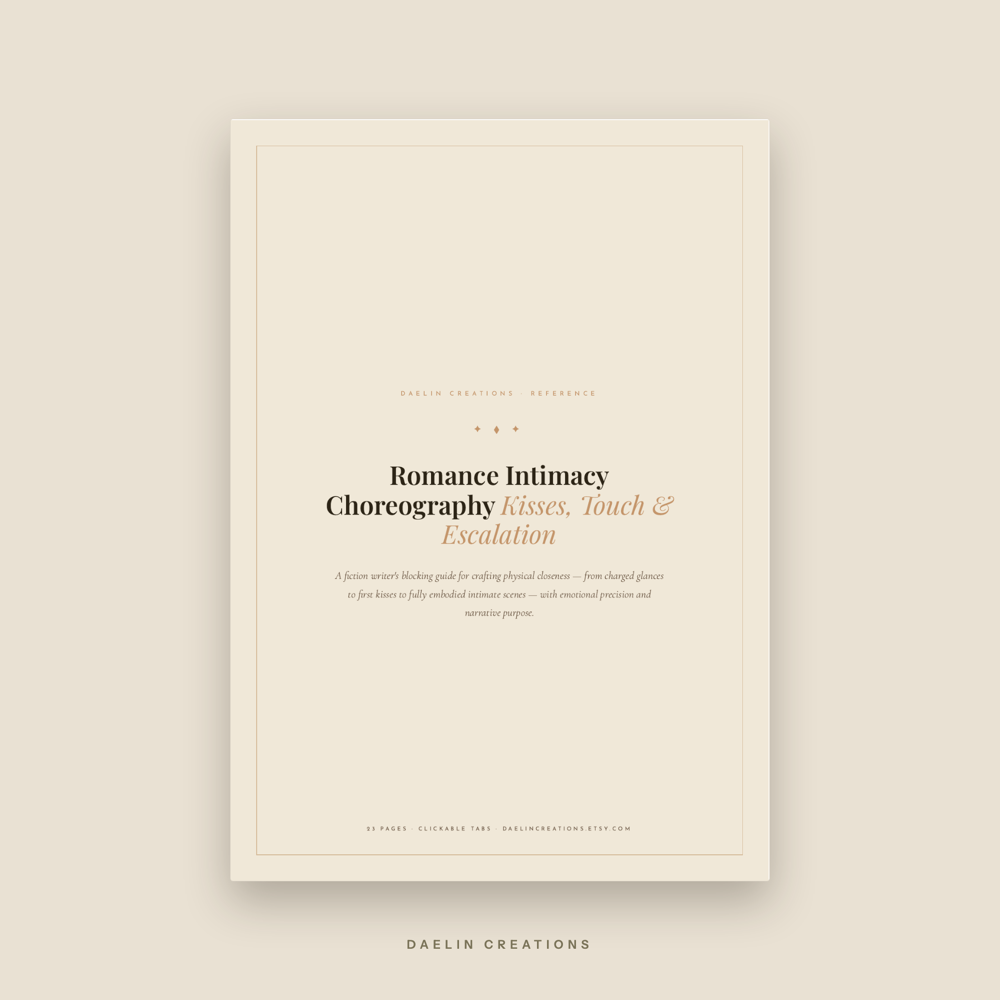
Romance Intimacy Choreography
Every kiss lands harder when it's choreographed with intention. This writer's reference guide breaks down the craft of physical intimacy scene by scene — from the first accidental brush of hands to fully realized romantic climaxes — giving you the blocking, pacing, and emotional grounding to make each moment land with real weight.
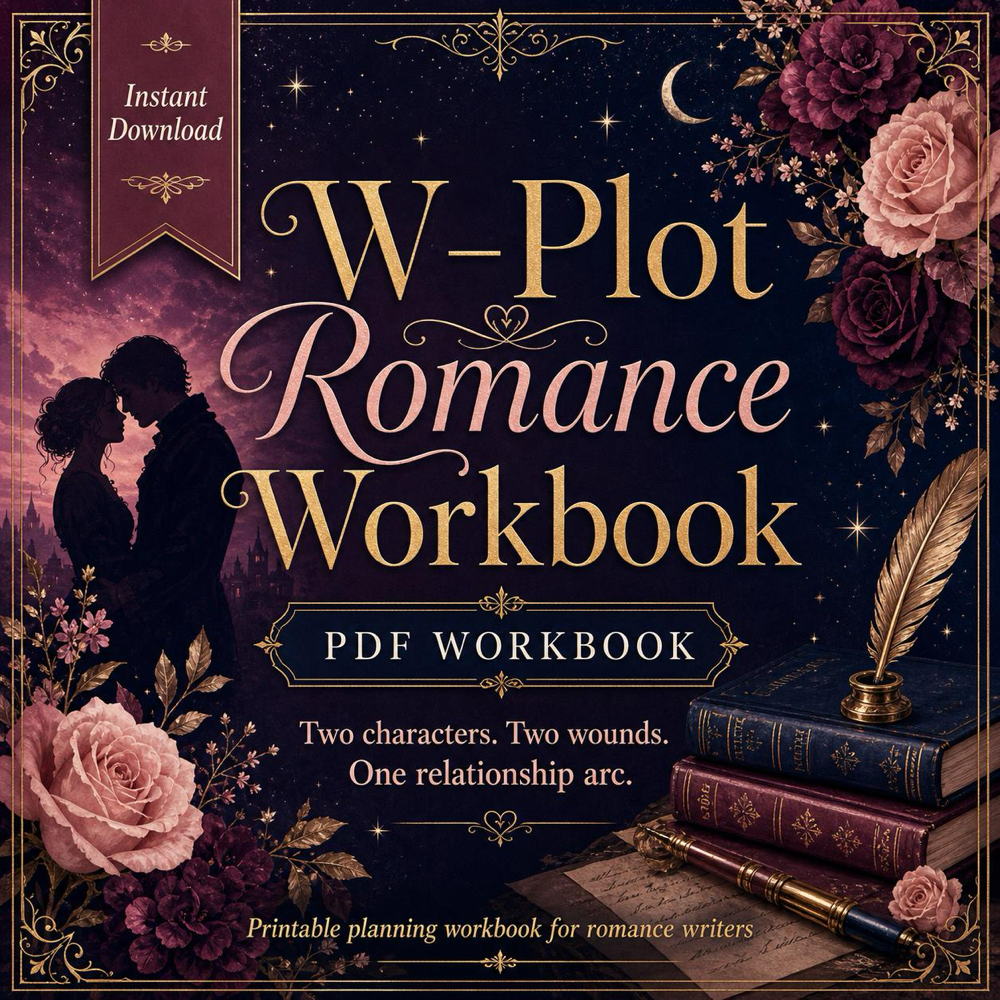
Romance Novel Plot Workbook, Dual Arc W-Plot Planner (PDF Download)
ROMANCE NOVEL PLOT WORKBOOK — DUAL-ARC BEAT SHEET (PRINTABLE)

Romance Story Planner
Two characters. Two wounds. One relationship arc that heals both.
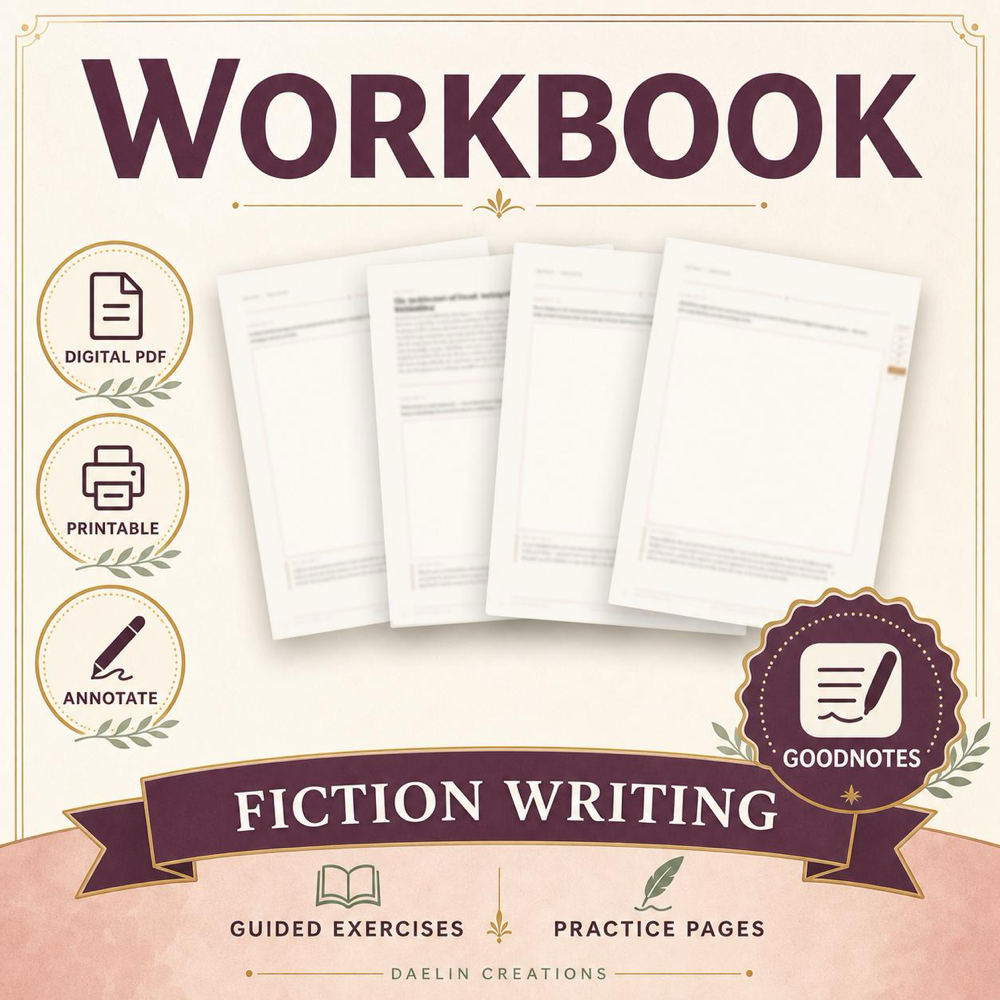
Secondary Characters Workbook for Fiction Writers
Every unforgettable novel has a supporting cast that readers think about long after the book ends — the friend who kept something back, the rival who almost became the hero, the mentor whose grief was never quite explained. This printable workbook gives fiction writers the structured exercises to build secondary characters exactly like those.
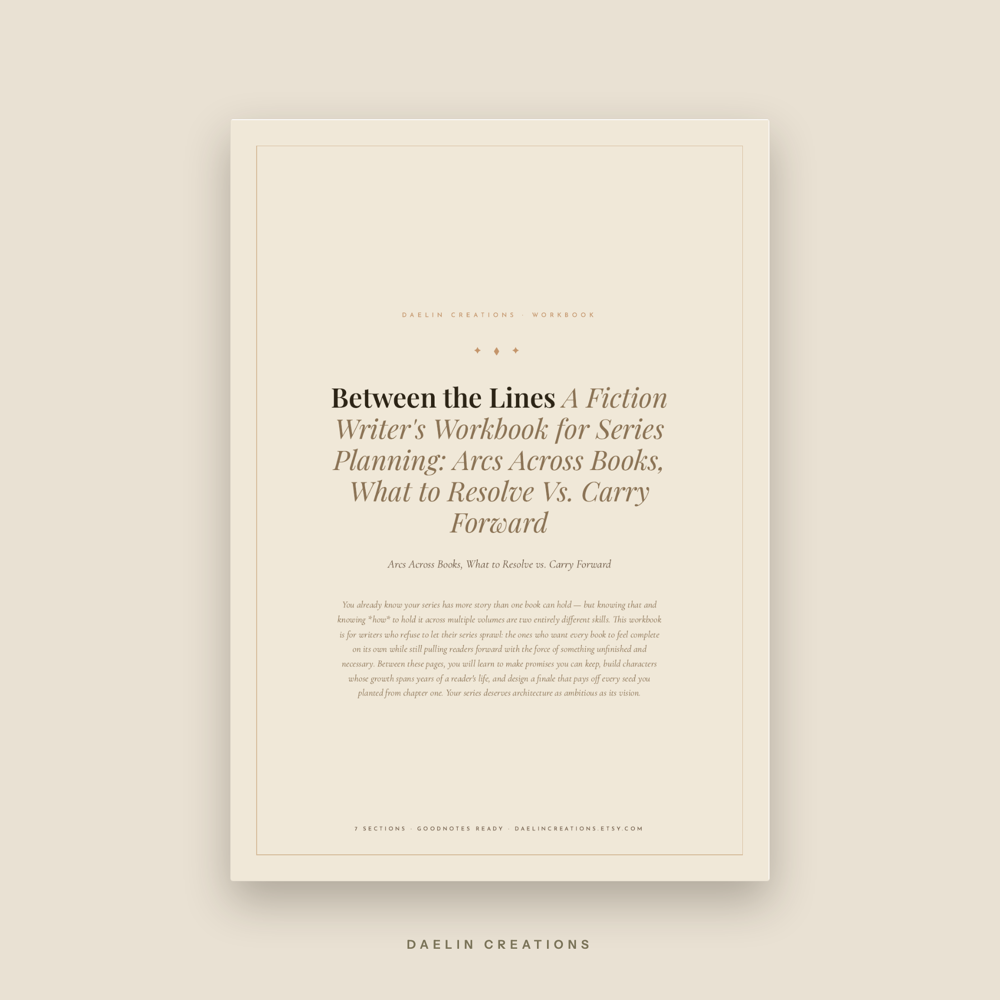
Series Planning Workbook for Fiction Writers
Planning a multi-book series is one of the most demanding creative challenges a fiction writer can take on — and this 7-section printable workbook gives you the architectural framework to do it with intention and confidence. Designed for novelists planning trilogies, sagas, or any multi-book story, *Between the Lines* guides you from articulating your series' core emotional promise all the way through reverse-engineering your finale before you write a single chapter.
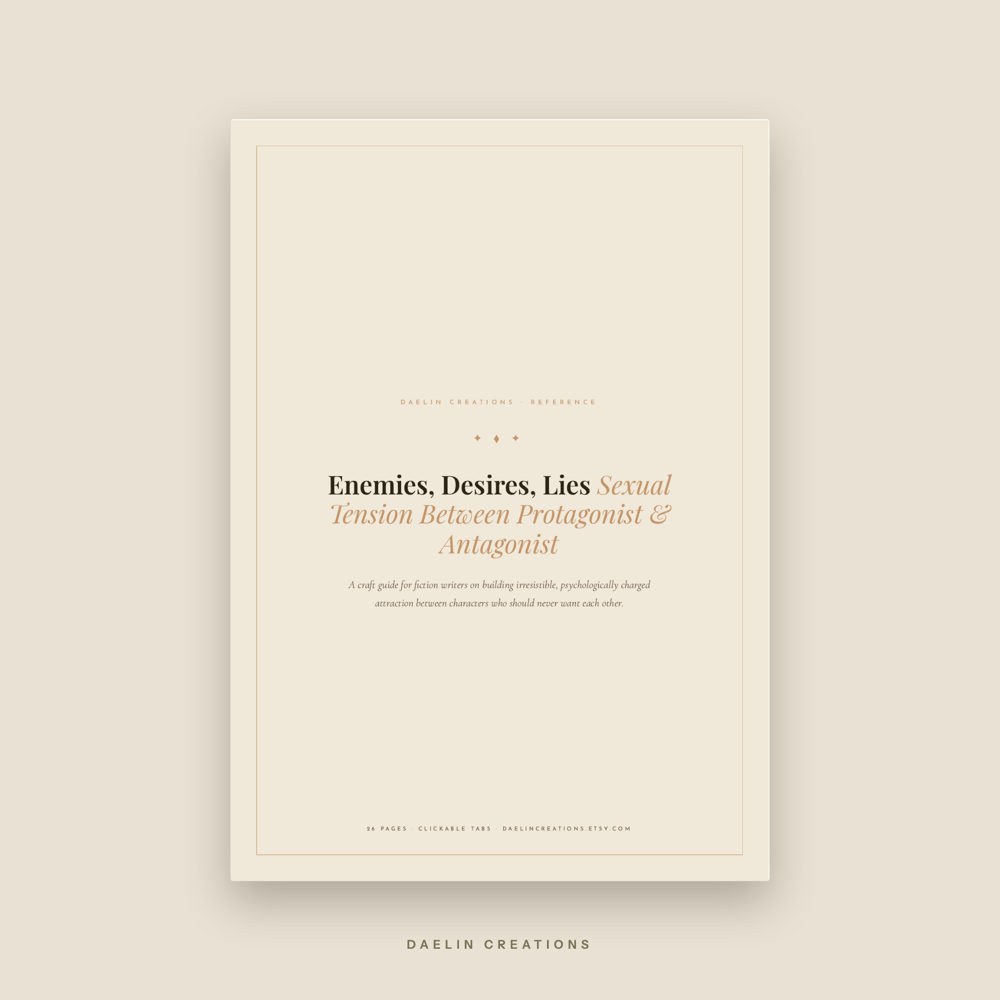
Sexual Tension Writing Guide
They shouldn't want each other. That's exactly why readers can't look away.
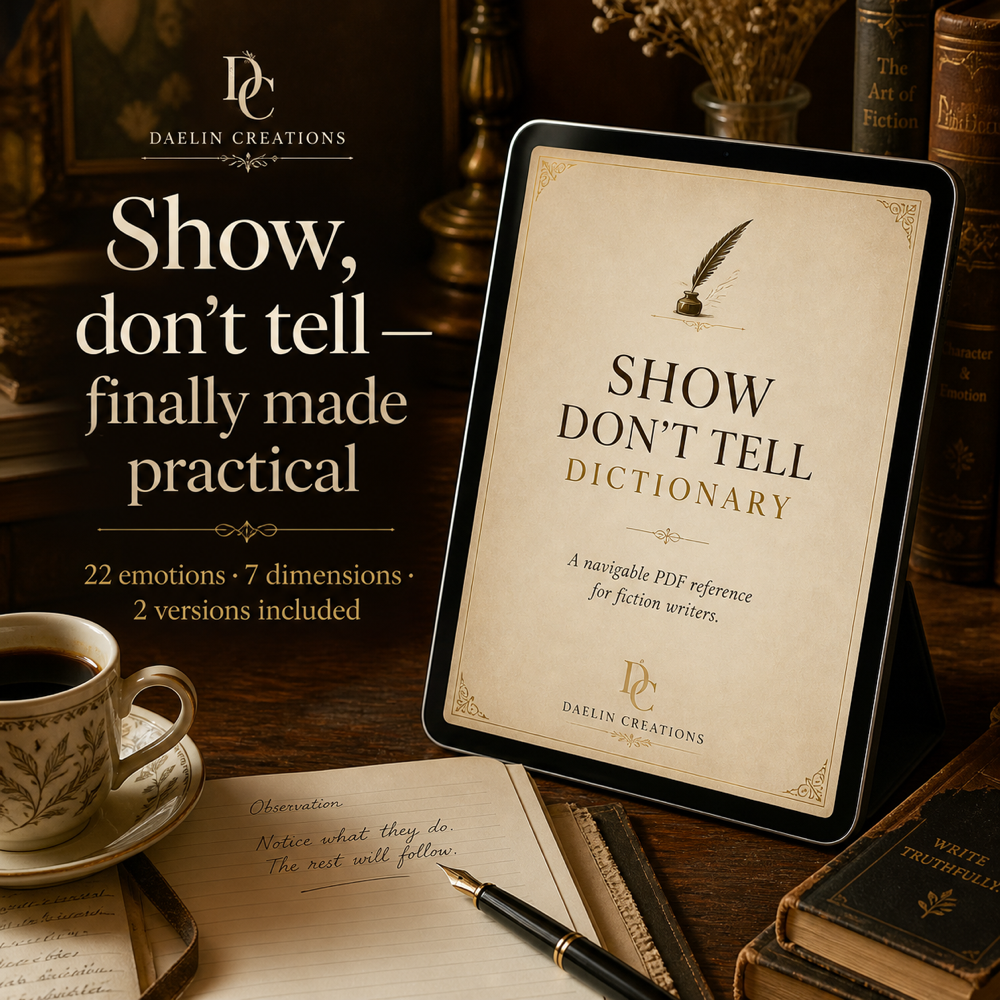
Show Don't Tell Guide for Writers
You know the rule. You've heard it a hundred times. *Show, don't tell.*
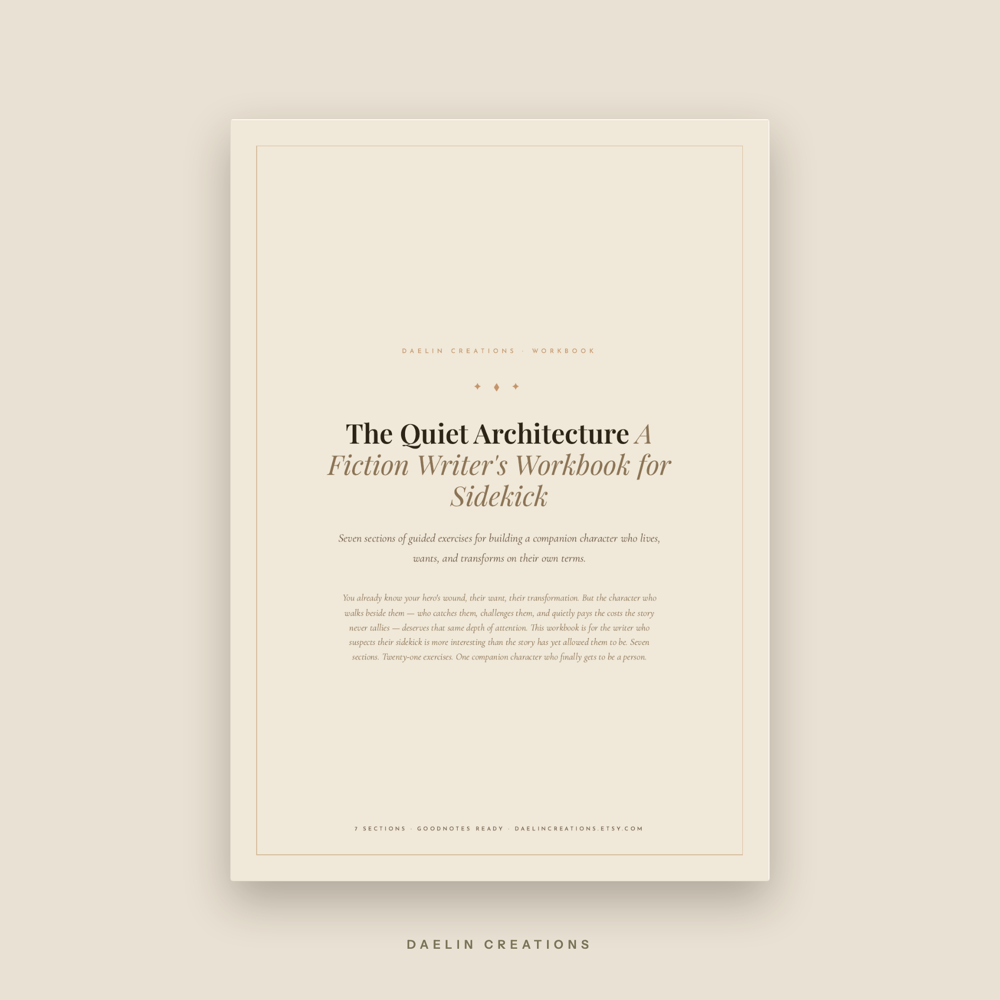
Sidekick Character Workbook for Fiction Writers
Your sidekick deserves more than a supporting role — and this workbook will help you give it to them. The Quiet Architecture is a seven-section printable PDF workbook designed specifically for fiction writers who want to develop their companion characters with the same depth and intention they bring to their protagonists.
Signal and Noise
Your villain doesn't need to be more evil. They need to be more human.
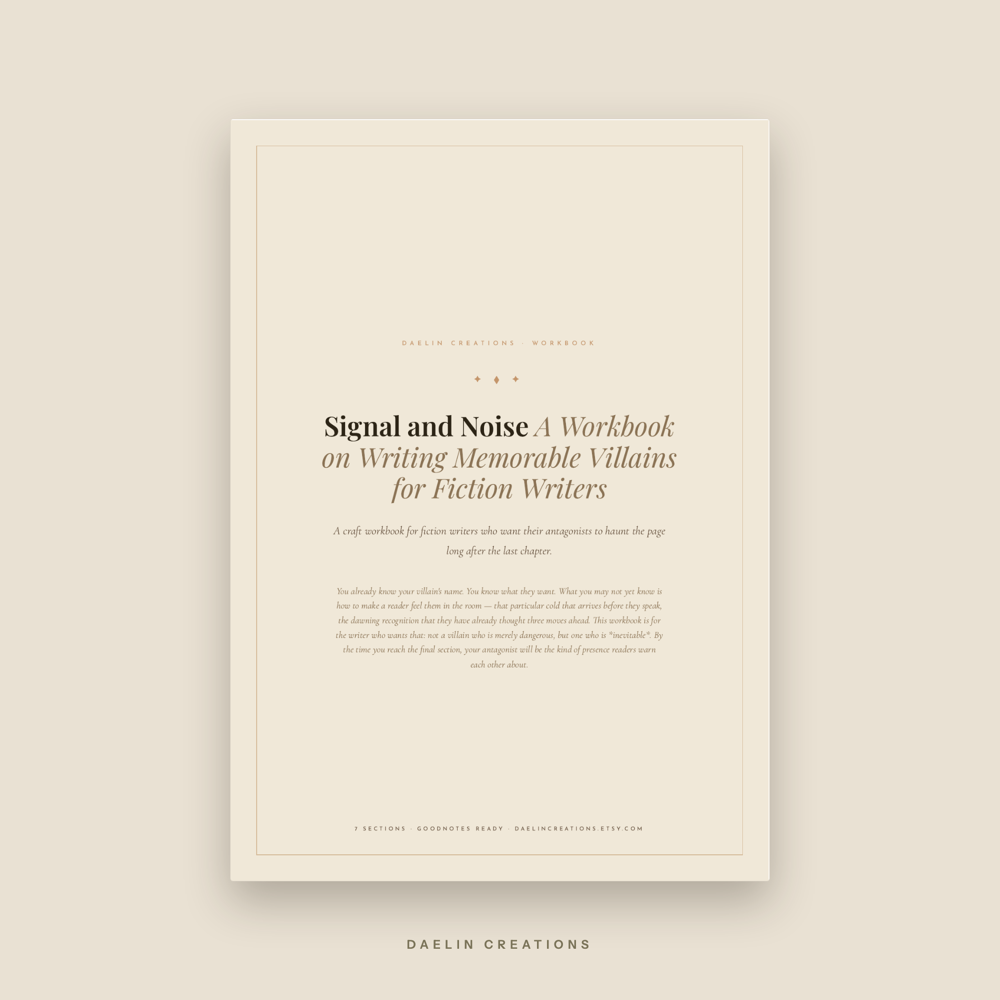
Signal and Noise: Villain Writing Workbook for Fiction Writers
Your villain should be the reason readers can't put the book down — and this workbook is built to make that happen. Signal and Noise is a 7-section printable craft workbook for fiction writers who want to build antagonists that are specific, credible, and genuinely terrifying: the kind of villain readers warn each other about.
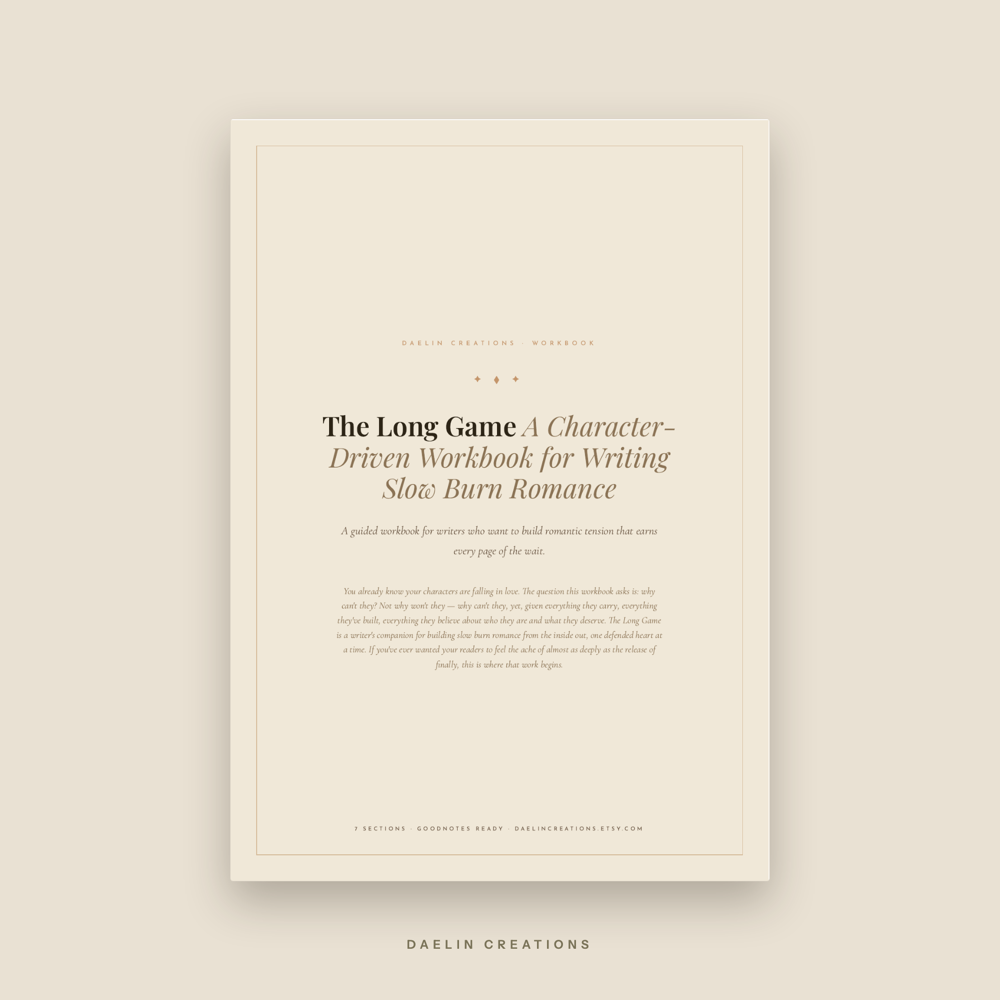
Slow Burn Romance Writing Workbook — Character-Driven Fiction Writing Prompts
If you've ever wanted your readers to feel the ache of almost as deeply as the relief of finally, this workbook was made for you. The Long Game is a 7-section, character-driven writing workbook designed specifically for authors crafting slow burn romance — the kind where the wait is the story.
Story Circle Planner – Interactive 8-Step Novel Structure Tool (Digital Download)
Plan your novel with Dan Harmon's Story Circle in one interactive, offline HTML dashboard — all 8 steps with 32 guided questions, characters, worldbuilding, and a step calculator.
Story Circle Workbook – 8-Step Novel Plot Planner (PDF Download)
Plan your novel step by step with Dan Harmon's Story Circle — eight steps from comfort to chaos and back, one guided page each, built for GoodNotes and print.
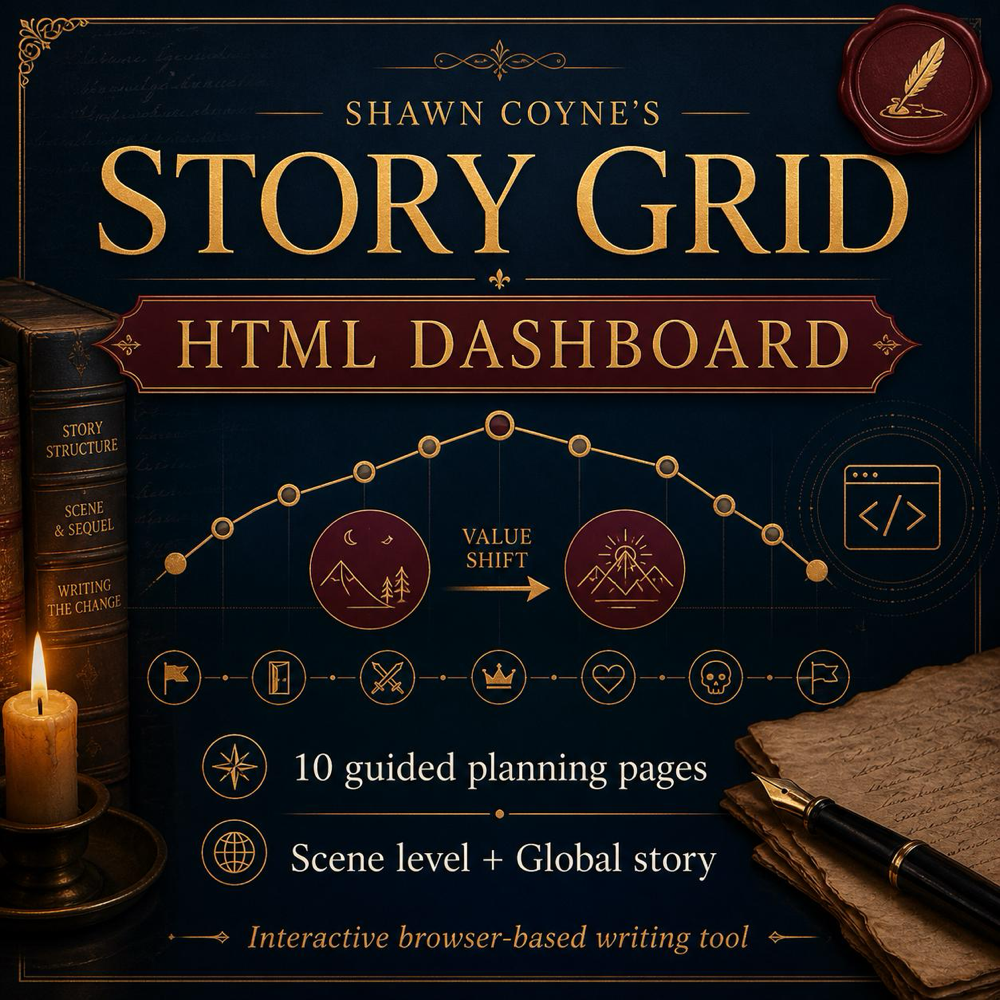
Story Grid Writer's Scene Planner, 5 Commandments Dashboard, Novel Outline Tool
Plan your novel with the Story Grid structure in one interactive, offline HTML dashboard — all 5 commandments with 20 guided questions, characters, worldbuilding, and a commandment calculator.
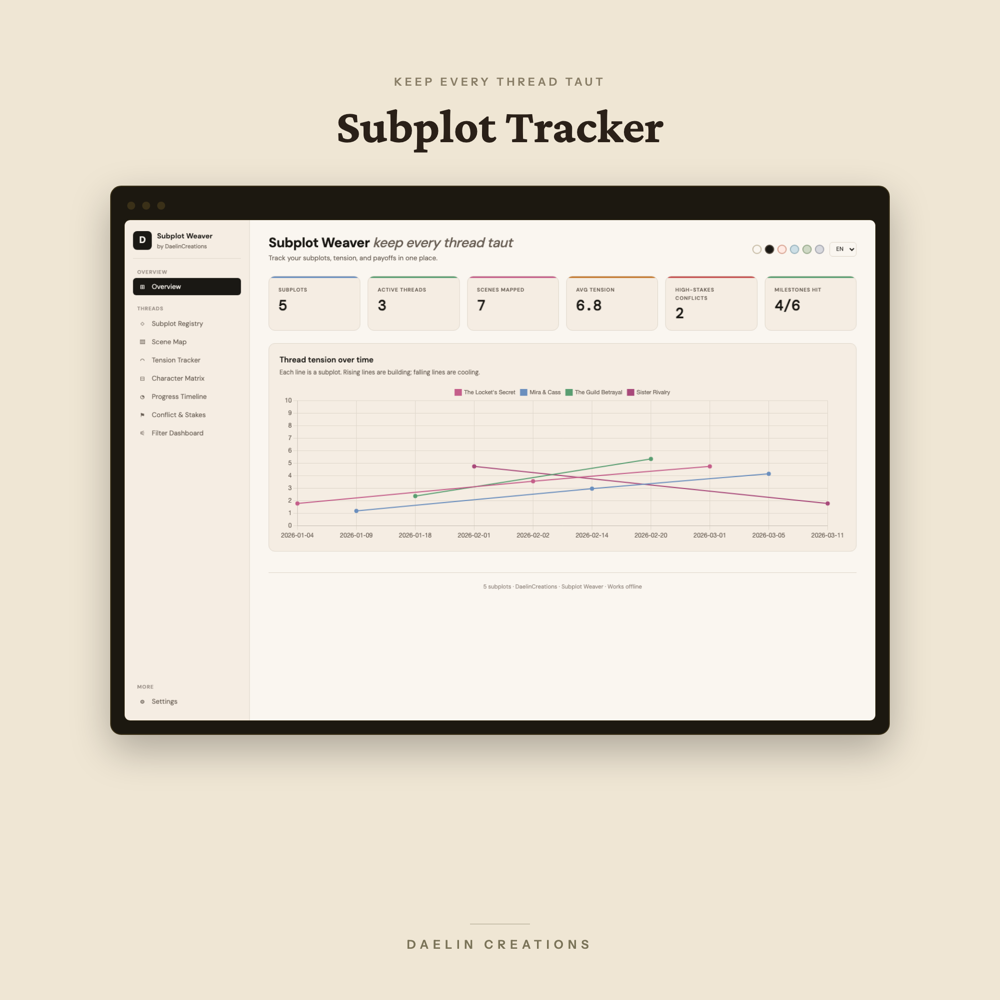
Subplot Tracker Dashboard for Fiction Writers
Never lose track of a story thread again.
Subplot Workbook for Fiction Writers
Most novels don't fall apart at the main plot — they fall apart in the spaces between. Signal and Noise is a printable PDF workbook designed to help fiction writers at every stage build, time, braid, and close the secondary threads that give a story its depth, resonance, and emotional weight.
Subtext & Implication Quick-Reference Guide for Fiction Writers
What your characters don't say is often the most powerful thing on the page. This printable quick-reference guide walks fiction writers through the essential techniques of subtext and implication — the craft skills that separate flat, on-the-nose prose from writing that resonates long after the last line.
Subtext & Implication Writing Guide
What your characters leave *unsaid* is where your story lives.
The Liar's Anatomy
Does your liar feel flat on the page? Does your interrogation scene lose its nerve before the confession lands? *The Liar's Anatomy* is a writer's field guide to deception — a craft-focused reference that breaks down the observable signals of lying (verbal, physical, and structural) and shows you exactly how to translate them into prose that crackles with tension.
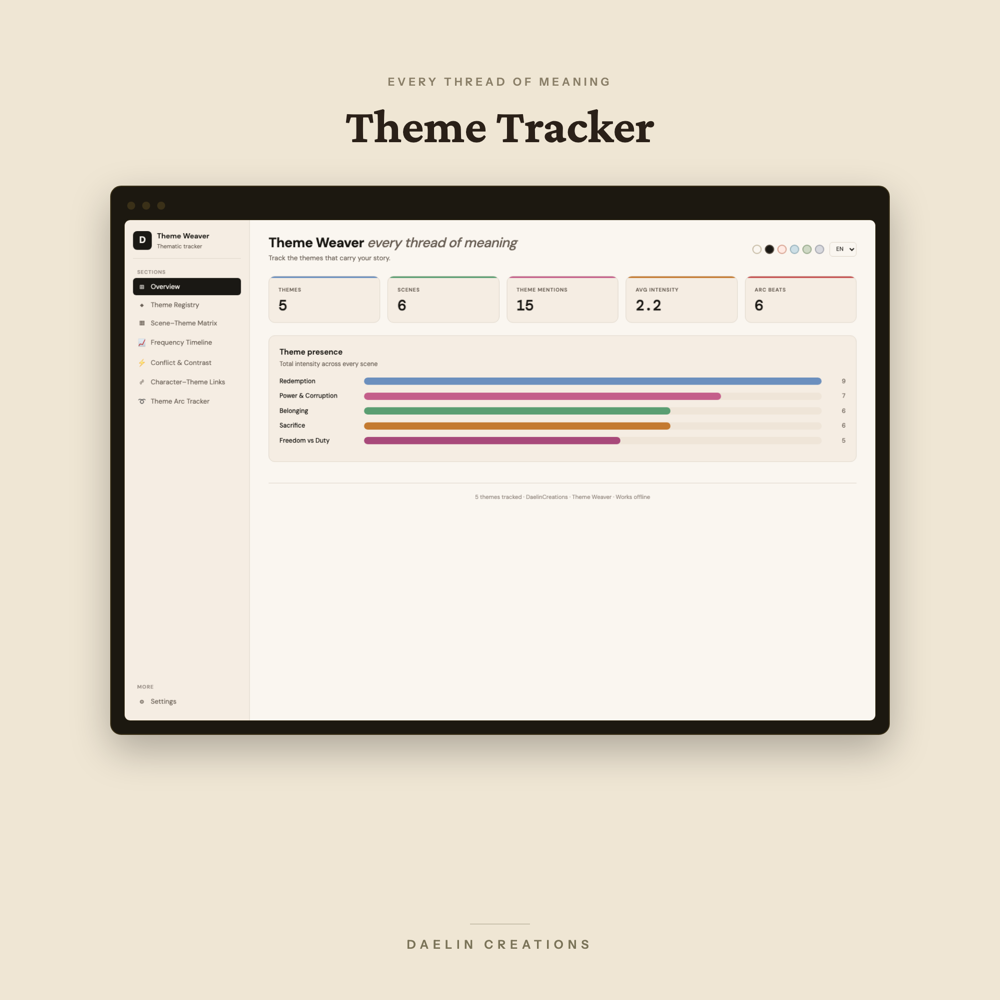
Theme Tracker Dashboard
Finally see every theme, motif, and symbol in your story at a glance — no more losing track of what your novel is really about.
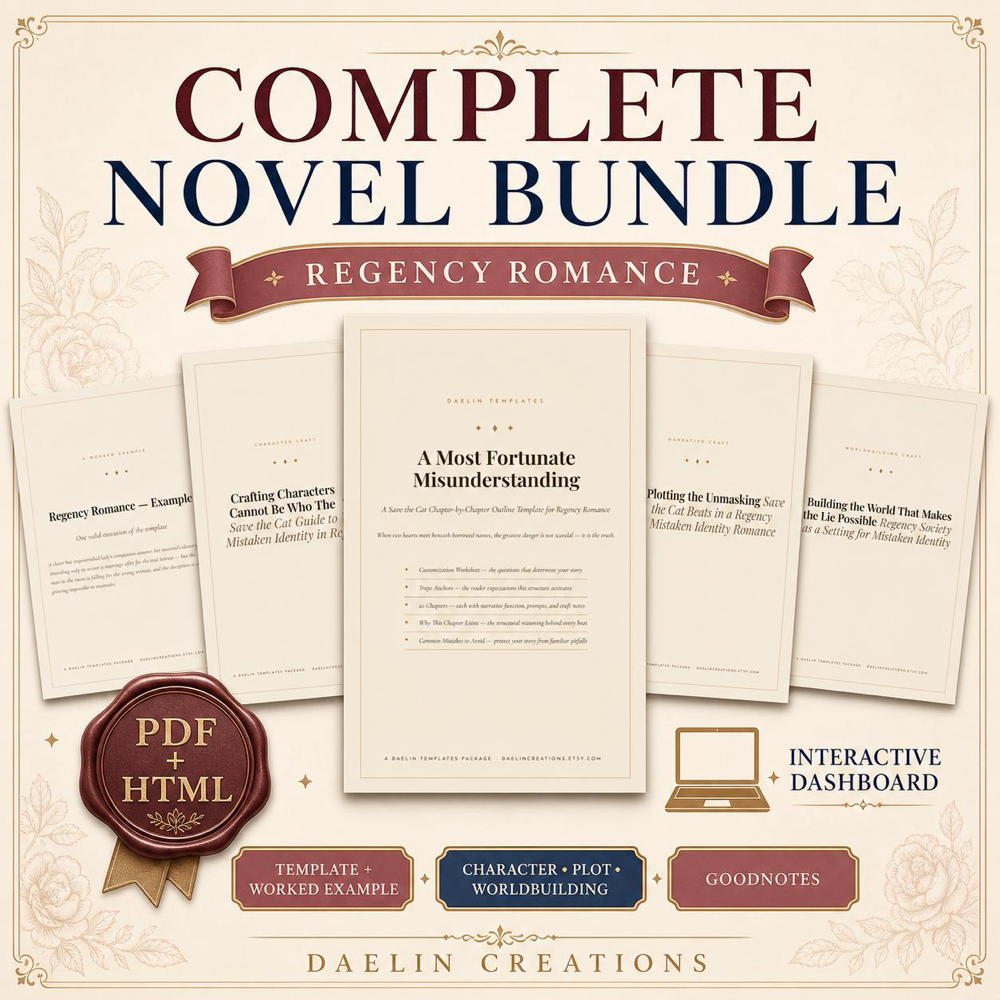
Thriller Story Structure Bundle
Some secrets don't stay buried — they claw their way back.
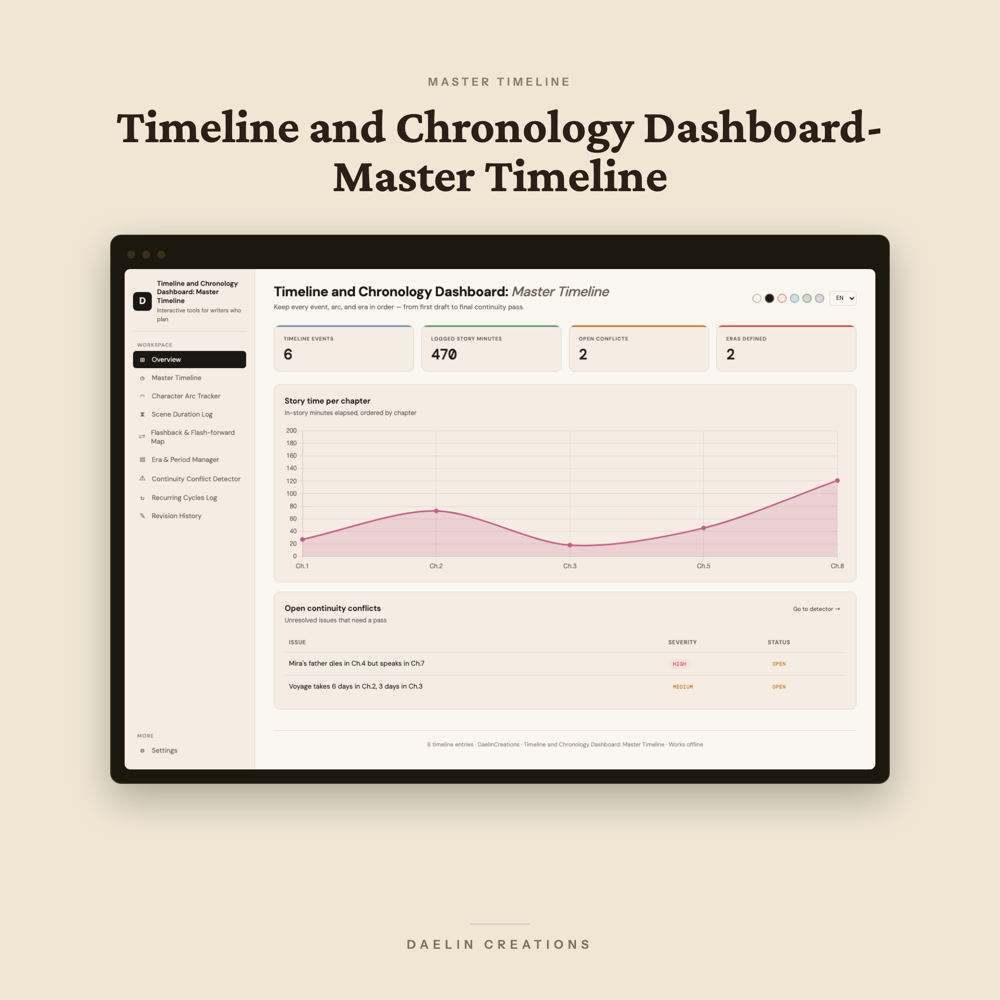
Timeline and Chronology Dashboard: Master Timeline
Keep every chapter, century, and character arc in perfect sync — without losing track of what happened when, to whom, and why it matters.
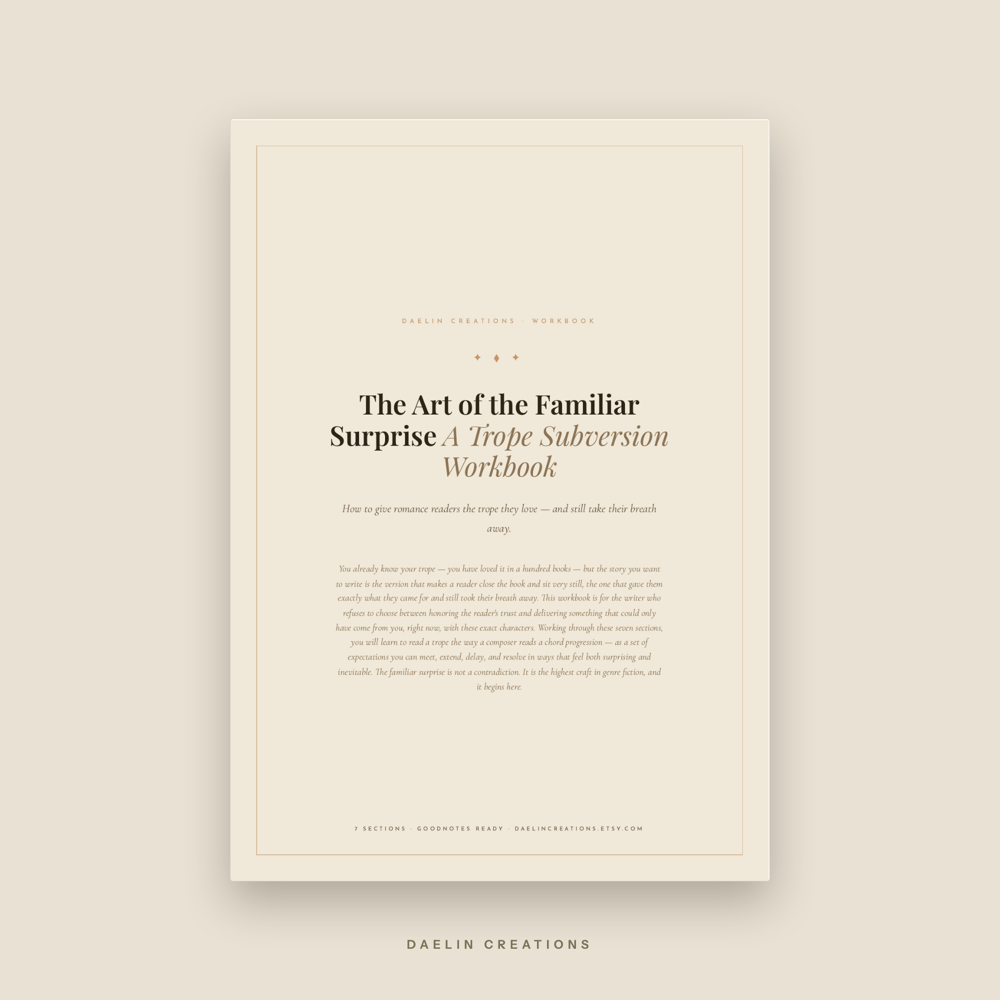
Trope Subversion Workbook for Romance Writers
Give your readers the trope they came for — and the surprise they did not know they needed.
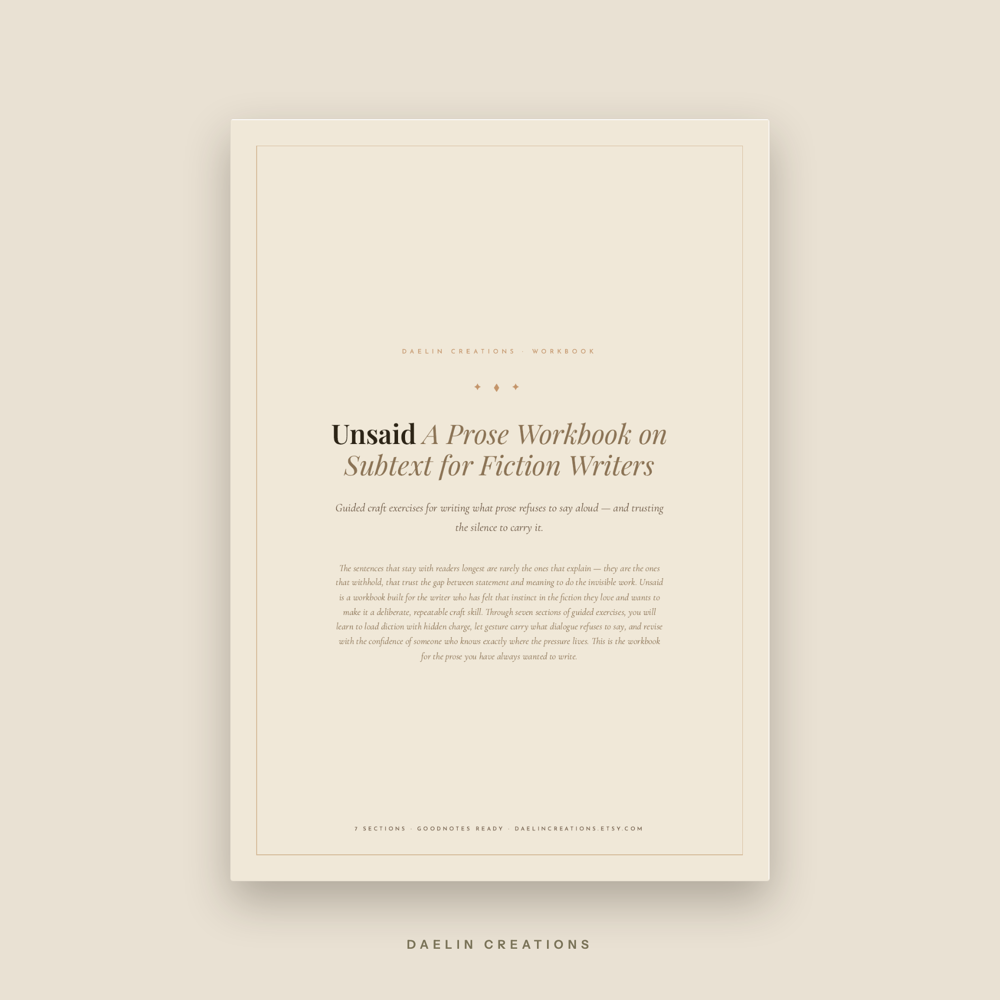
Unsaid — Subtext Workbook for Fiction Writers
Unsaid is a printable prose workbook for fiction writers who want to master the art of subtext — the gap between what prose states and what it means, between what characters say and what they cannot bring themselves to say.
Want vs Need Fiction Writing Workbook
Between the Lines takes the most useful idea in fiction craft — the gap between what a character wants and what they actually need — and moves it out of the outline and into the sentence.
Clean Your Prose Fix-It Guide
Struggling with flat prose that keeps readers at arm's length? This printable craft reference walks you through the four most common sentence-level mistakes fiction writers make — and shows you exactly how to fix them.
Fiction Writing Workbook — Endings & Denouement
Every writer knows the ending is where novels are won or lost — and this printable workbook gives you the sentence-level tools to stick the landing.
Grief & Loss Scenes Workbook
Writing grief well is one of the hardest craft challenges in fiction — and this workbook gives you the tools to meet it. Across seven carefully sequenced sections, you'll explore how narrative voice positions itself toward loss, how syntax fractures and flows under emotional pressure, how strategic omission out-performs direct confession, and how tense control can render the way grief collapses time. Every exercise is specific, craft-grounded, and designed to produce pages you can bring directly into your manuscript.
Head-Hopping Workbook for Fiction Writers
Struggling with point of view in your fiction? This beautifully designed printable workbook walks you through every dimension of the head-hopping problem — from recognizing the exact sentence where the narration slips, to understanding what it costs your reader emotionally, to building a character voice so distinct that no other narrator could occupy it.
Horror Writing Workbook Printable PDF
Build fear on purpose, page after page.
Info Dumping Workbook for Fiction Writers
If your prose ever stalls — if you feel readers drifting through passages you know are necessary — this workbook is the precision tool you've been looking for. Common Craft Mistakes: Info Dumping is a printable PDF workbook designed for serious fiction writers who want to understand exposition at the structural level and fix it for good.
Moon, Stars & Shadow
Does your story live under a sky that actually means something? **Moon, Stars & Shadow** is a practical reference guide for fiction writers who want to use celestial symbolism with intention — not decoration.
Multi-POV Fiction Writing Workbook
Juggling multiple points of view is one of the most demanding — and most rewarding — techniques in fiction writing. This printable PDF workbook gives serious writers a rigorous, section-by-section framework for building a multi-POV structure that earns its complexity on every page.
Never Kill the Dog
Does your fiction earn its darkness — or only deploy it? **Never Kill the Dog** is a printable craft workbook for serious fiction writers who want to examine the ethical architecture of their stories with the same rigor they bring to plot and prose.
Revision and Self-Editing Workbook for Fiction Writers
Your third draft is clean, correct, and somehow no longer sounds like you. This workbook fixes that with a seven-stage revision process that treats your voice as the thing being protected rather than the thing being corrected.
Sensory Signature
Every writer has a sensory fingerprint — a habitual way of entering a scene that shapes their voice without their knowing it. This printable PDF workbook helps fiction writers identify, examine, and deliberately expand how they use sensory detail on the page.
Show Don't Tell Fiction Writing Workbook
Stop telling your readers what to feel — and start making them *feel it*. This beautifully designed printable workbook guides fiction writers through the art of show, don't tell in seven scaffolded sections, moving from foundational awareness all the way to full-scene revision.
Unsaid: Grief & Loss Scene Workbook for Fiction Writers
Writing grief honestly is one of the hardest things a fiction writer can do — and one of the most ethically demanding. Unsaid is a printable PDF workbook for novelists and short story writers who want to render loss on the page with precision, moral seriousness, and genuine craft.
Writing Routine Workbook for Fiction Writers
Build a writing practice that survives your worst weeks
Atmosphere Writing Workbook for Fiction Writers
This is the workbook for fiction writers who know how to write what happens — and want to master making readers dread it before it does. *Beneath the Surface* is a 7-section craft workbook built around the specific, teachable techniques of atmospheric tension: the weight of physical space, the power of withheld information, weather as structural pressure, time distortion at the sentence level, physiological sensation as emotional delivery, the menace of a single object, and the suspended moment before a threshold is crossed.
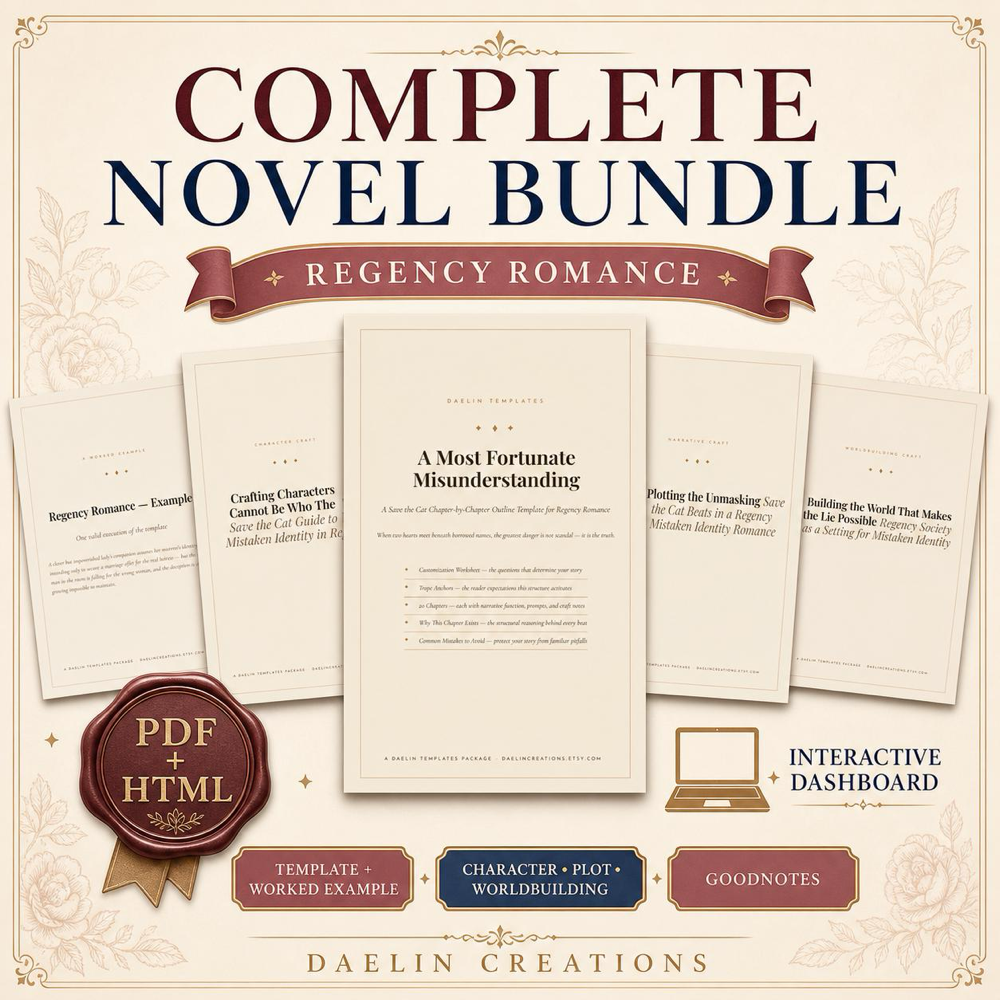
Bundle Interactive Planner
You know the feeling: the forced proximity arc is working, the tension is *there*, but somewhere between the midpoint and the Dark Night of the Soul, the pacing collapses. The hidden past reveals lands too early or too late. The morally gray love interest feels inconsistent, and you can't pinpoint where the structural rhythm broke.
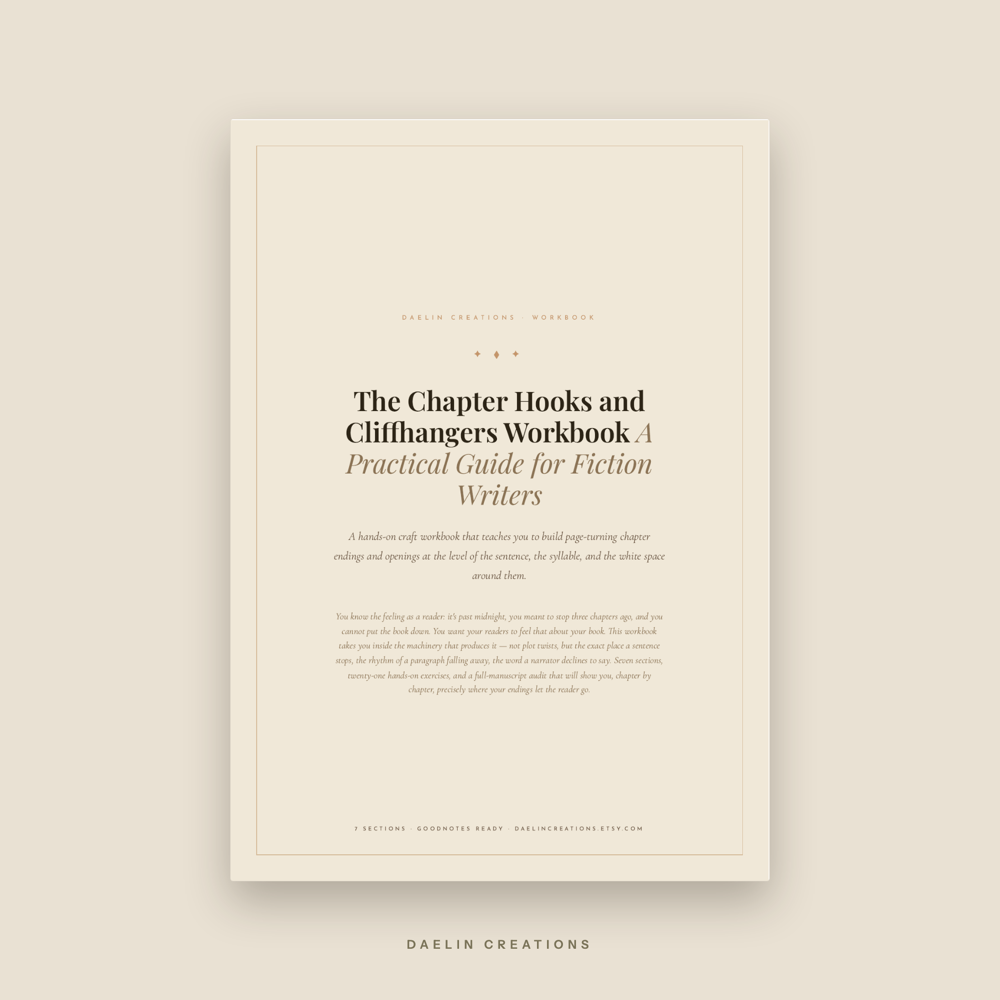
Chapter Hooks and Cliffhangers Workbook
Why readers say "just one more chapter"
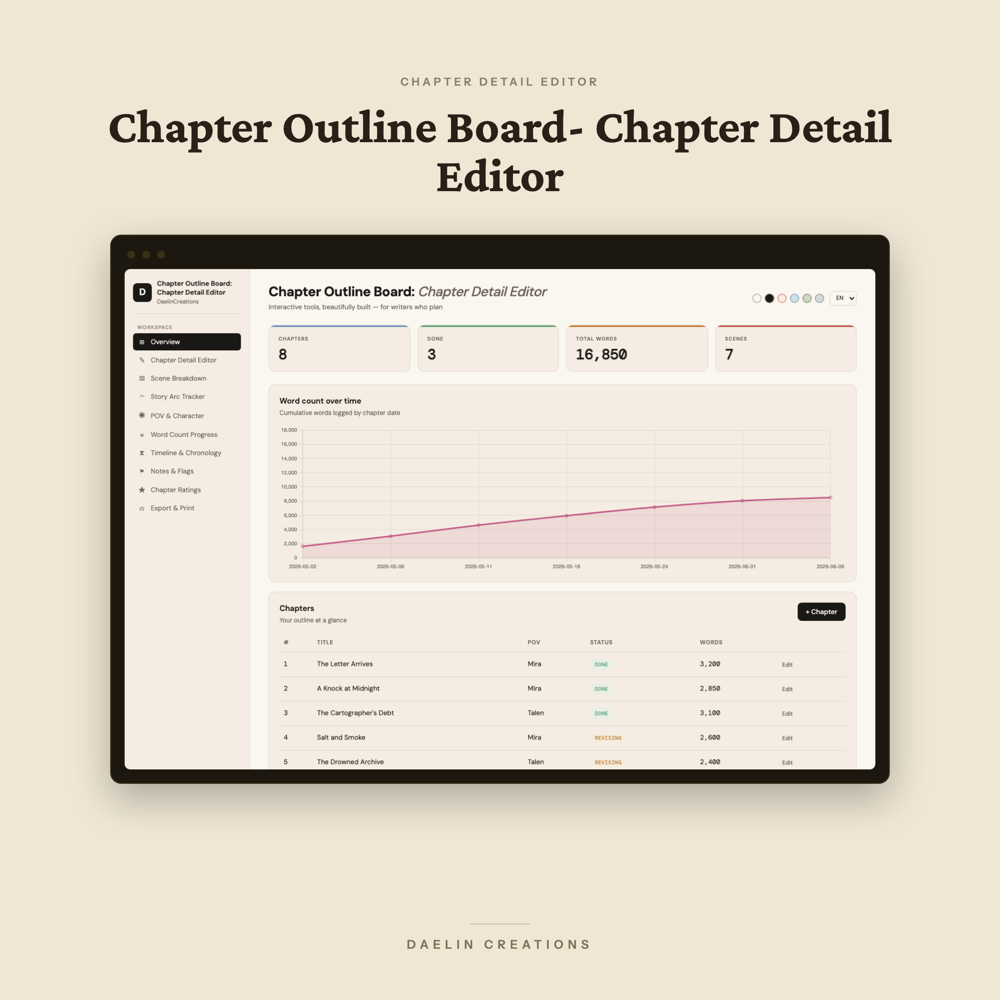
Chapter Outline Board: Chapter Detail Editor
Plan every chapter with surgical precision — from scene-by-scene breakdowns to arc tracking, POV filtering, and a built-in timeline log, all in one offline HTML file you own forever.
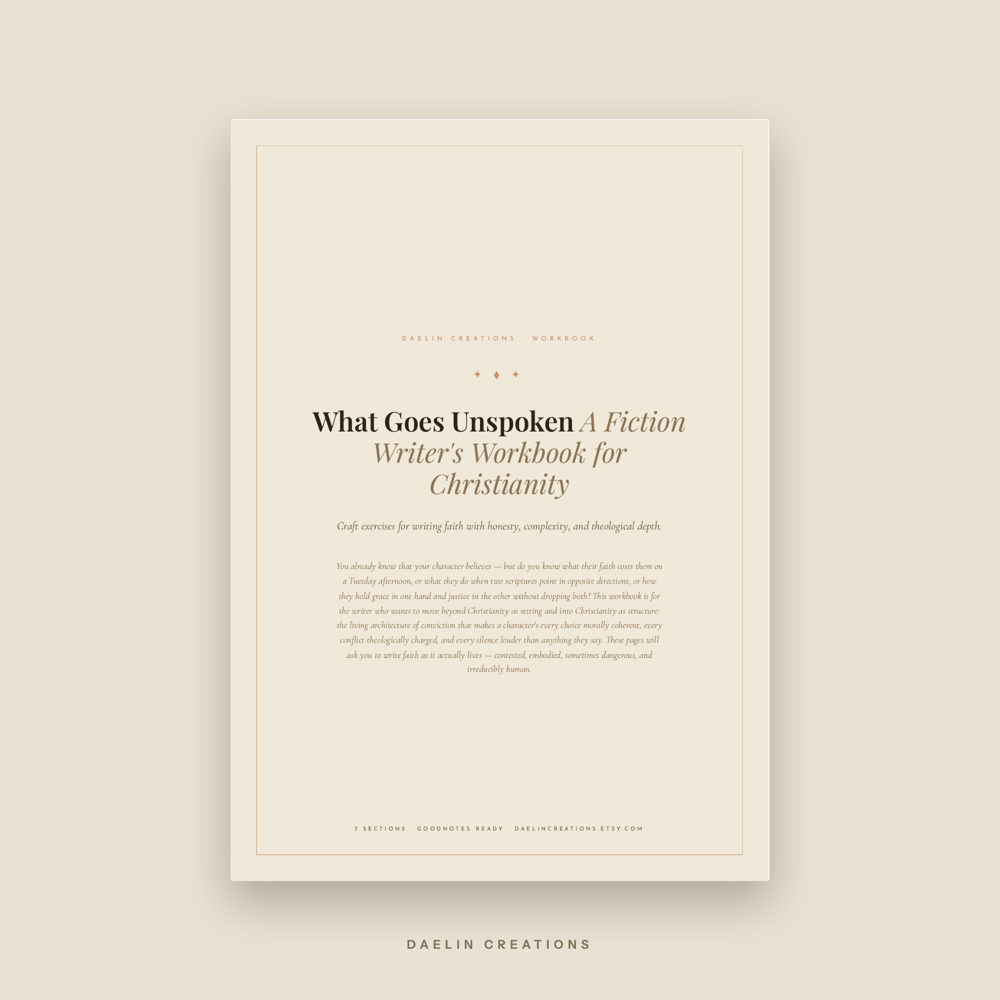
Christian Fiction Writing Workbook
What Goes Unspoken is a 7-section printable workbook for fiction writers who want to write Christian faith with theological honesty, moral complexity, and genuine craft. Designed for novelists, short story writers, and screenwriters working in literary or genre fiction, this workbook moves through the ideas that carry the most dramatic weight in Christian-inflected storytelling: building faith as character architecture, writing grace as an ethically disruptive force, grounding sin in legitimate human need, portraying institutions that are both sources of grace and structures of harm, handling scripture as an act of power, distinguishing meaningful sacrifice from romanticized suffering, and constructing redemption arcs that earn their resolution.
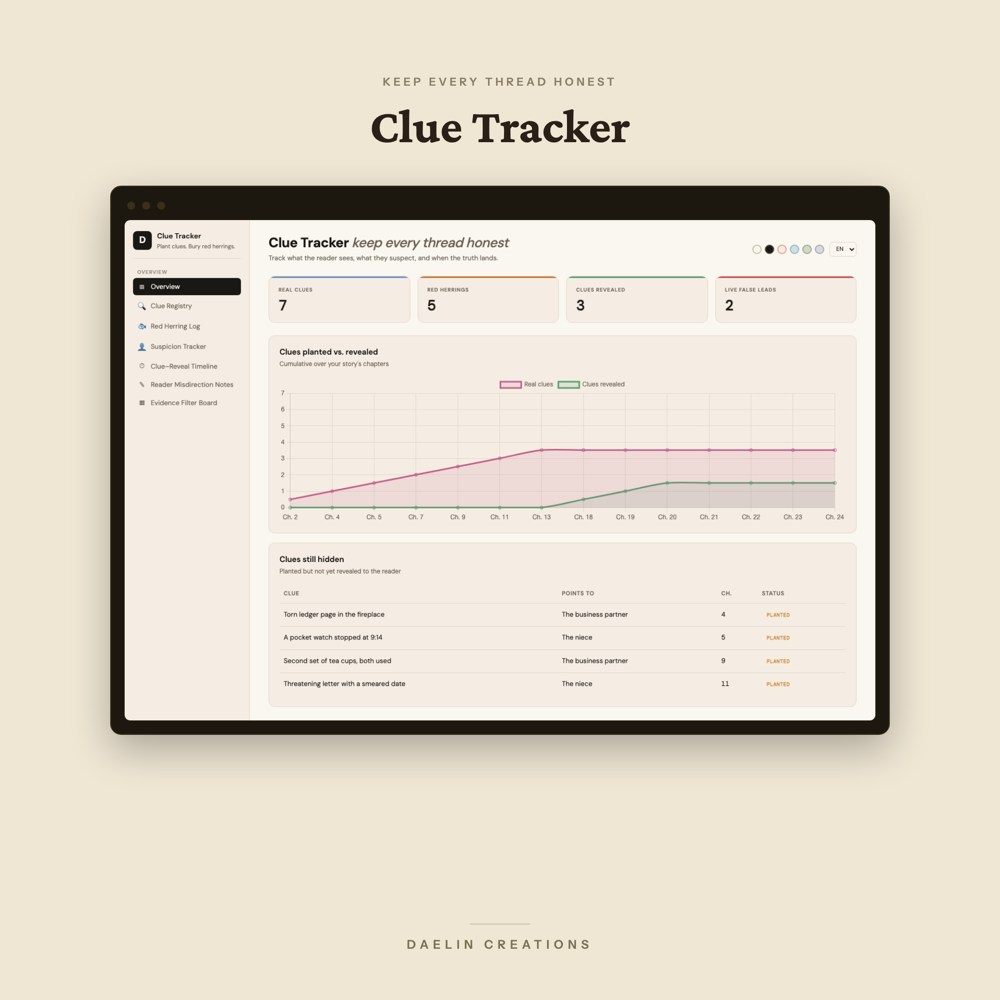
Clue Tracker
[REVISAR — listing automático de fallback; a geração do texto falhou e este é um rascunho mínimo]
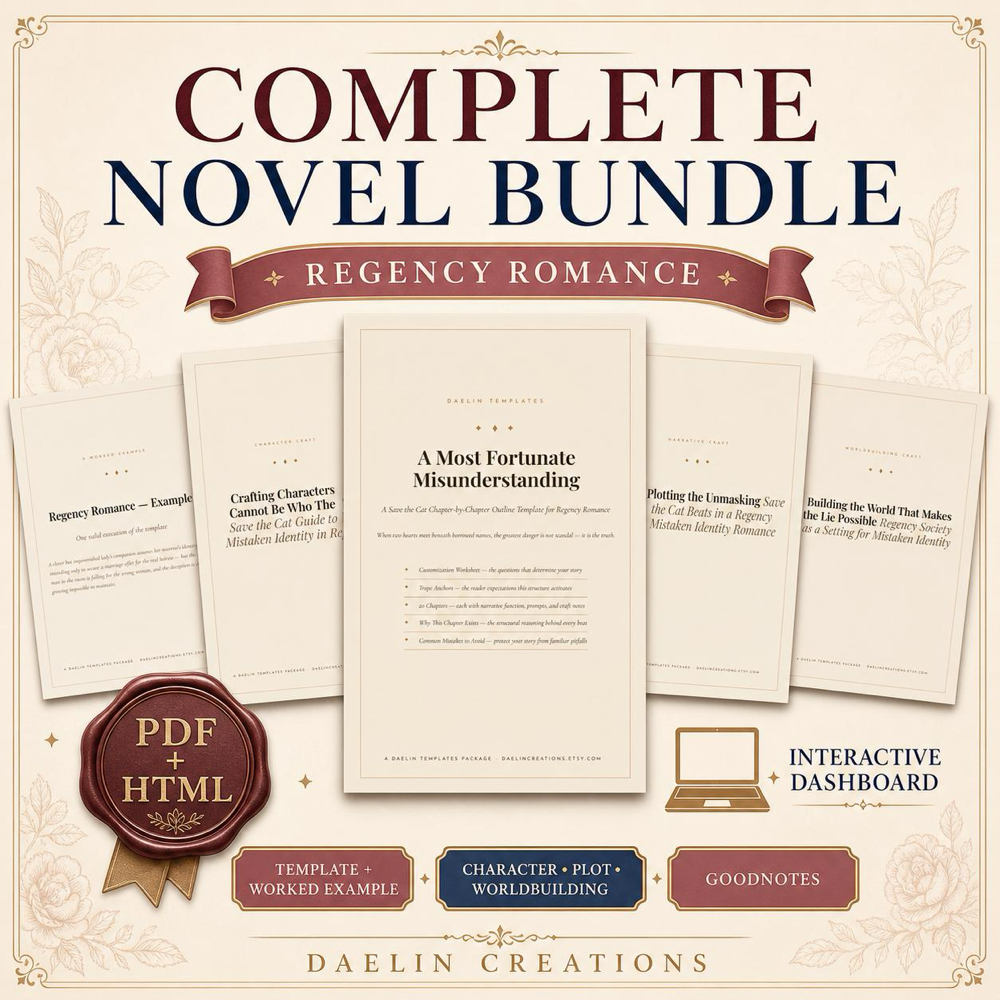
Coming of Age Writing Template
Some stories don't begin with a call to adventure. They begin with a lie — a name worn like armor, a truth locked so deep it has calcified into something unrecognizable. This is not the story of who your character is. This is the story of who they've been pretending to be.
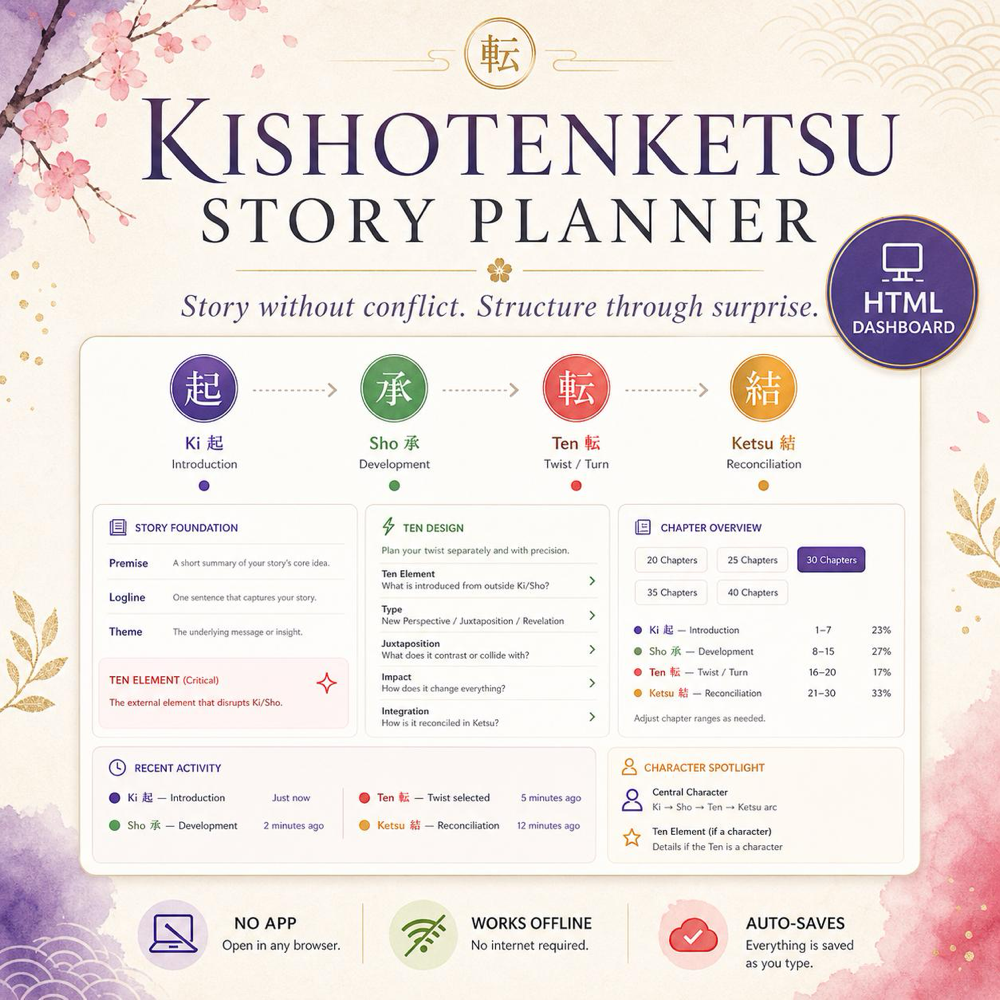
Dashboard Novel Story Planner
Plan your novel with Kishōtenketsu — the four-part structure that runs on contrast instead of conflict — in one interactive, offline HTML dashboard. All 4 parts with 16 guided questions, characters, worldbuilding, and a part calculator.
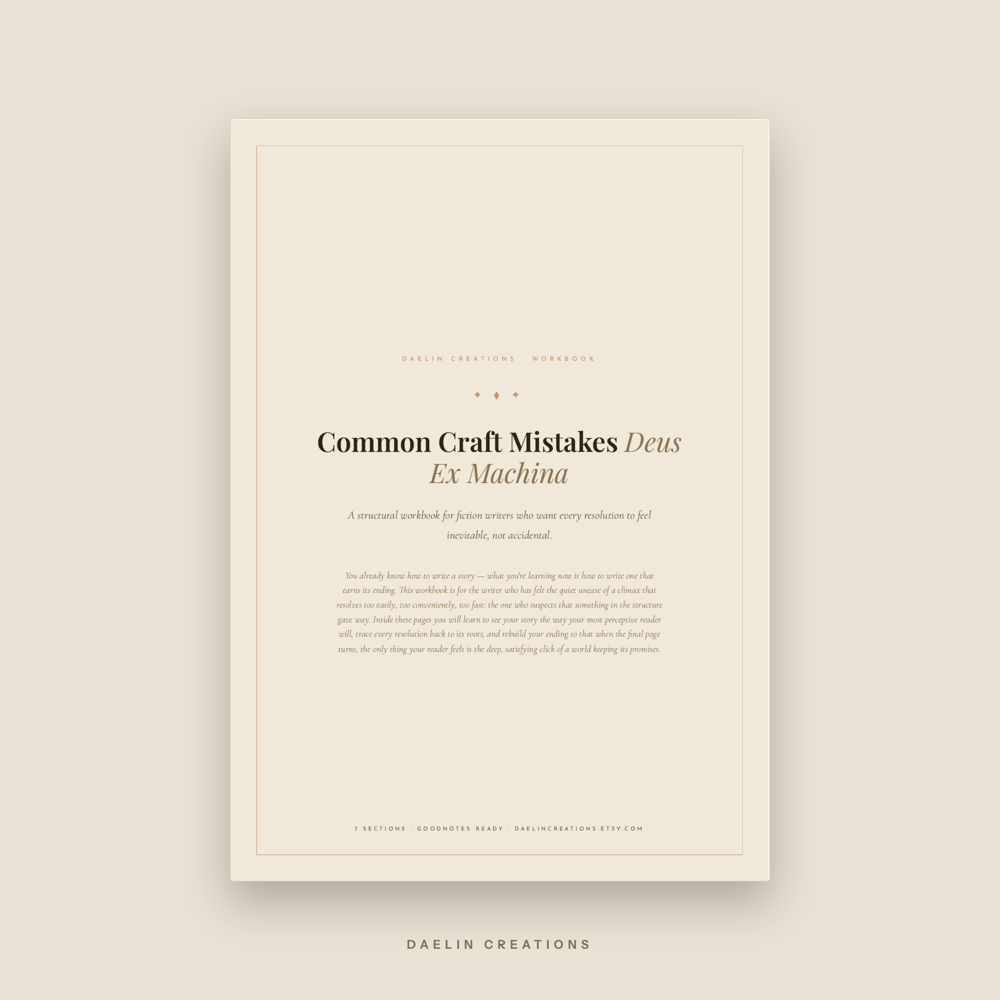
Deus Ex Machina Workbook
Does your story's ending feel a little too convenient — even to you? This printable PDF workbook walks fiction writers through a complete structural diagnosis and repair process for deus ex machina endings, from identifying unearned resolutions to building a scene-by-scene revision roadmap.
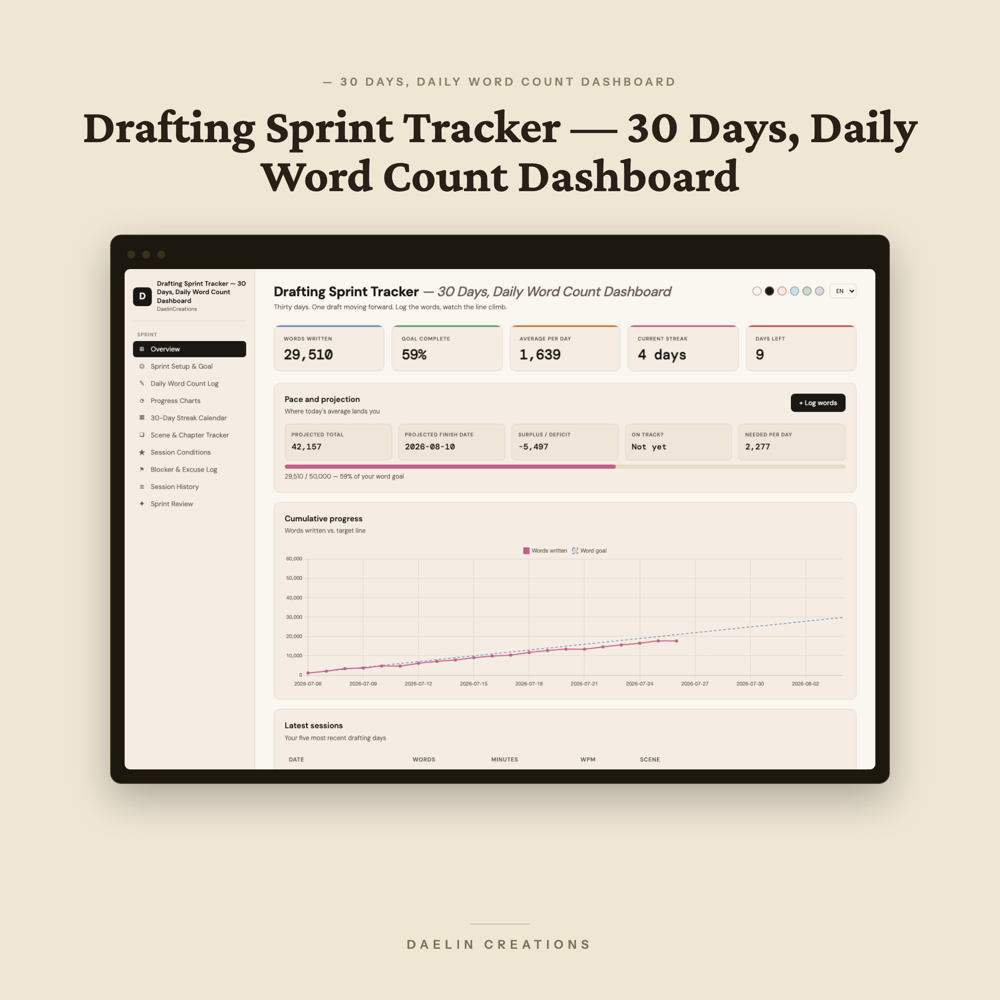
Drafting Sprint Tracker
Finish the draft by watching the numbers move. This interactive HTML dashboard turns thirty days of drafting into one live picture: you log the day's word count, and the cumulative curve, the daily output bars, the streak calendar and the projected finish date all update in front of you.

Eight-Point Arc Workbook
Plan your novel with Nigel Watts' Eight-Point Arc — the W-Plot's eight stages from stasis to a changed new normal, one guided page each, built for GoodNotes and print.
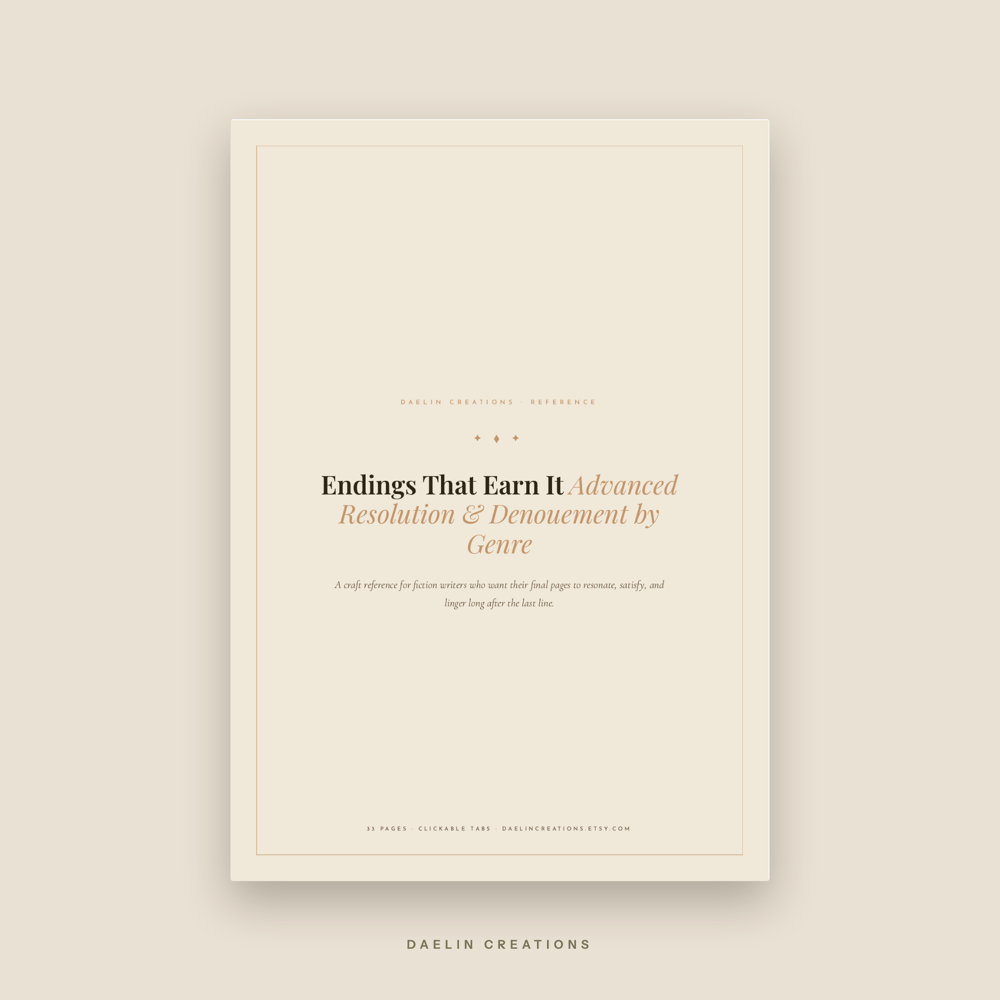
Endings That Earn It
Does your ending feel flat, rushed, or off-genre — even when the plot wraps up cleanly? This advanced craft reference helps fiction writers close their stories with power and precision.
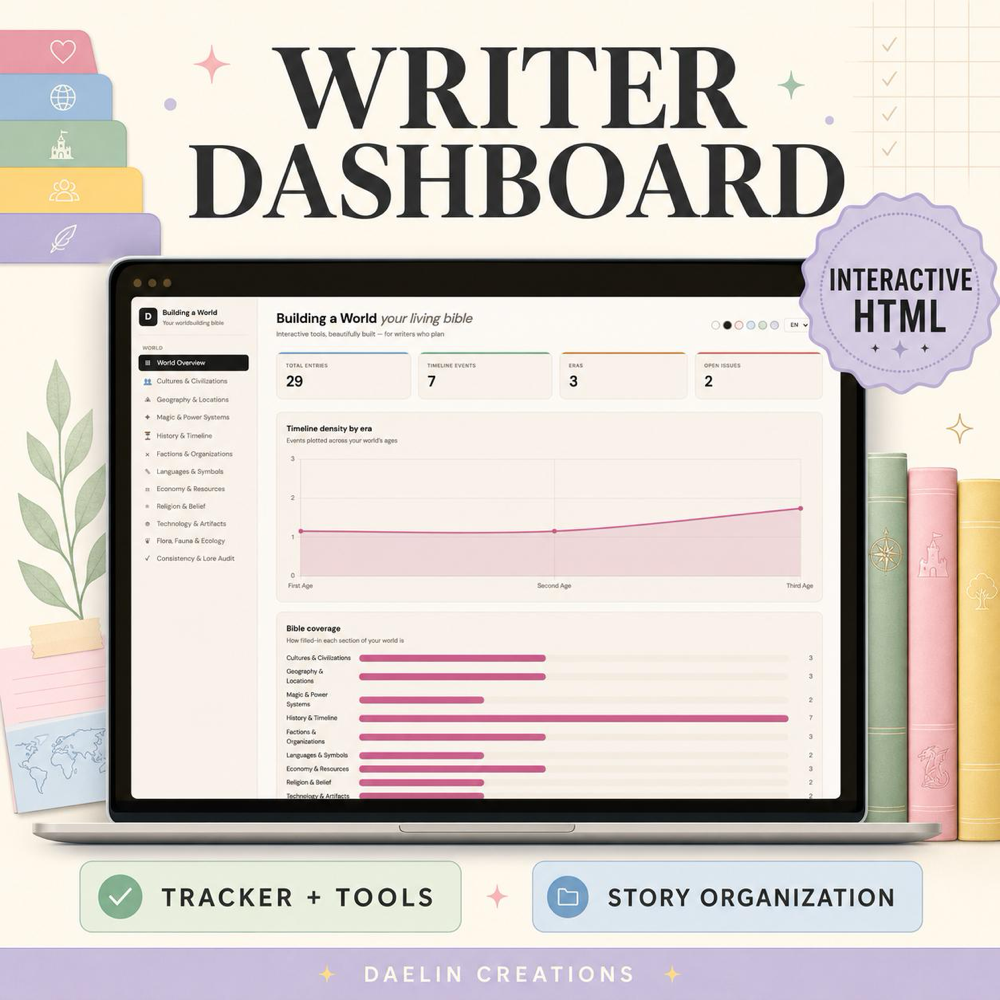
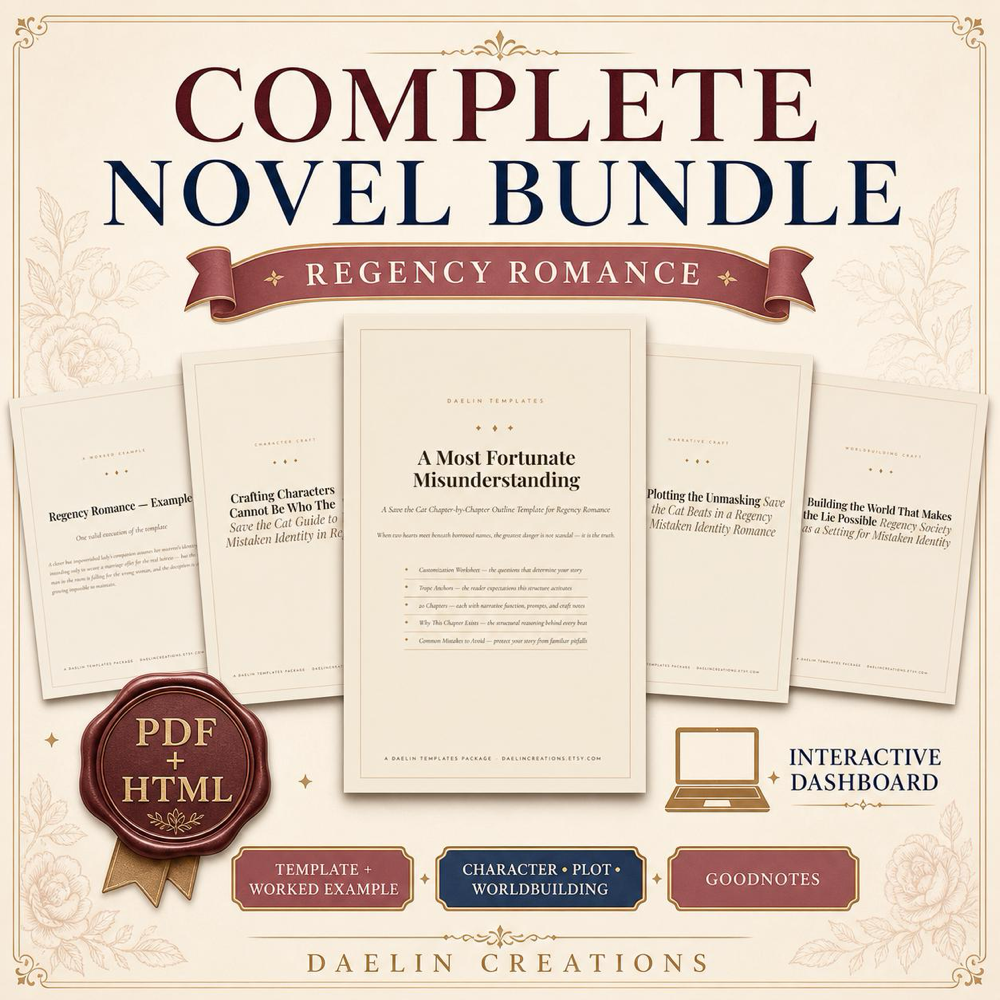
Enemies to Lovers Beat Sheet • Save the Cat Plotting Dashboard (Digital Download)
The beat sheet for the trope you actually write
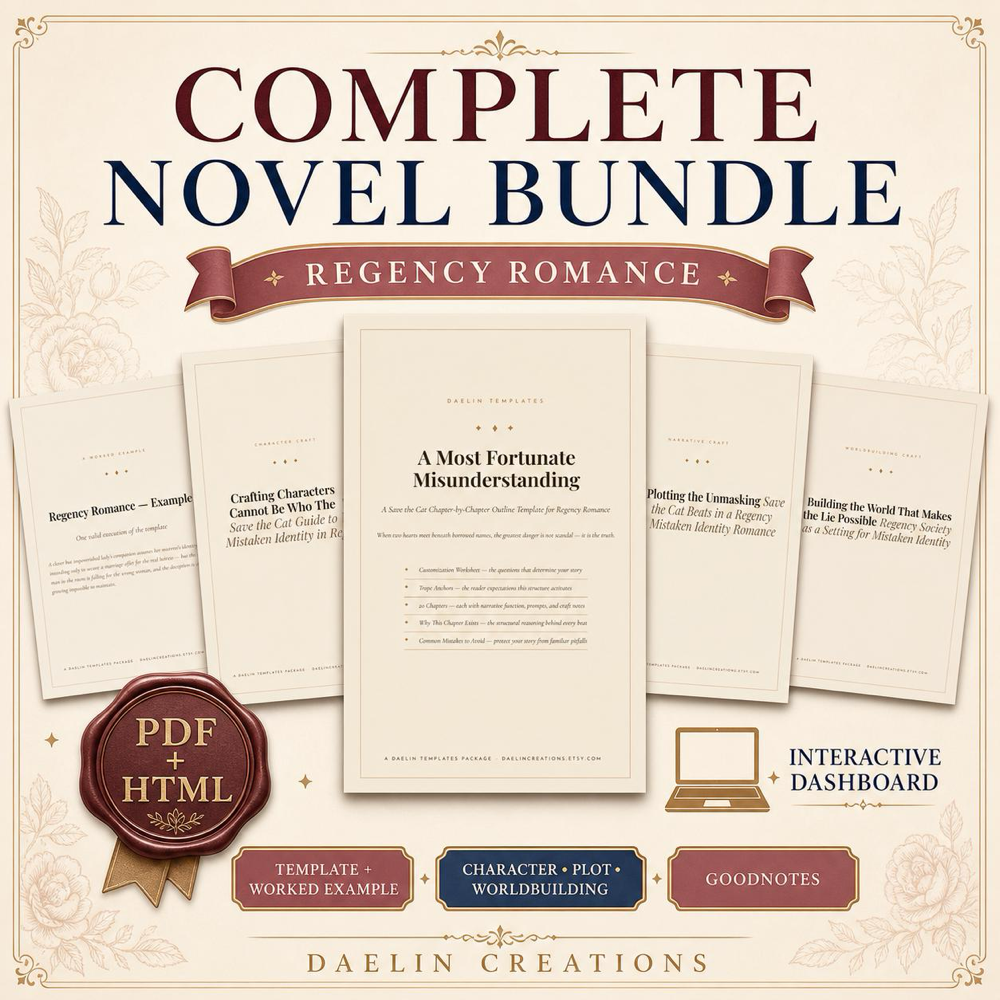
Enemies to Lovers Romantasy Bundle
There is a moment — right before the mask comes off — when you still have a choice.
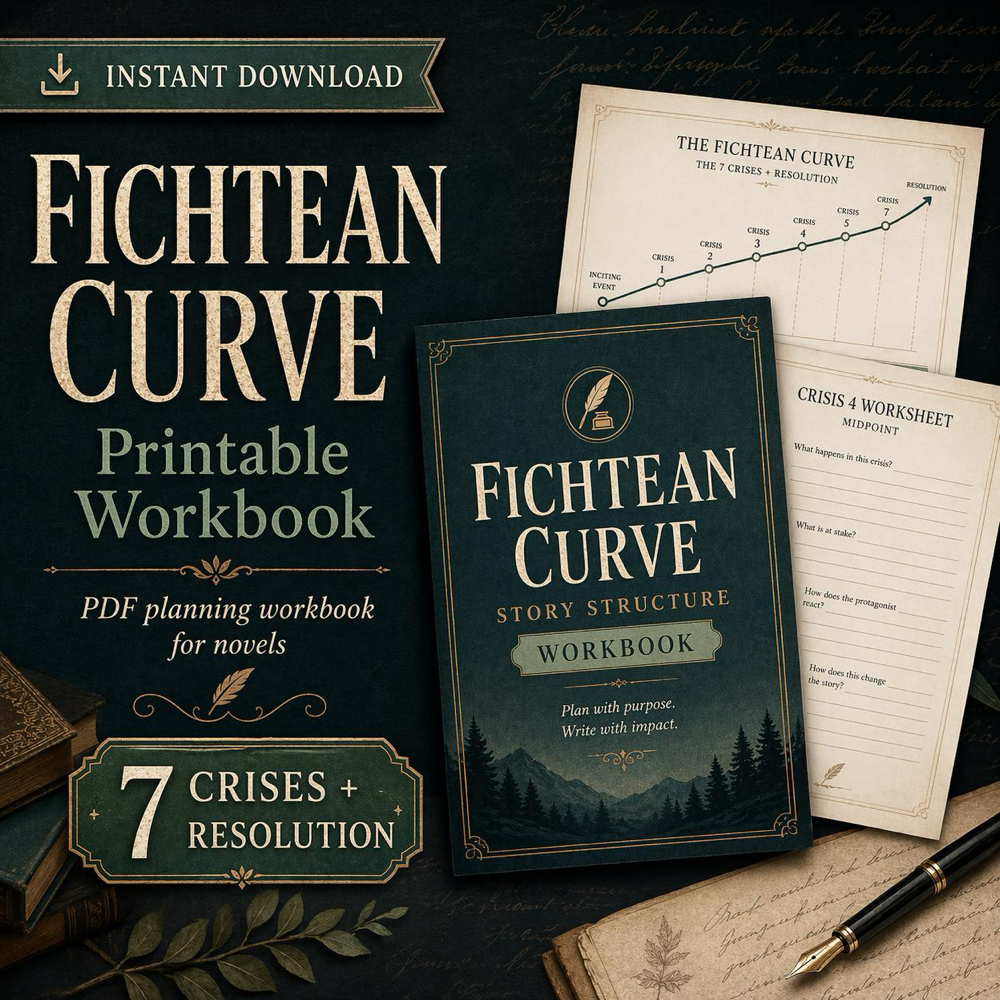
Fichtean Curve Novel Planner – 7 Crises Story Structure Workbook (PDF Download)
Stop circling the pressure at the heart of your story and start building it with structural precision. The Fichtean Curve Novel Planner is a printable PDF workbook designed for fiction writers who are ready to construct a narrative that begins in crisis and never stops climbing — from the first wave of conflict to the only ending the story could have earned.
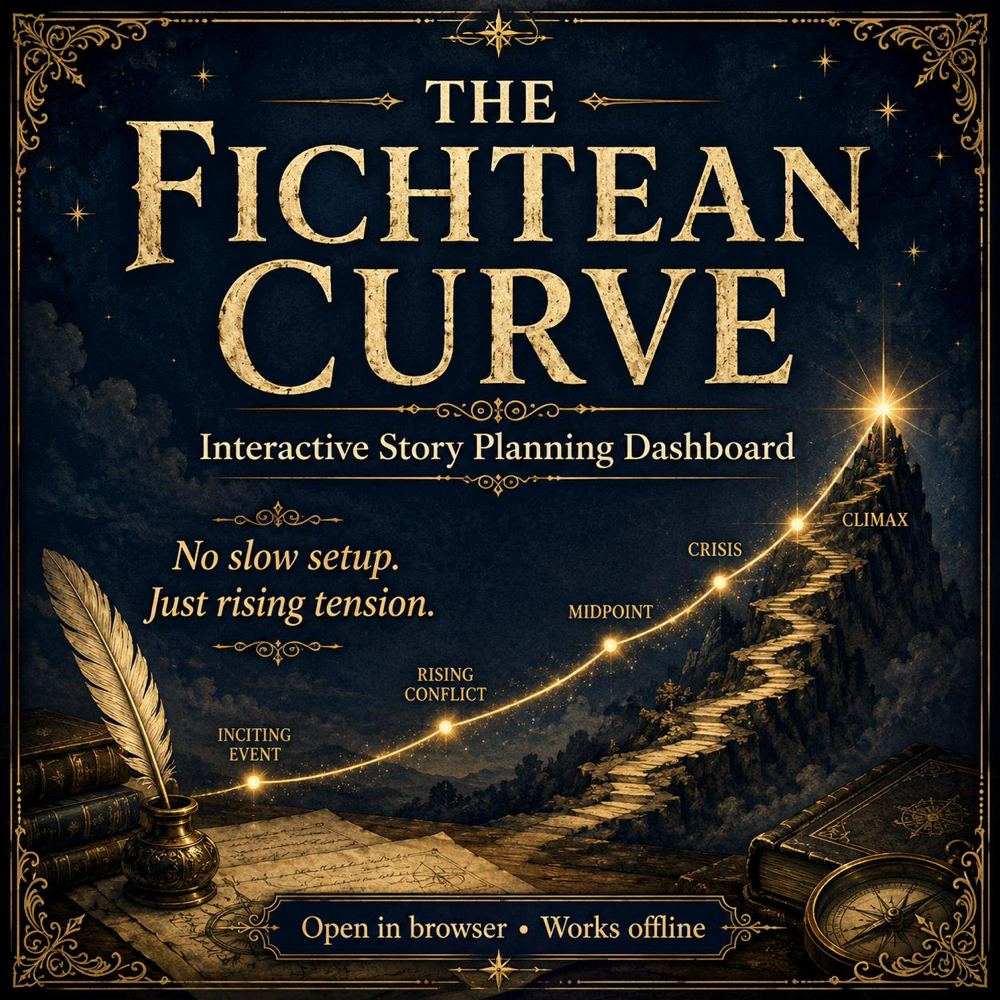
Fichtean Curve Plot Outline Template, Interactive Story Planning Dashboard
No setup. No lull. Seven crises, each one worse than the last
Fiction Writing Workbook
Struggling to keep your middle act from going flat? The Escalation Ladder is a structured, printable PDF workbook designed to help fiction writers build rising action that compounds, tightens, and refuses to release its grip on the reader.
Fiction Writing Workbook — Pacing Guide for Writers
Does your story drag in places — or rush past moments that should land? This printable fiction writing workbook walks you through seven carefully scaffolded sections designed to help you hear, map, and reshape the rhythm of your manuscript with craft and intention.
Fiction Writing Workbook — Plot Twists: Planting, Misdirection & The Re-Read
This printable workbook gives fiction writers a complete, guided system for crafting plot twists that feel both surprising and inevitable — the kind that make readers immediately want to start the book over.
Fight Scene Blueprint
Struggling to write fight scenes that grip readers from the first blow to the last? **Fight Scene Blueprint** is a practical craft reference for fiction writers who want their combat and action sequences to feel visceral, believable, and emotionally resonant — not like a choreographed checklist.
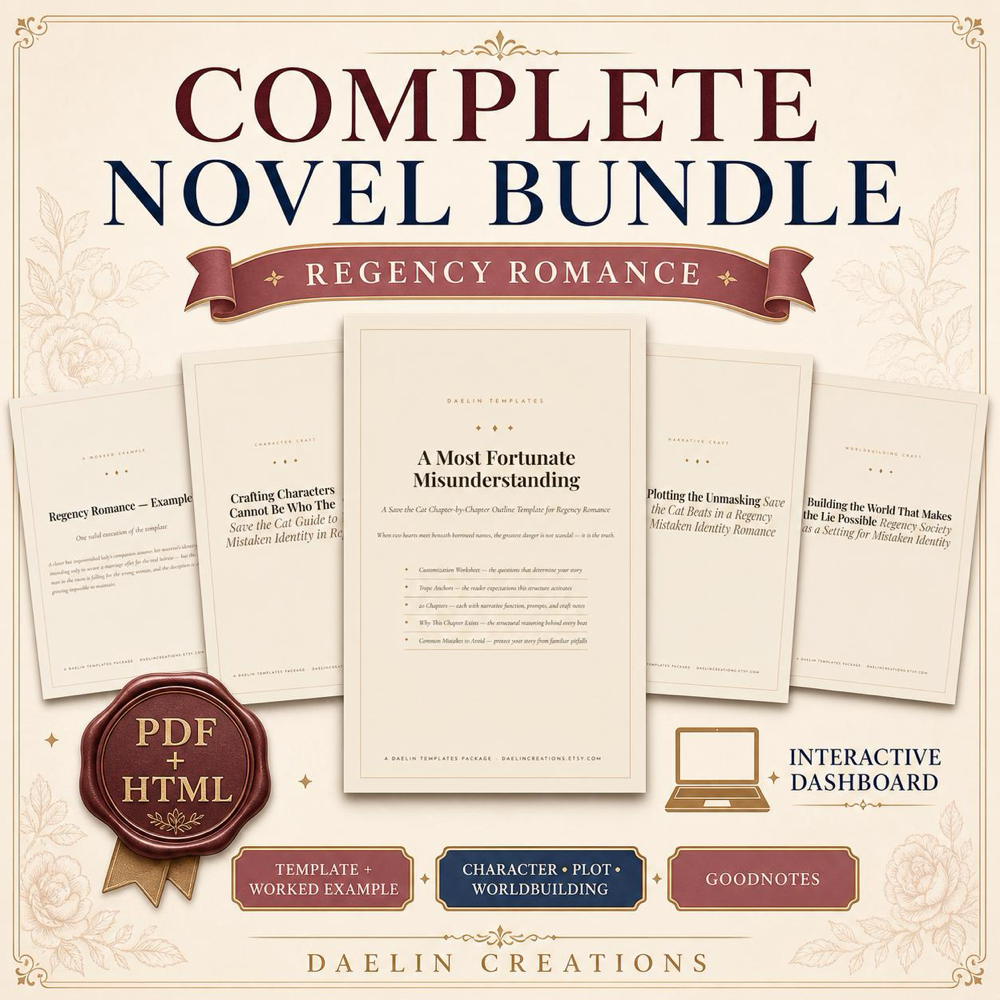
Finding Myself Romantic Comedy Story Structure Workbook
FINDING MYSELF
Flashbacks & Time Jumps Workbook for Fiction Writers
Master the art of nonlinear storytelling with this printable fiction writing workbook — a complete craft companion for writers who want to use flashbacks and time jumps with confidence, control, and emotional precision.
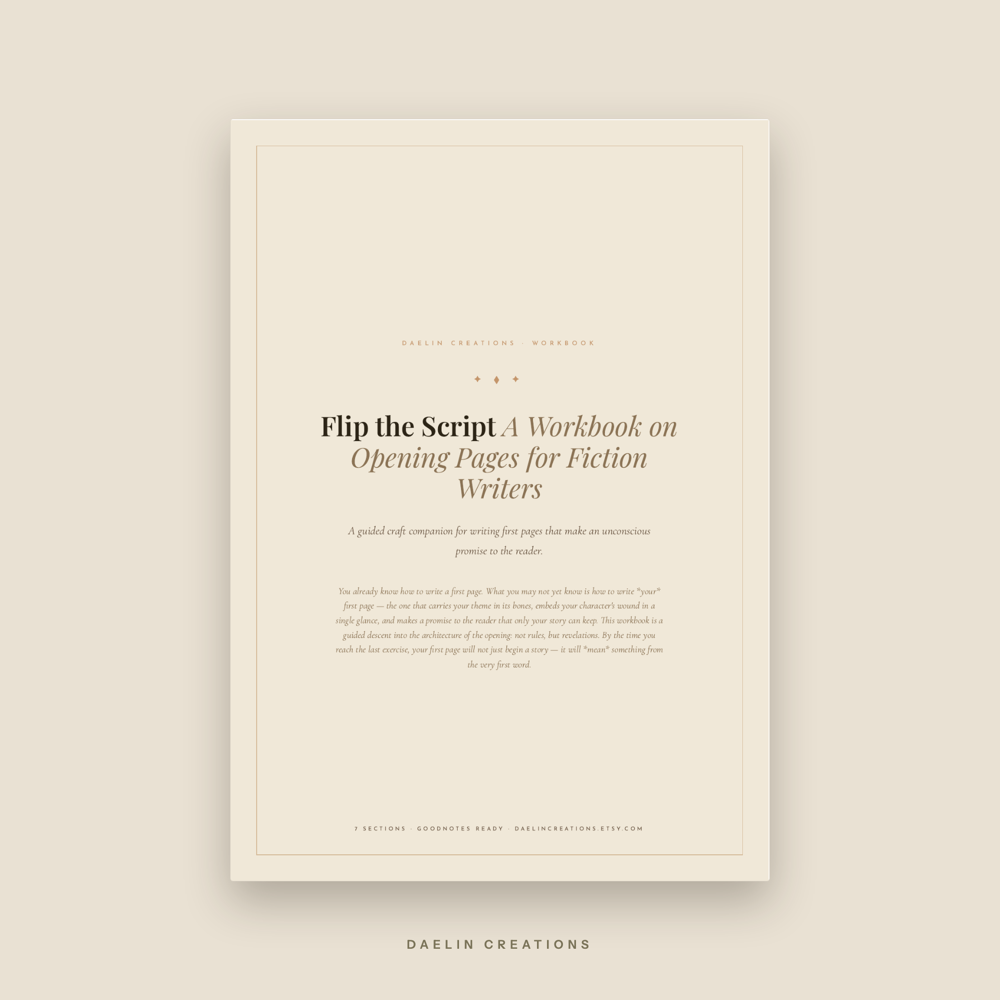
Flip the Script — Opening Pages Workbook for Fiction Writers
Your first page has one job: make a promise. This printable workbook gives fiction writers a rigorous, warmly guided path to crafting opening pages that carry thematic weight from the very first word.
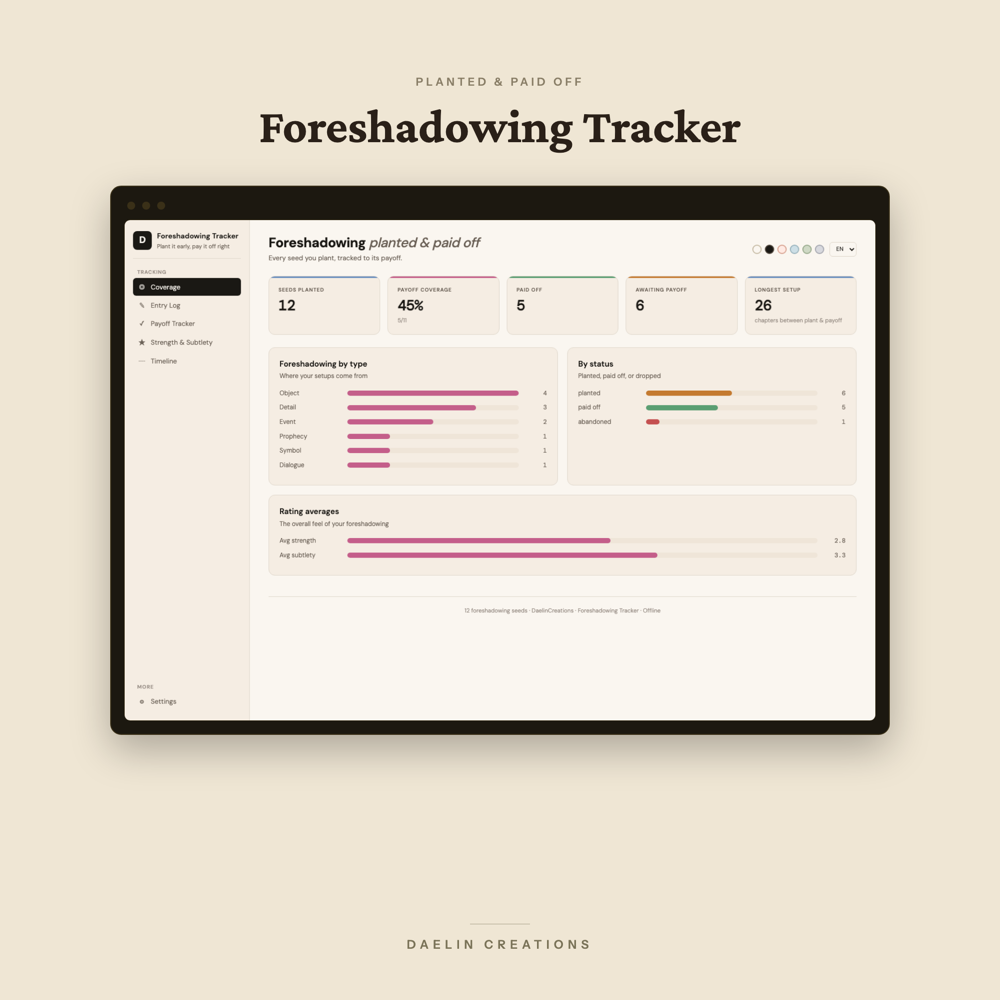
Foreshadowing Tracker
Never drop a planted clue again. This interactive HTML Foreshadowing Tracker helps fiction writers log every hint, plant every seed, and confirm every payoff — all in one beautifully organized dashboard that runs entirely in your browser, no login or internet required.
Freytag's Pyramid Story Structure Worksheet
There is a version of you that knows exactly how this story ends.
Genre Beat Calculator
Six narrative structures. Eight fiction genres. Forty-eight beat sheets, each one tuned for the way your genre quietly rewrites the rules.
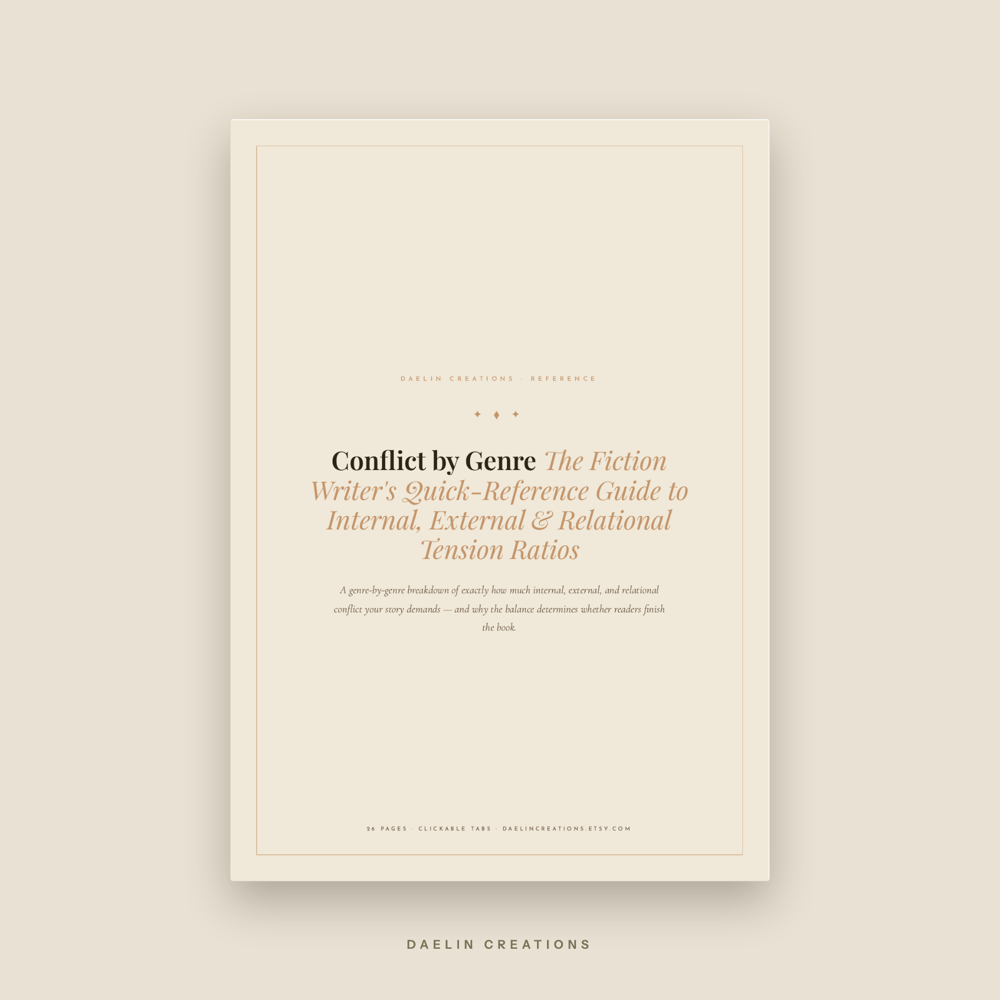
Genre Conflict Cheat Sheet for Fiction Writers
Every genre makes a silent promise to its reader — and that promise is built on conflict. But not all conflict is created equal. A romance lives or dies by the push and pull between two people; a thriller needs relentless external pressure; a literary novel demands the war be fought inside the character's own mind. Get the ratio wrong and readers sense something is off, even if they can't name it.
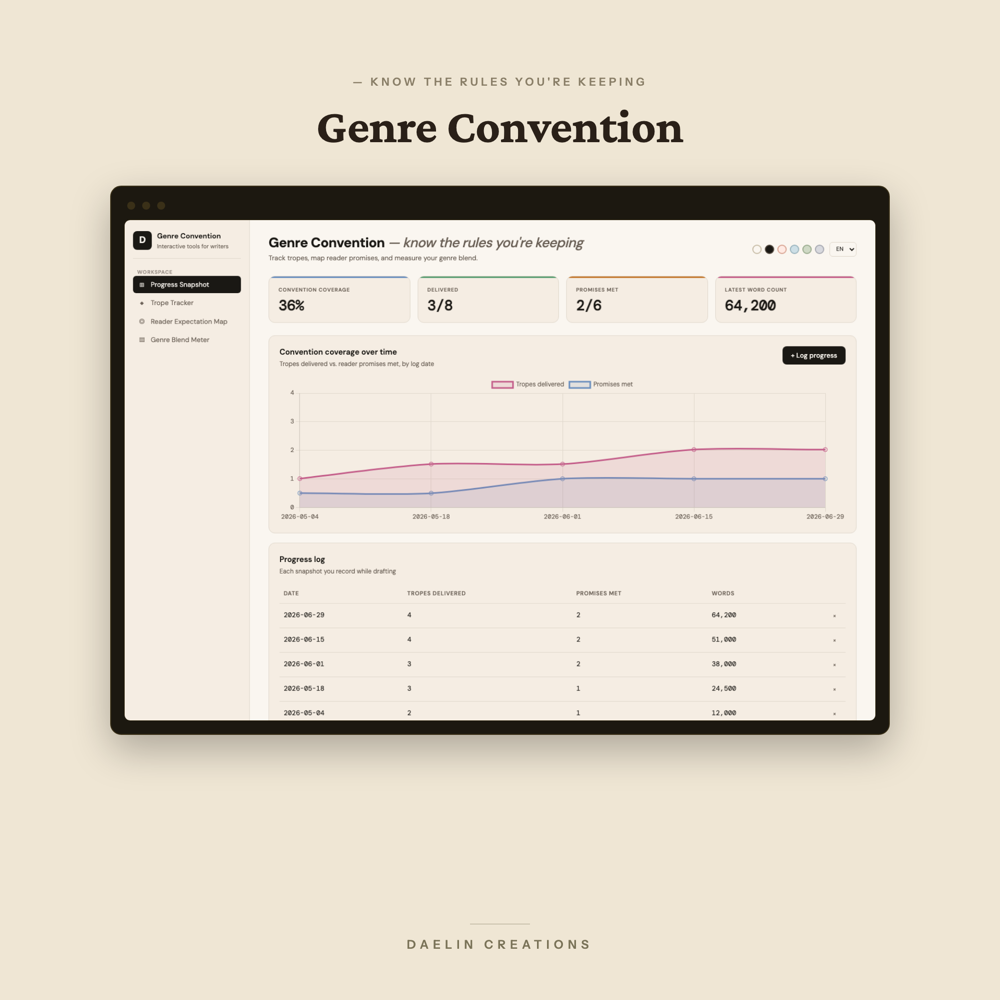
Genre Convention Checklist
Never miss a genre expectation again — this interactive checklist keeps every convention, trope, and reader promise for your current manuscript in one clean dashboard.
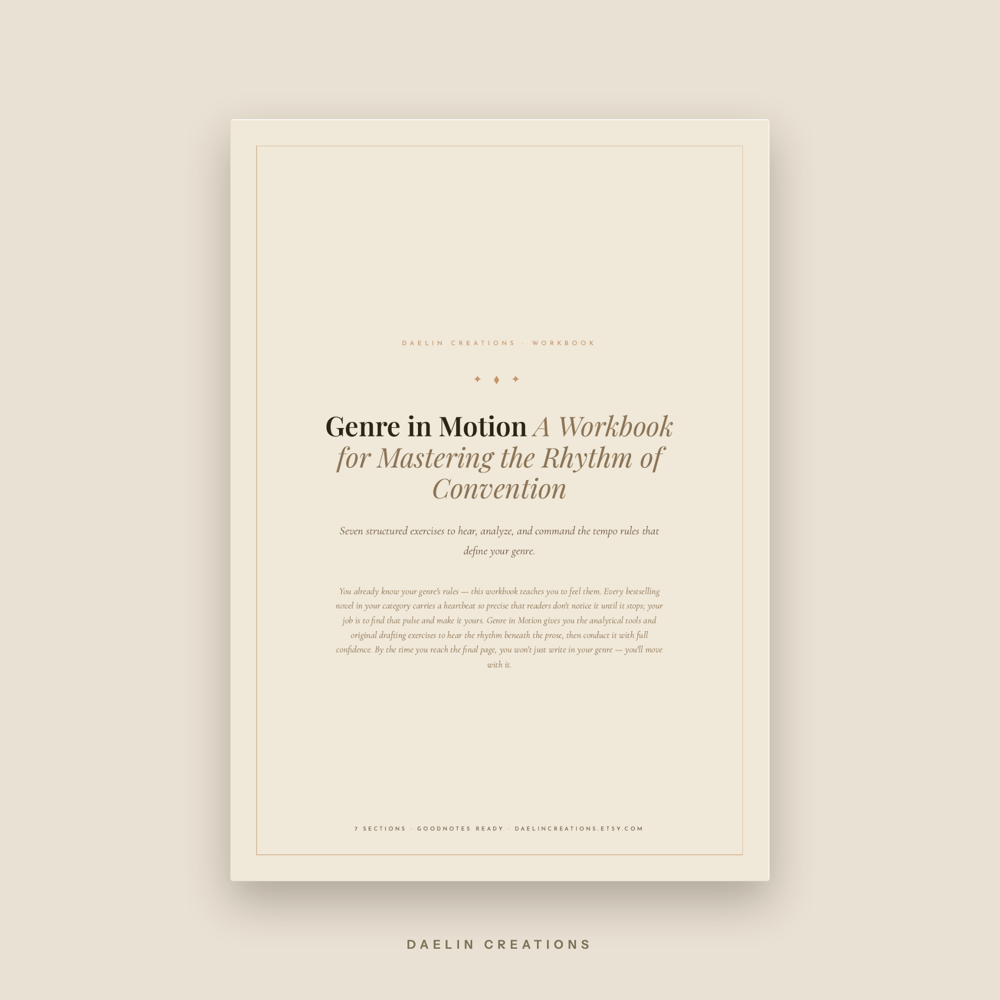
Genre Fiction Pacing Workbook
Every genre runs on rhythm — and Genre in Motion gives you the tools to hear it, analyze it, and command it. This printable 7-section workbook guides fiction writers through the full arc of pacing craft: from mapping the tempo expectations your genre places on Chapter 1, to managing competing rhythms in genre blends, to crafting a final cadence that lands with the full weight your story has earned.
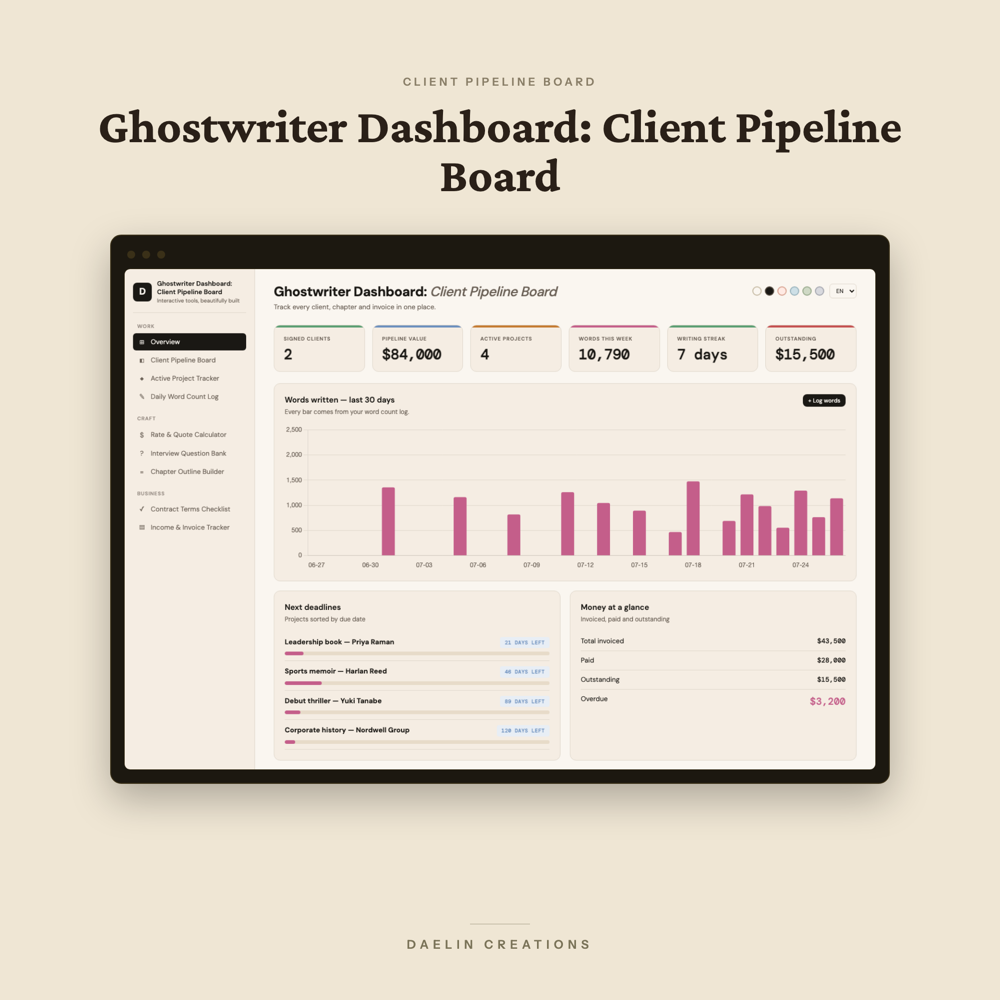
Ghostwriter Dashboard: Client Pipeline Board, Rate Quote Calculator, Interview Question Bank & Invoice Tracker HTML Tool
Run your ghostwriting business like a business, not a guessing game
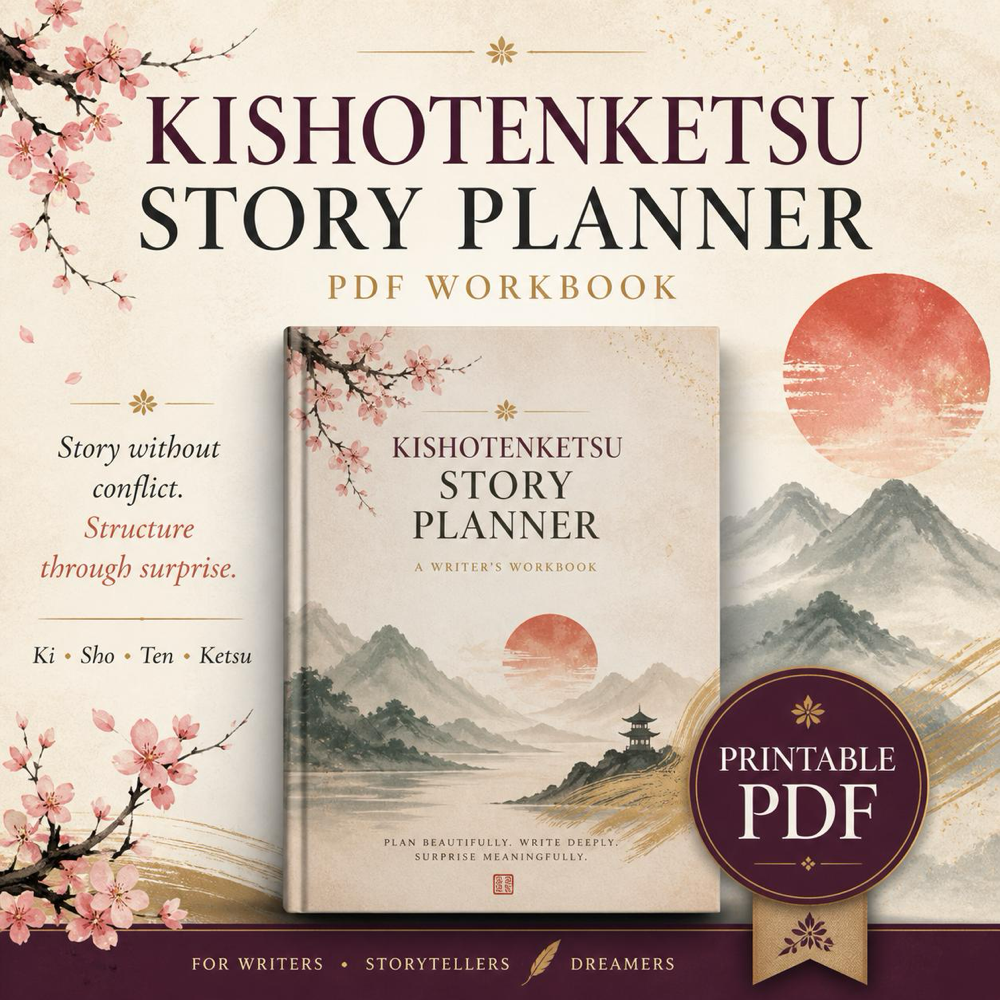
GoodNotes Planner
Plan your novel in four parts with Kishōtenketsu — a classical no-conflict structure of introduction, development, twist, and conclusion, one guided page each, built for GoodNotes and print.
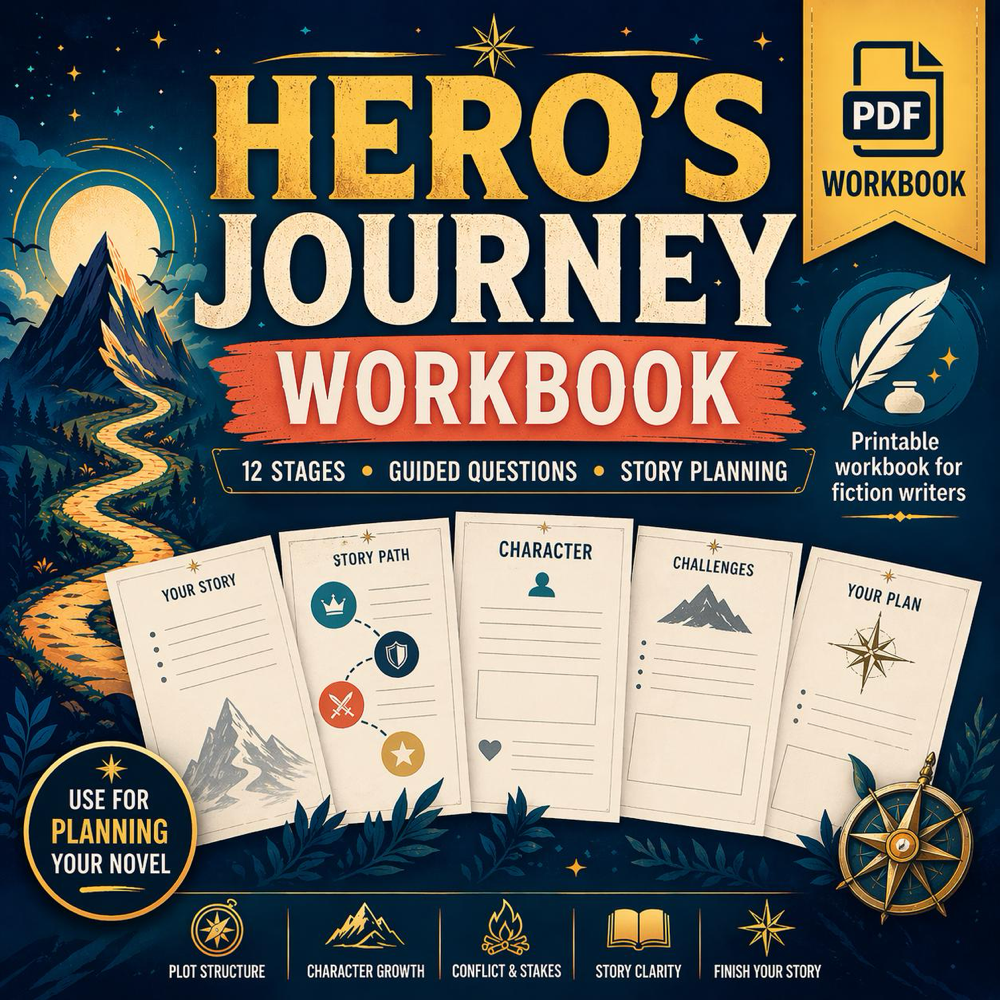
Hero's Journey Workbook – 12 Stage Novel Planner (PDF Download)
Plan your novel stage by stage with the Hero's Journey — all twelve mythic stages, one guided page each, in a beautifully typeset PDF built for GoodNotes and print.
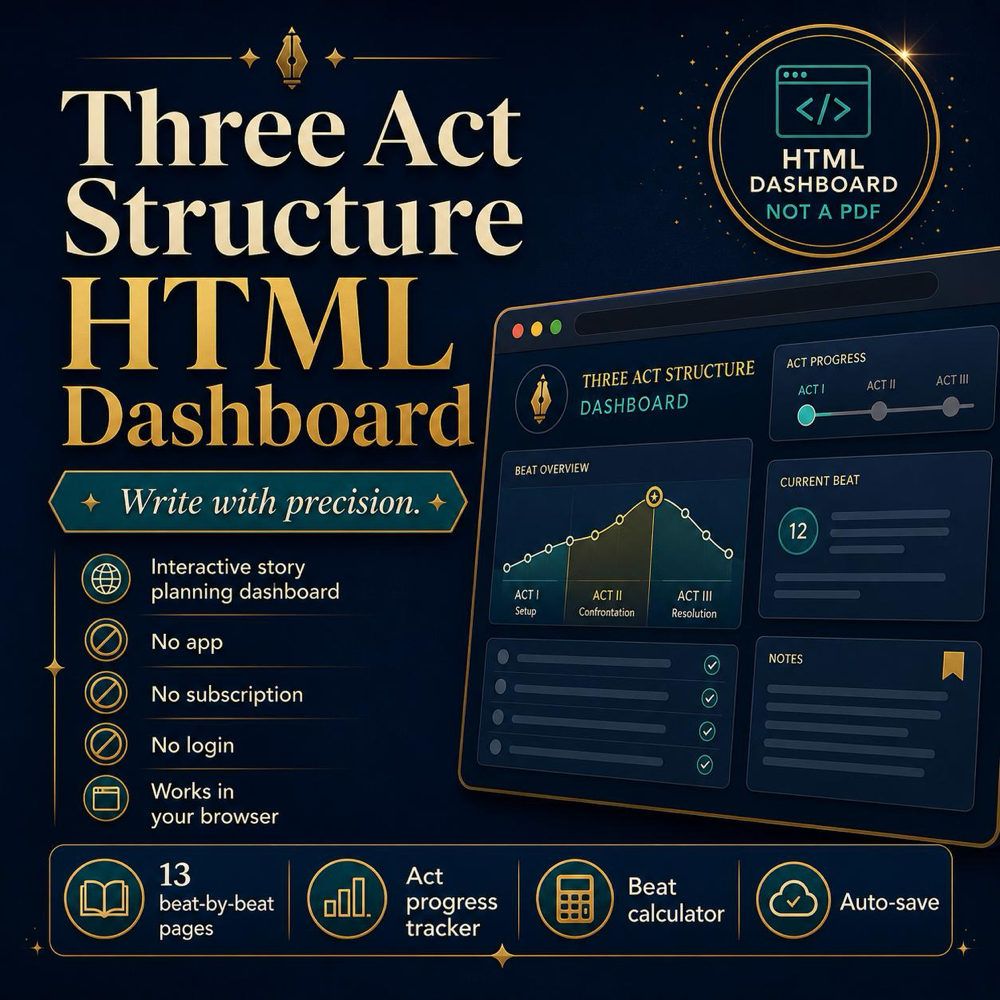
Interactive Novel Planner HTML Dashboard – Three Act Structure Story Tool (Digital Download)
Plan your novel with the Three-Act Structure in one interactive, offline HTML dashboard — all 9 beats with 36 guided questions, characters, worldbuilding, and a beat calculator.
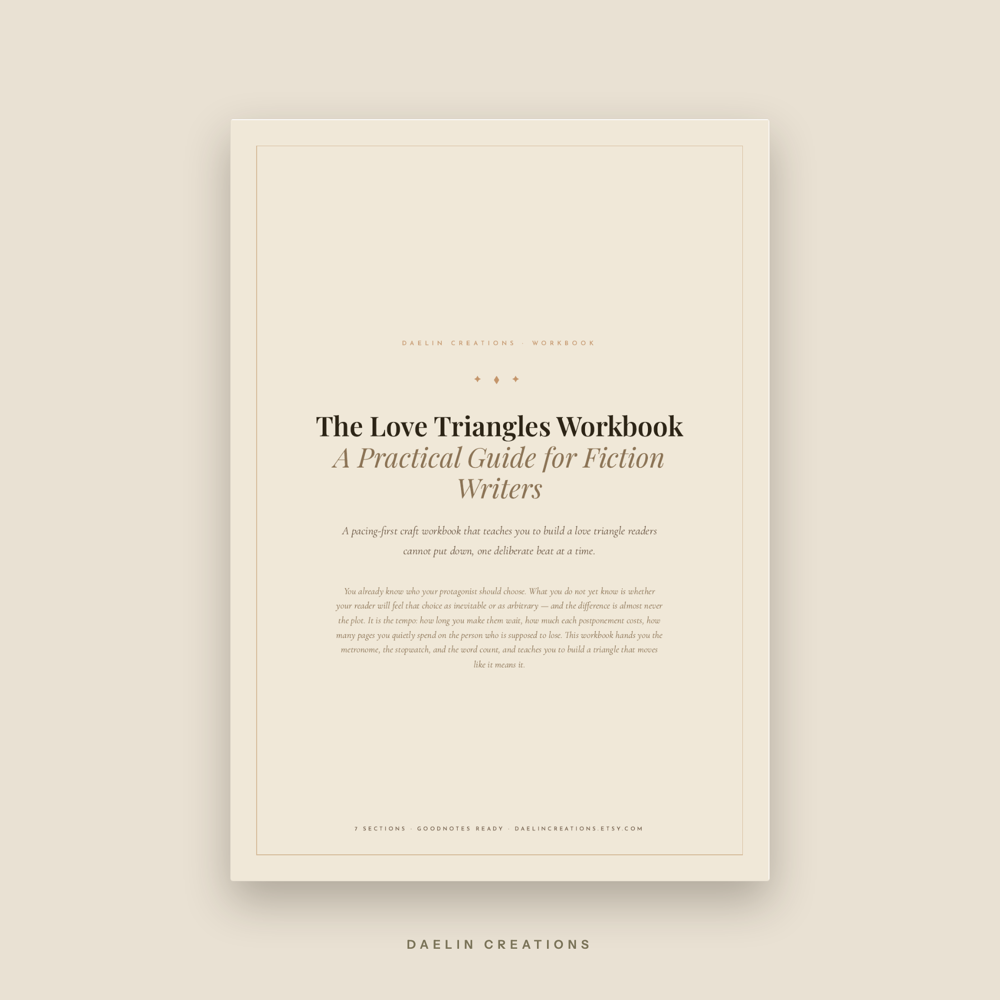
Love Triangles Workbook for Fiction Writers
Build a love triangle your readers cannot put down.
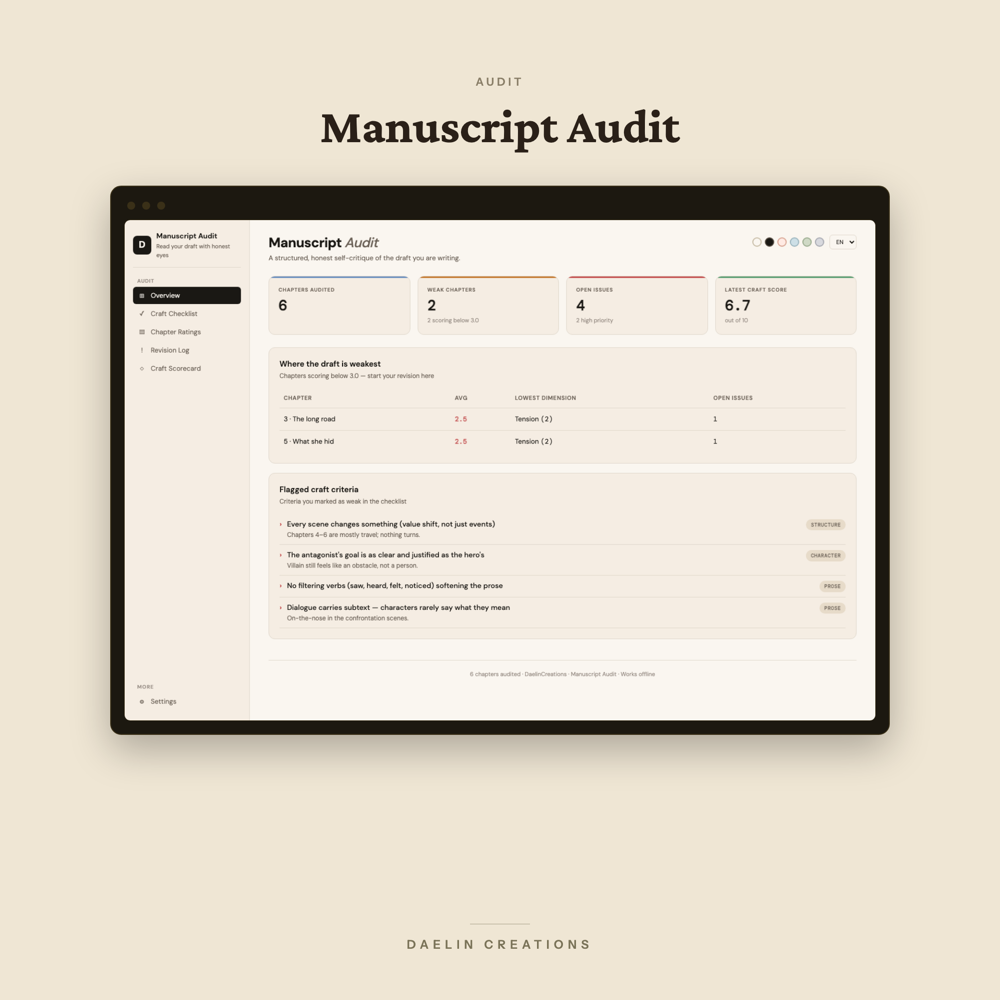
Manuscript Audit Dashboard
Audit your own draft with honest eyes. Manuscript Audit turns "something feels off" into a clear, prioritized list of what to fix — a structured self-critique you run between drafts.
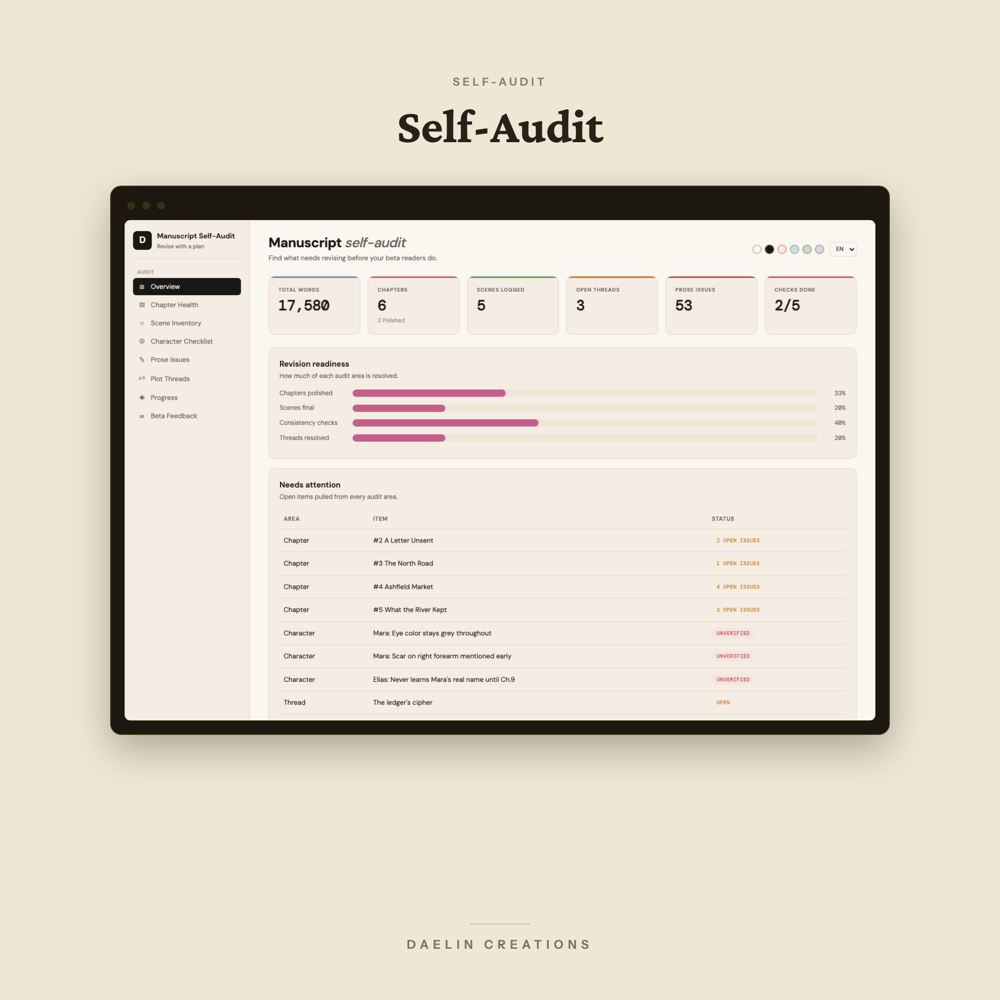
Manuscript Self-Audit Dashboard
Catch every weak scene, plot hole, and pacing issue before your manuscript reaches a single reader — all inside one interactive HTML file, no subscriptions, no apps, no internet required.
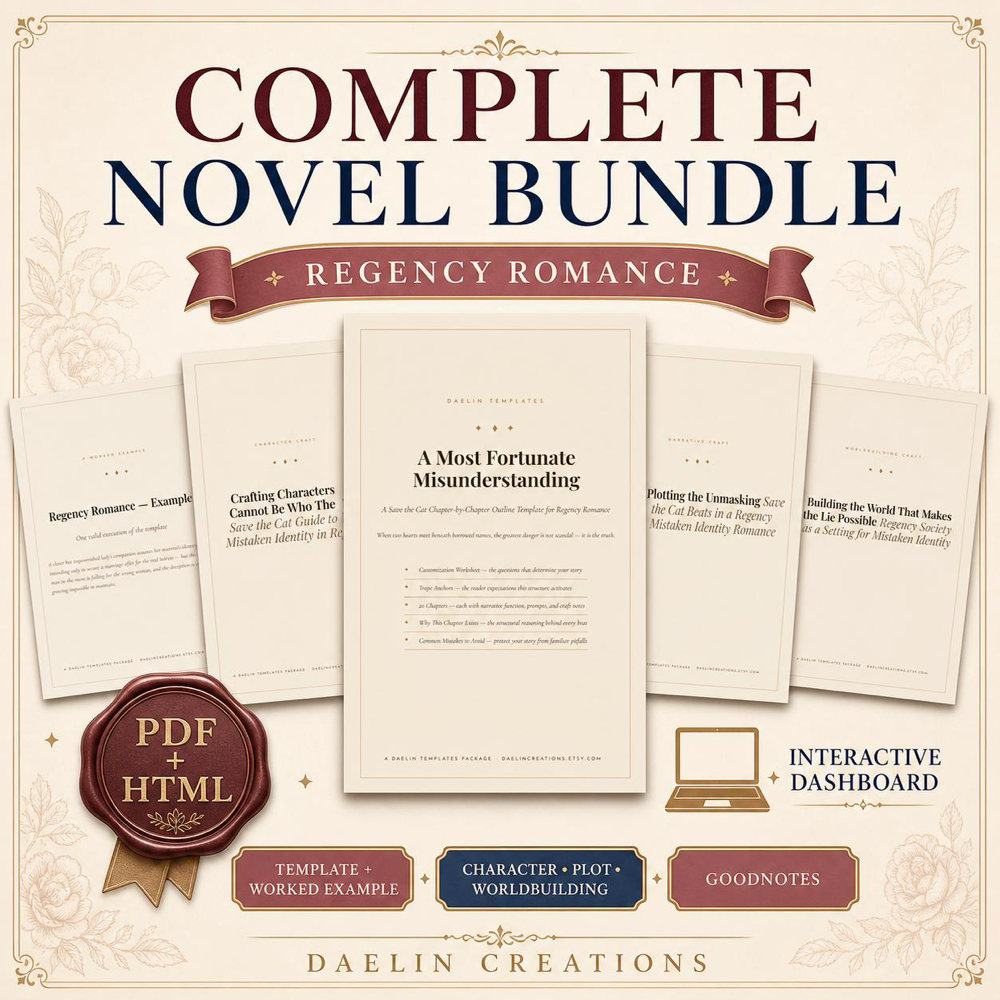
Medical Romance Writing Template
WHAT THIS IS
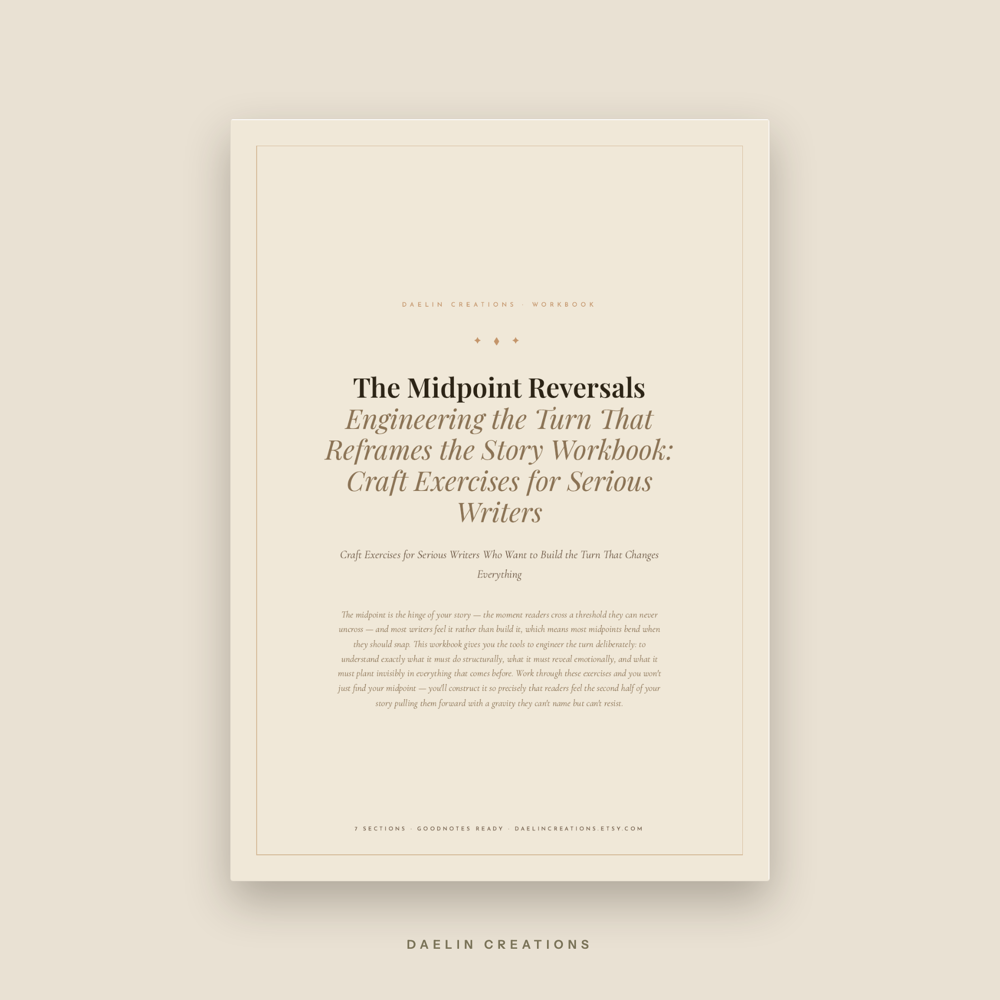
Midpoint Reversals Workbook
Every story has a moment where the ground shifts — and this workbook teaches you to build that moment with precision. The Midpoint Reversals workbook is a 7-section craft guide for serious fiction writers who want to engineer the structural turn that reframes everything: what came before it, what follows it, and what the whole story means.
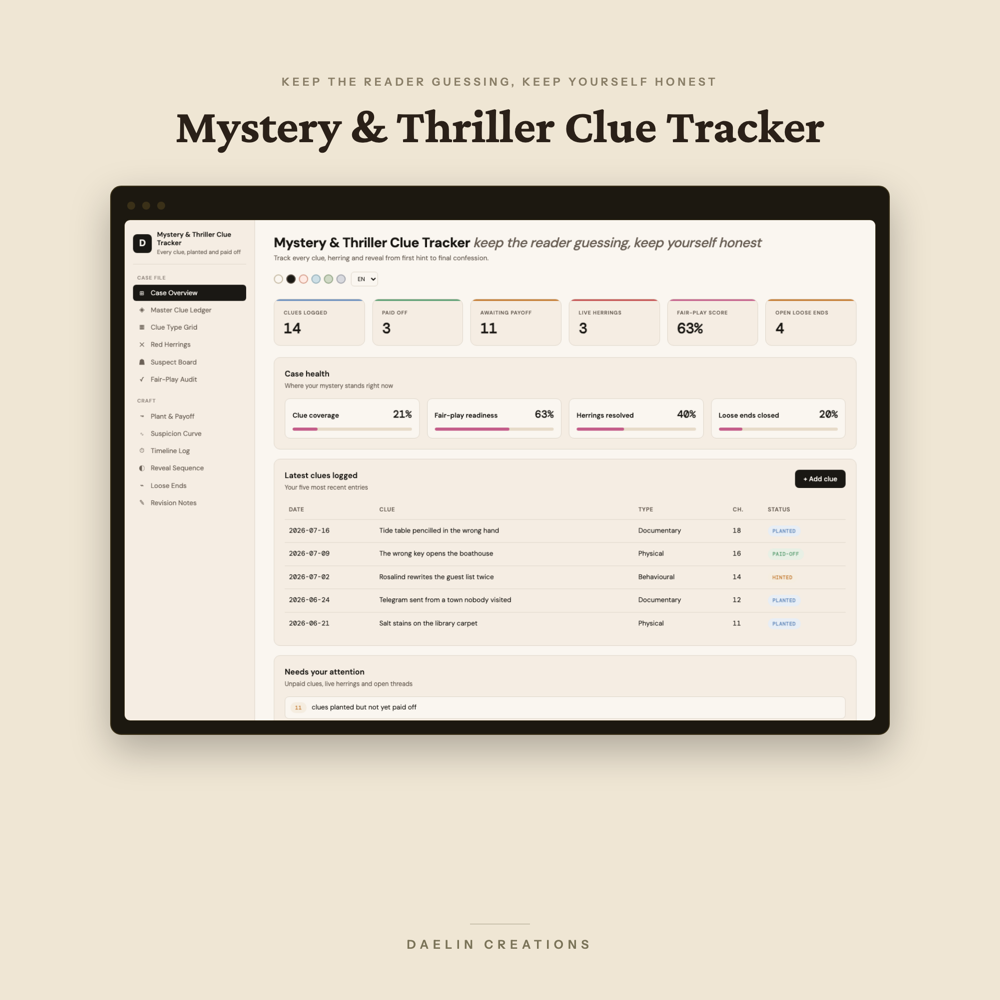
Mystery & Thriller Clue Tracker
Stop losing track of who knows what. This interactive HTML dashboard follows every clue from the page you planted it on to the page it finally pays off, so your ending lands as inevitable instead of arriving out of nowhere.
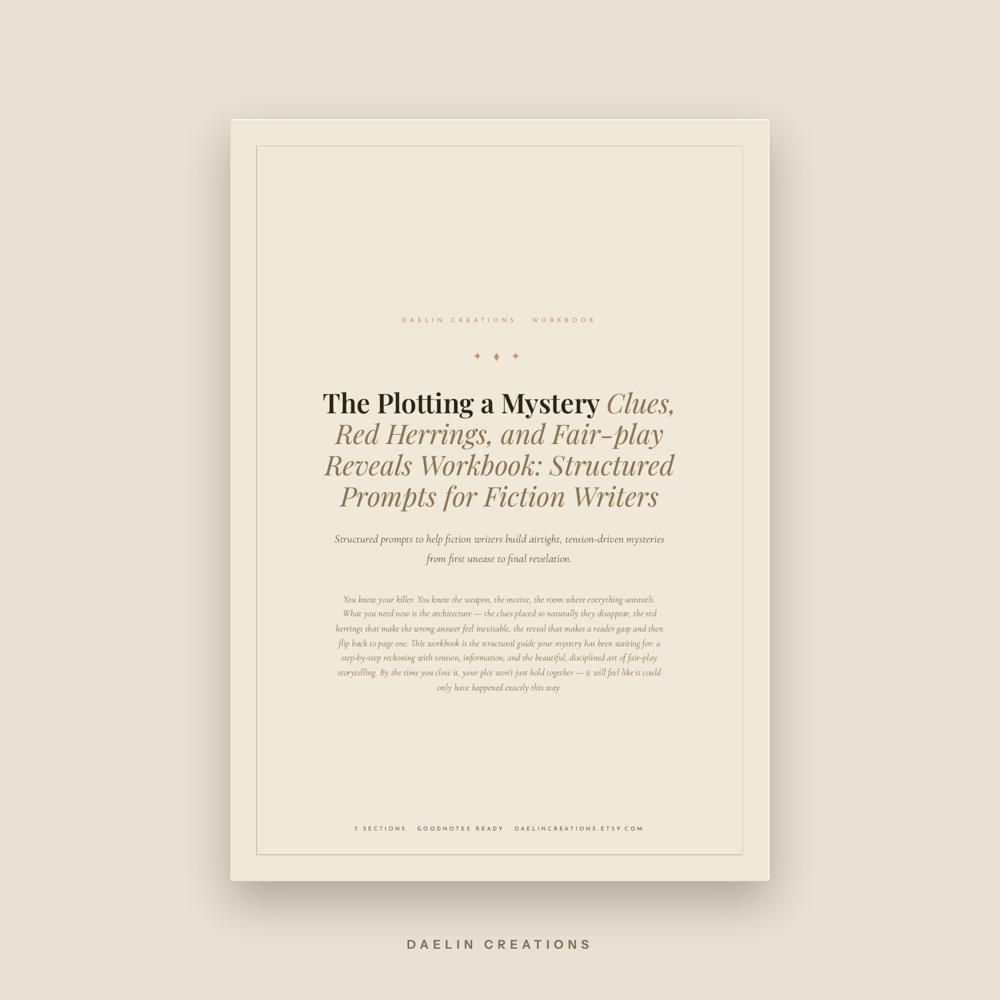
Mystery Writing Workbook
Every mystery is a promise made on page one. This printable workbook gives fiction writers the structured exercises to keep it. Across seven carefully sequenced sections — from seeding pre-crime dread through clue architecture, red herring design, investigator pressure, information-gap control, fair-play reveals, and the resonant aftermath — you'll find 21 specific, actionable prompts built for the complexity of real mystery plotting. This is not a generic writing journal. Every exercise is calibrated to the craft of mystery: dual-explanation clue testing, pressure-transfer red herring scenes, fair-play annotation checklists, and the killer's-eye diagnostic monologue that reveals gaps in your clue trail before your readers do. Designed for A4 paper with generous annotation lines and a warm, journal-style layout. Compatible with GoodNotes for digital use. Perfect for mystery and crime fiction writers drafting a first novel, revising a stalled manuscript, or deepening their craft. Instant PDF download — print at home or annotate digitally.
Novel Writing Workbook
Plan and edit your novel with Shawn Coyne's Story Grid — the Five Commandments of Storytelling, one guided page each, built for GoodNotes and print.
Novel Writing Workbook — Story Structure Planner
Plan your novel point by point with Dan Wells' Seven-Point Story Structure — hook, five turns, and resolution, one guided page each, built for GoodNotes and print.
Opening Pages Workbook for Fiction Writers
Your opening page has one job: make a reader unable to stop. This printable workbook gives you seven structured exercise sets designed specifically to help fiction writers build first pages that are immersive, specific, and impossible to put down.
Openings Hook Anatomy First Line Guide
Struggling to write an opening that earns the next page? This advanced craft reference guide breaks down the architecture of powerful fiction openings — from the single first line all the way through the closing beat of chapter one.
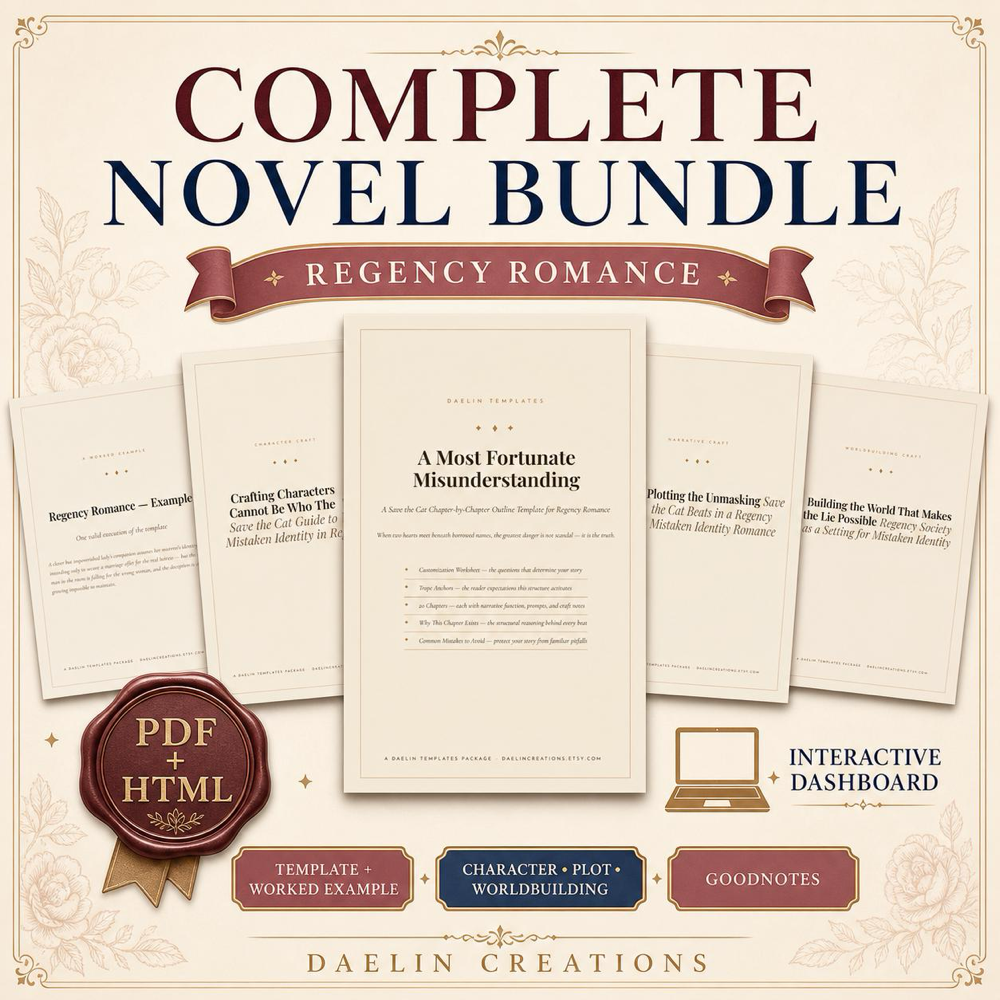
Plot Tracker
There is a version of your protagonist the world was never meant to know.
Point of View Techniques Reference Guide for Fiction Writers
What this guide is
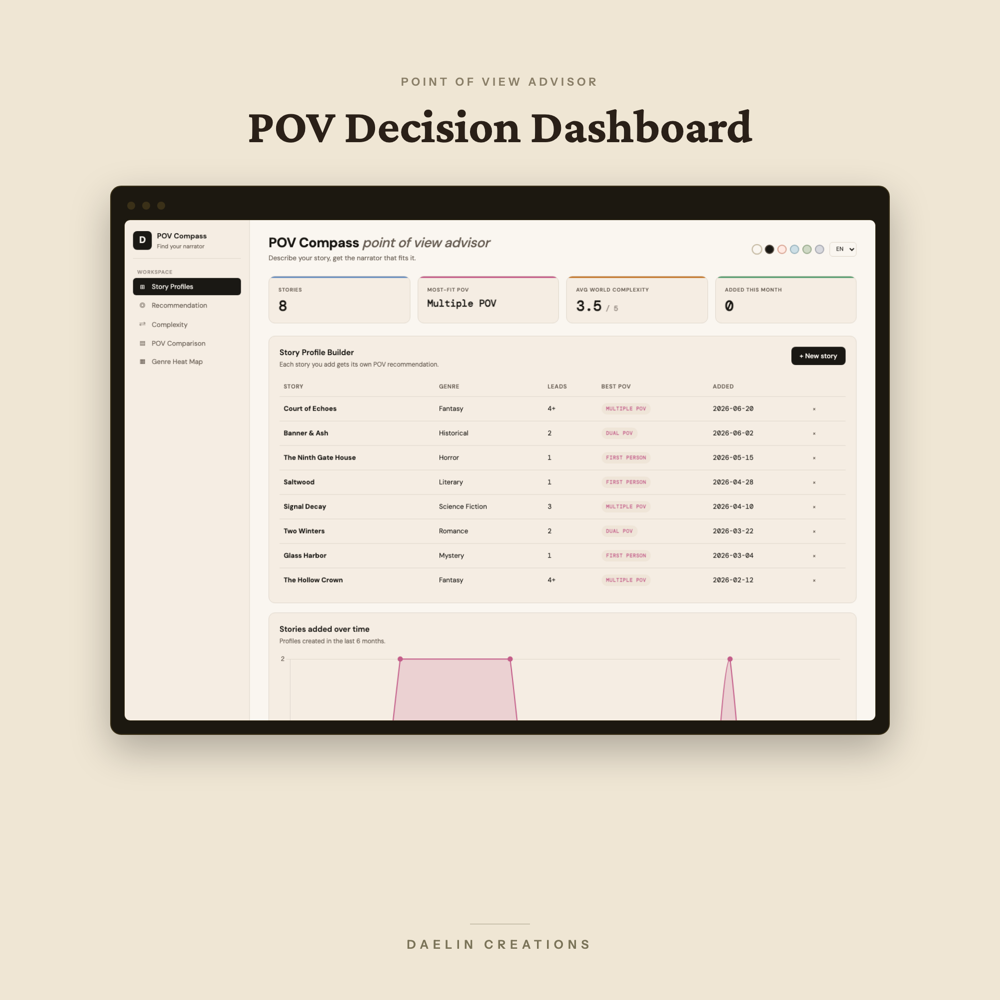
POV Finder for Fiction Writers – Interactive HTML Tool
Stop guessing which point of view belongs in your story. This interactive HTML tool asks you four targeted questions about your narrative — genre, number of protagonists, world complexity, and central mystery — then instantly recommends the POV that fits your story best.
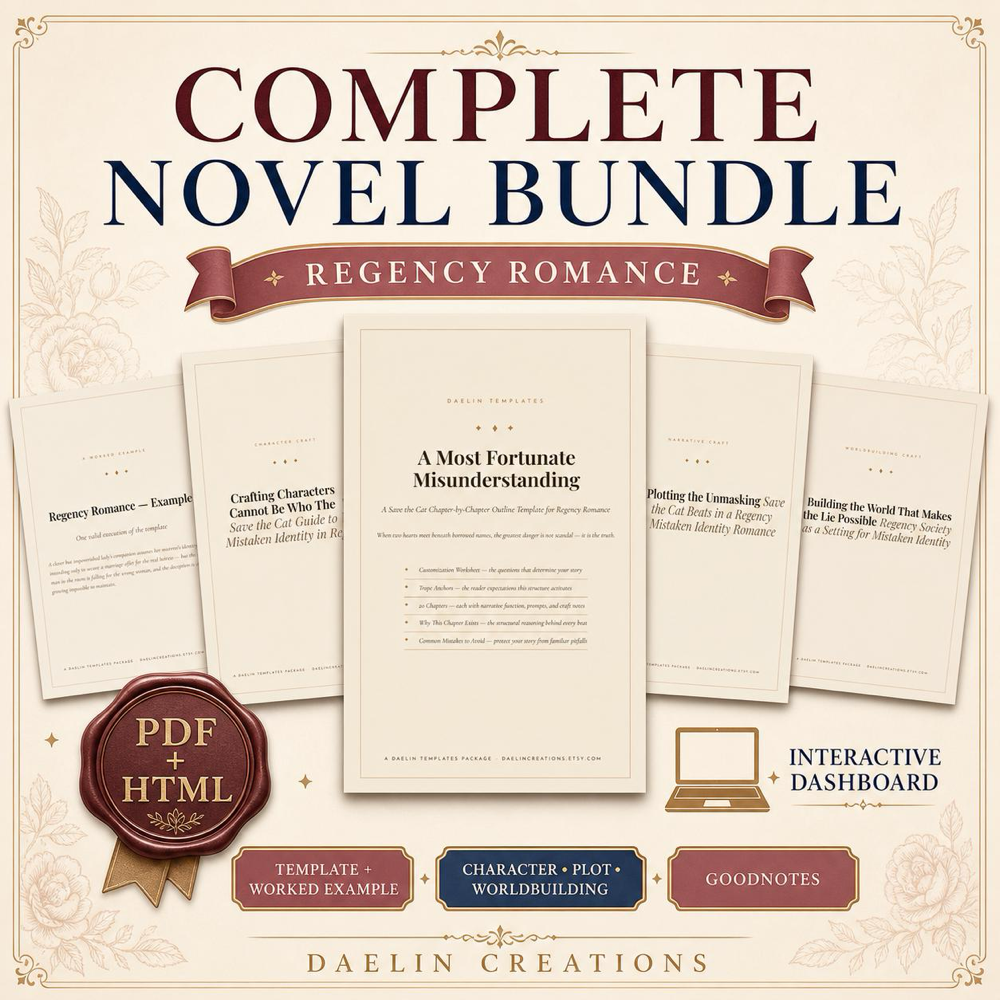
Psychological Thriller Plot Tracker Bundle
GRACEFUL
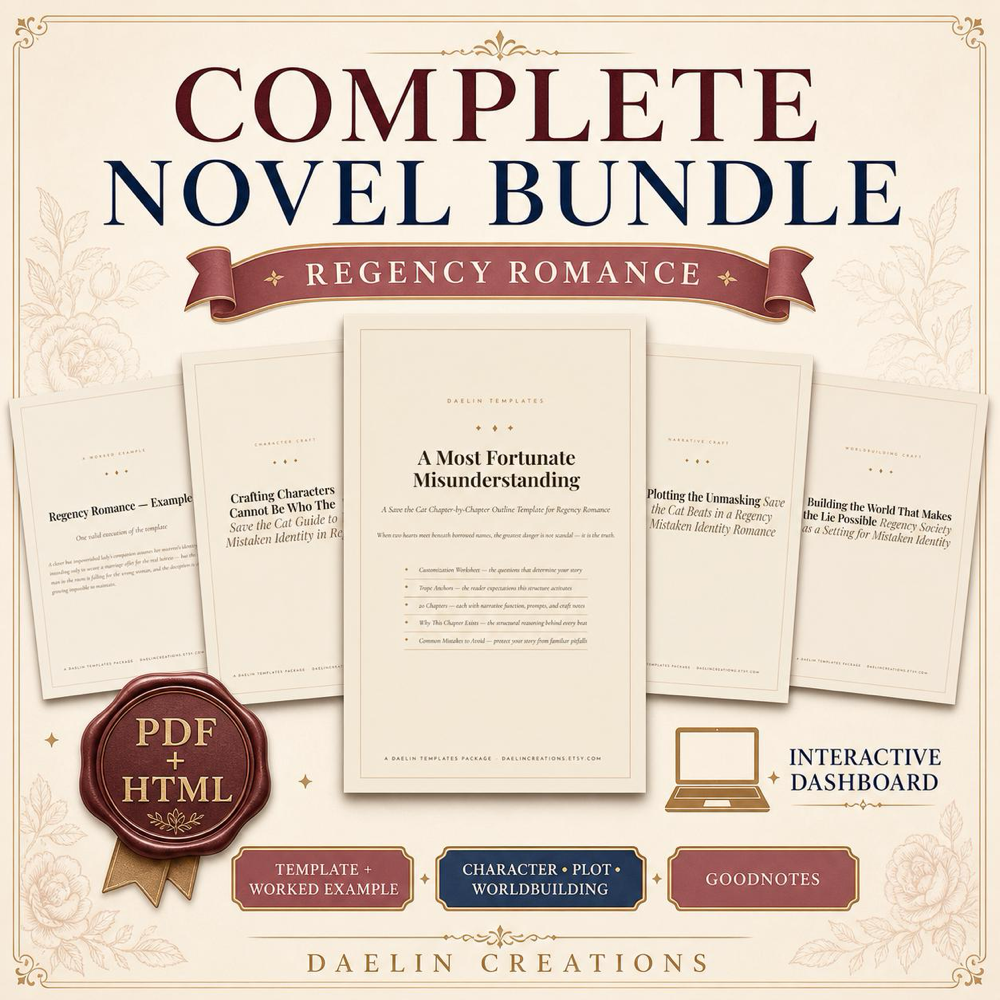
Psychological Thriller Writing Bundle
The Earth Remembers
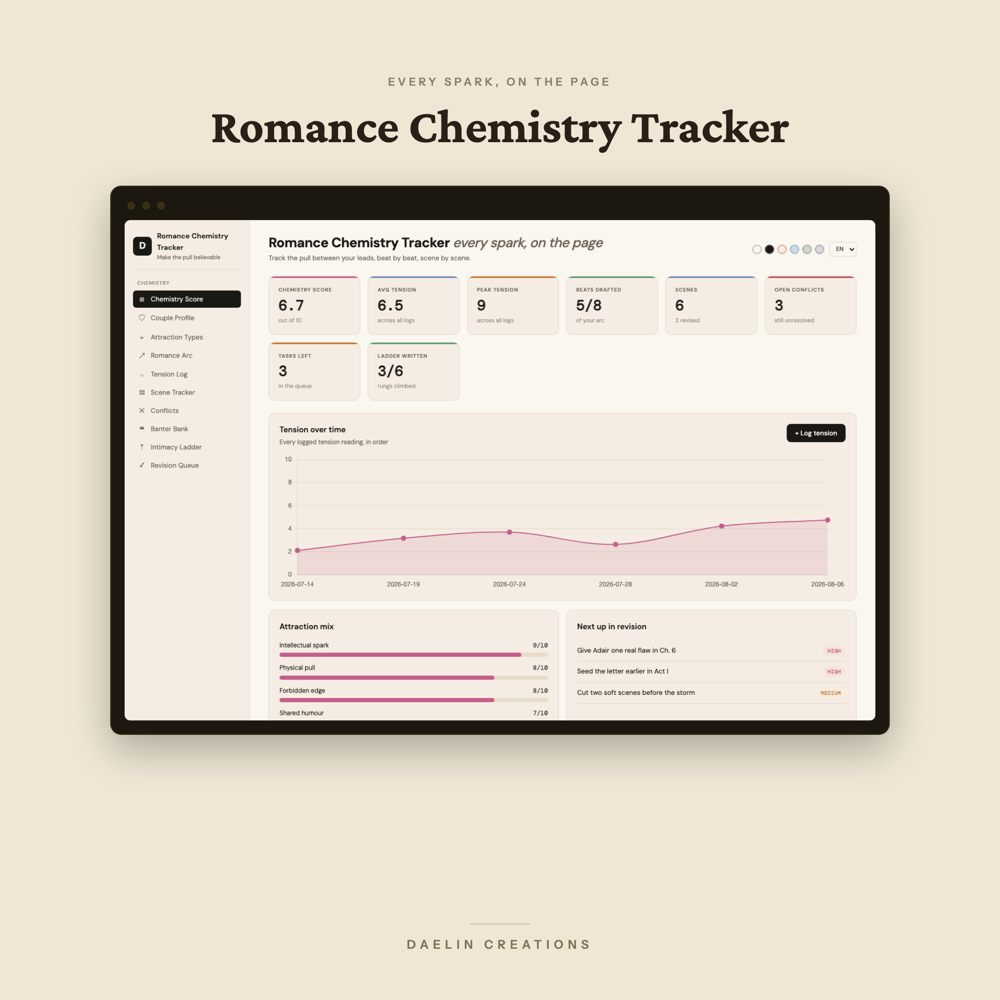
Romance Chemistry Tracker
Your readers can feel the difference between two characters who belong together and two characters who simply share a page. This dashboard exists to make that difference measurable, so you stop guessing whether the pull is landing and start seeing exactly where it goes flat.
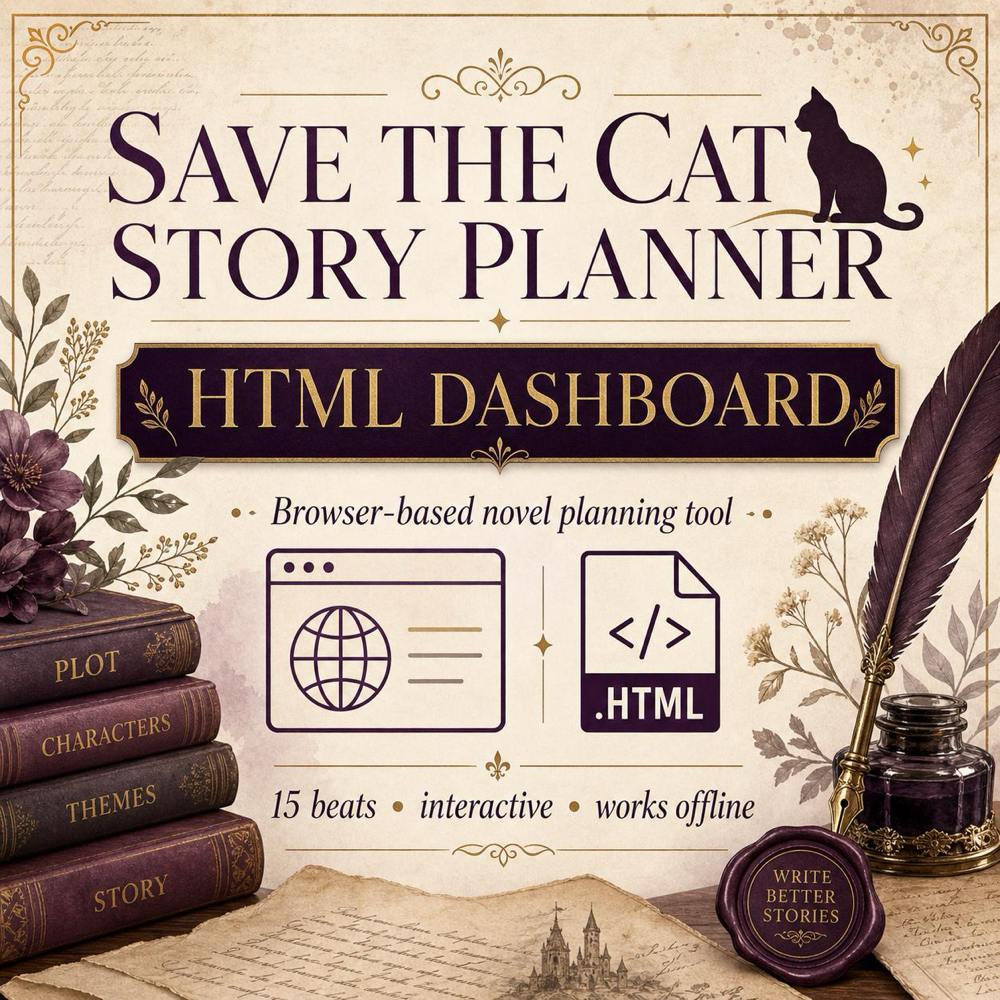
Romance Planner
Plan your novel with the Save the Cat structure in one interactive, offline HTML dashboard — all 15 beats with 60 guided questions, characters, worldbuilding, and a beat calculator.
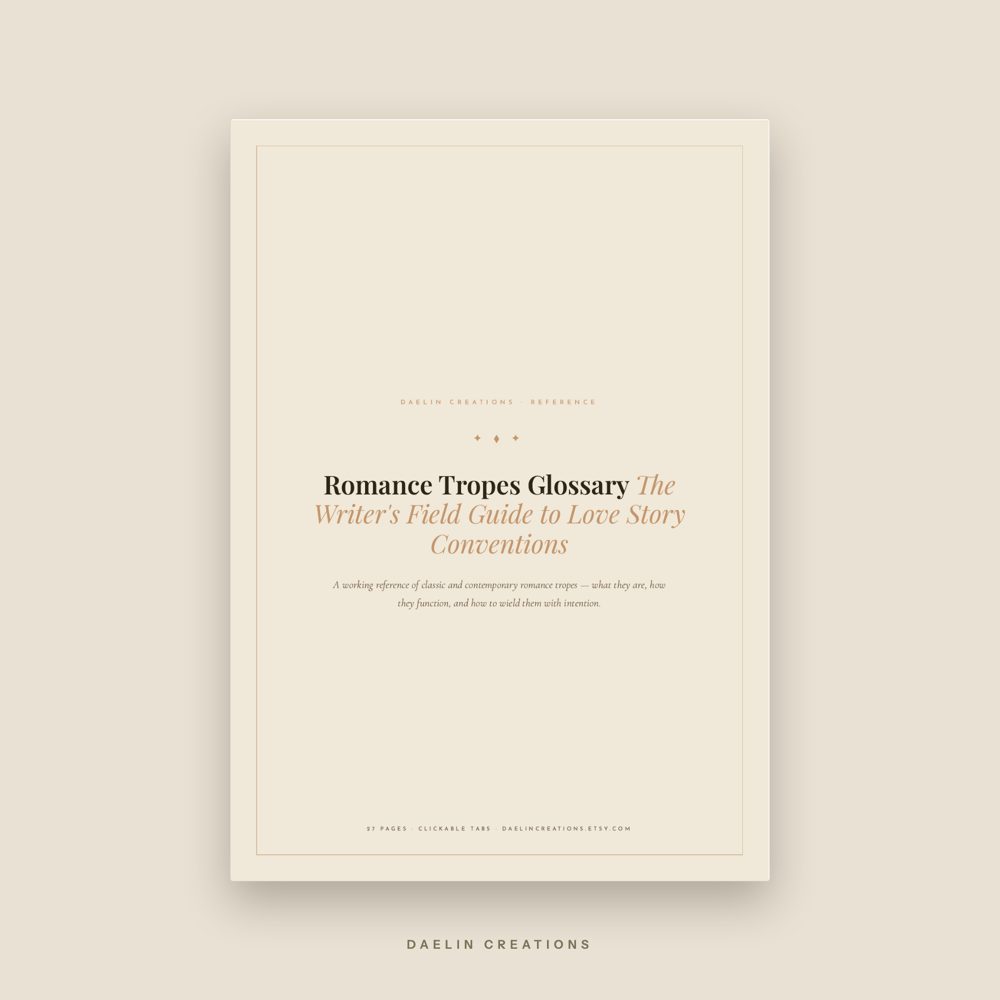
Romance Tropes Glossary — Writer's Field Guide to Love Story Conventions
Every romance trope carries a silent promise to your reader — this guide helps you keep it.
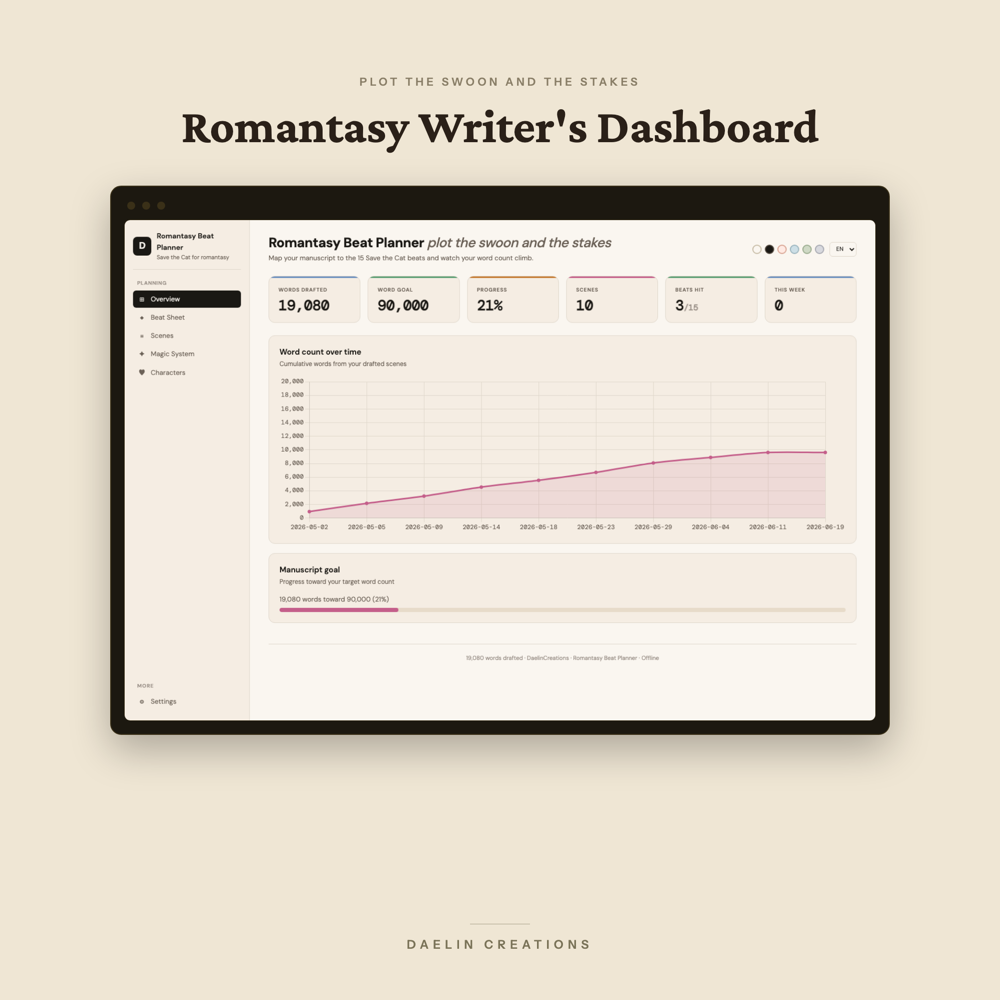
Romantasy Writer Dashboard
Plot your romantasy novel with confidence — no more blank-page panic or sagging middles.
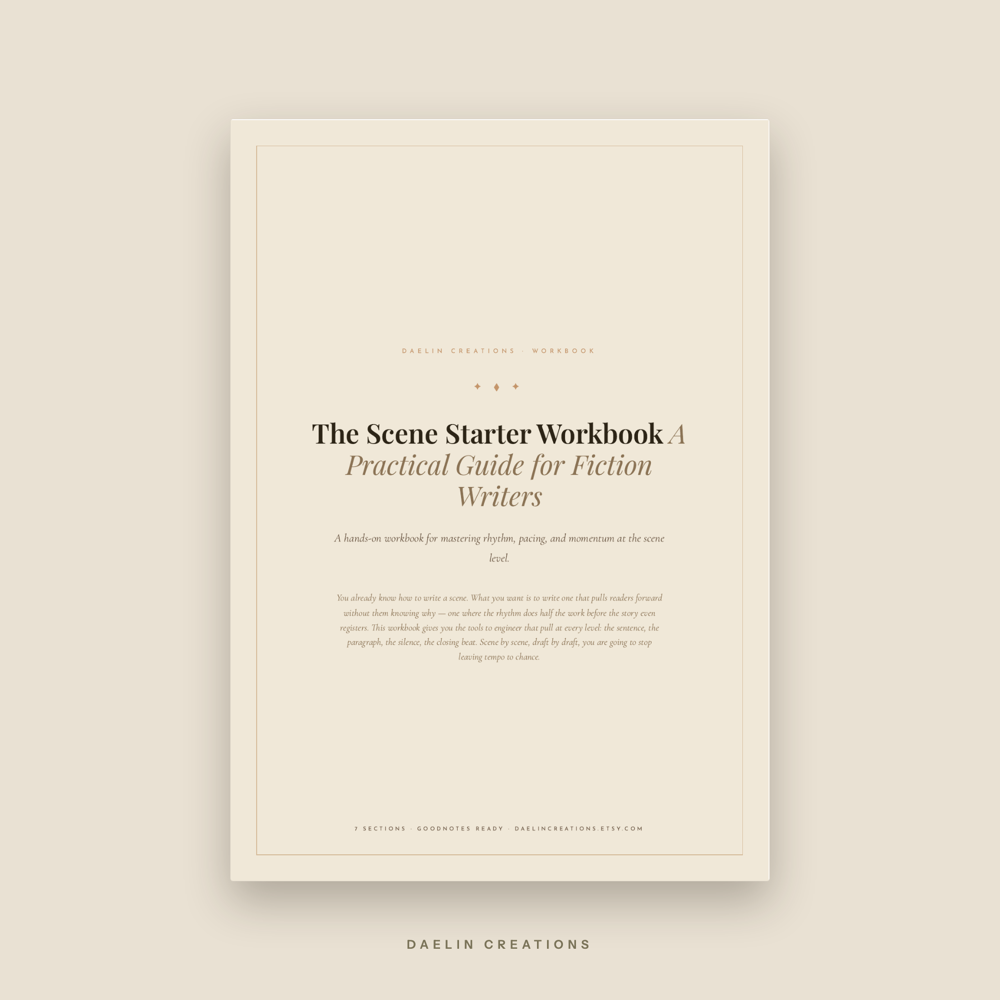
Scene Starter Workbook
Every scene you write has a rhythm — and this workbook teaches you to hear it, shape it, and use it with intention. The Scene Starter Workbook is a printable PDF guide for fiction writers who want to move beyond instinct and develop real craft-level control over how their scenes open, move, breathe, and land.
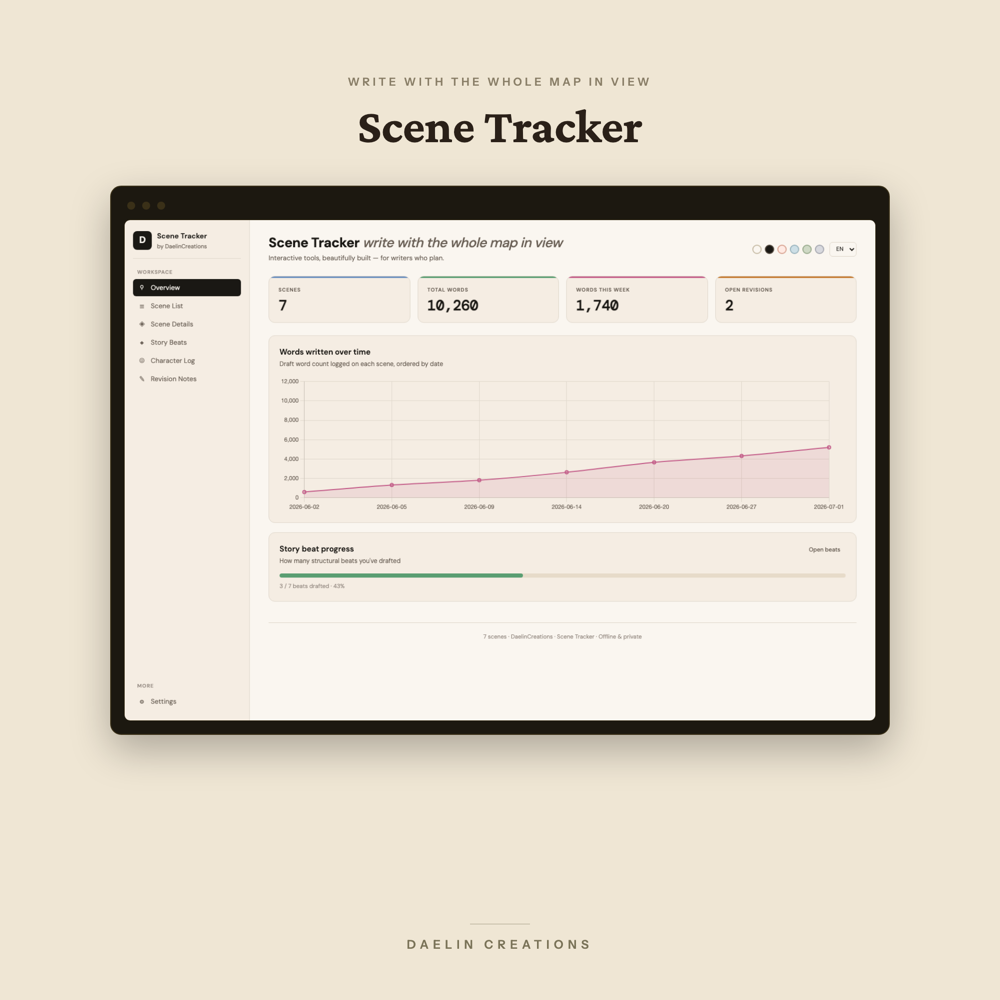
Scene Tracker Dashboard
Track every scene in your novel, screenplay, or short story — all in one private, offline dashboard that saves your progress automatically.
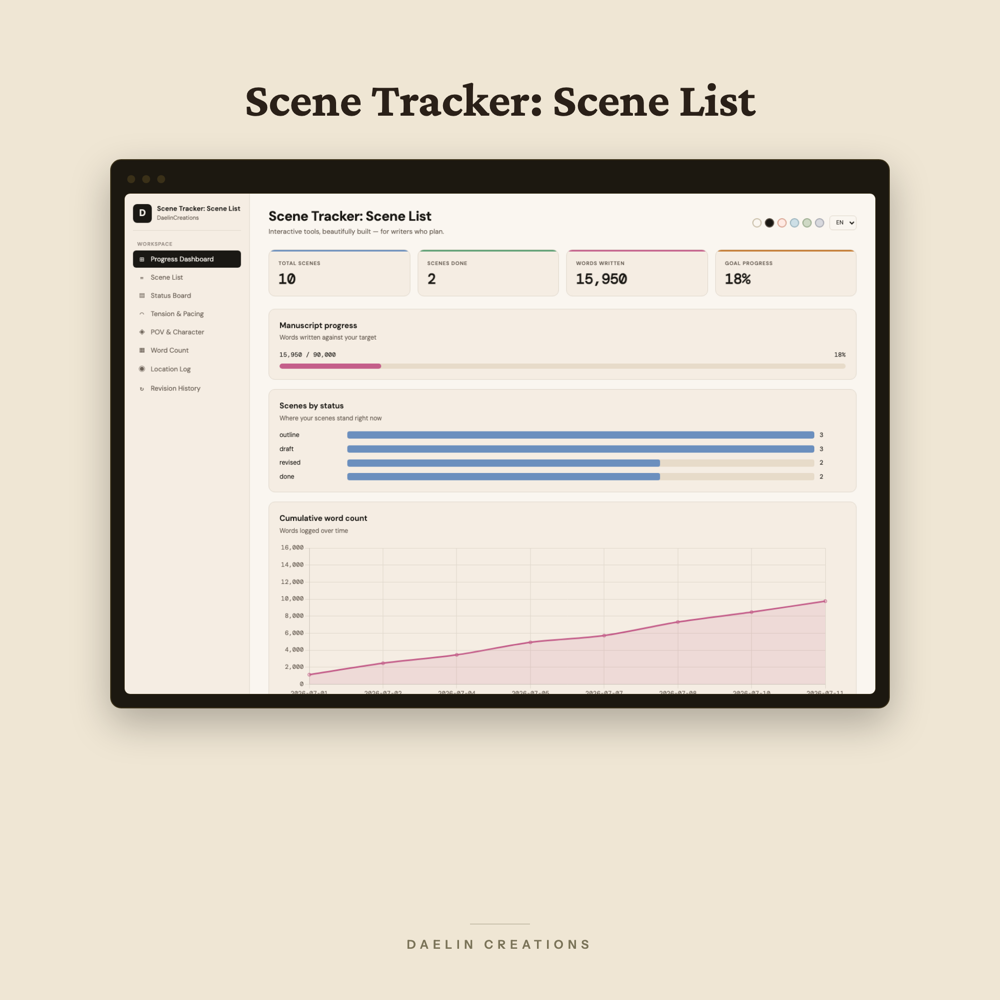
Scene Tracker: Scene List
See your entire manuscript in one view — every scene's status, tension curve, word count, and revision history, all in a single offline HTML file.
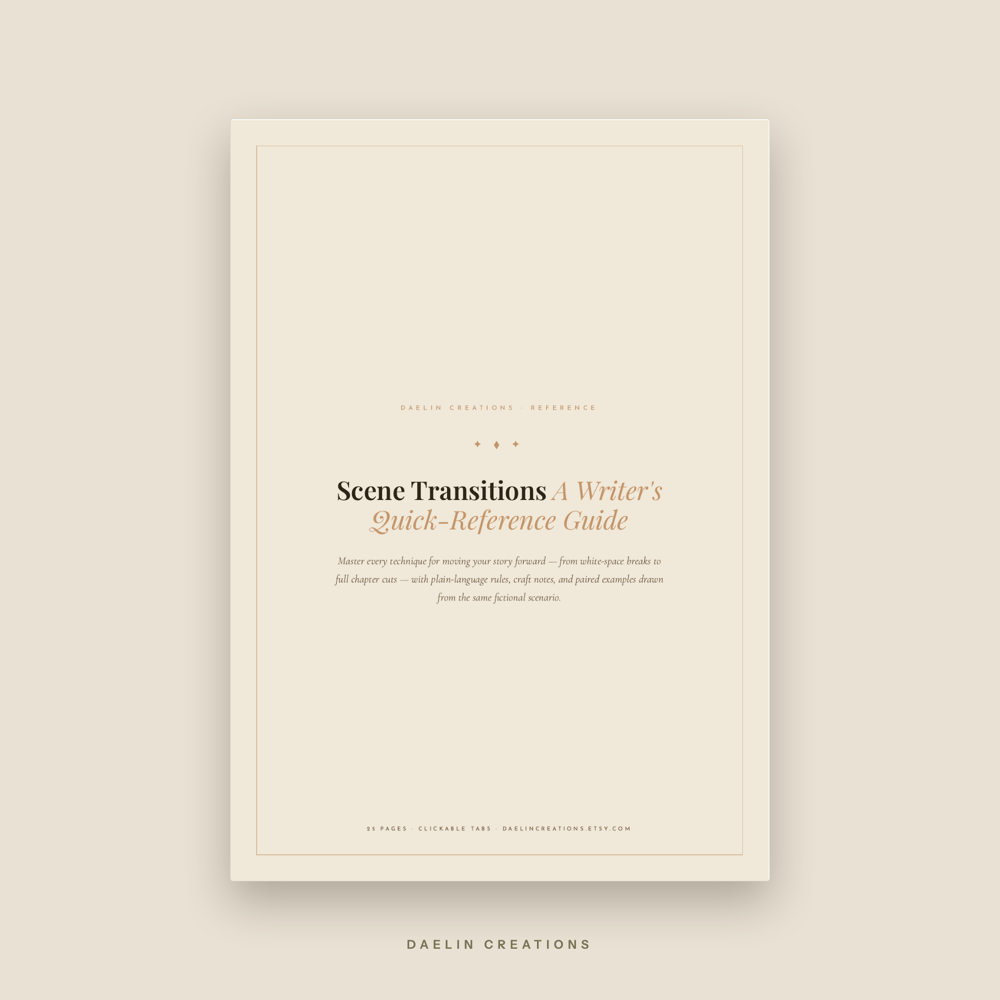
Scene Transitions Writer's Reference Guide
You're mid-draft and the scene won't end. Or it ends — but the next one crashes in too fast, too slow, and the whole rhythm collapses. This quick-reference guide was built for exactly that moment.
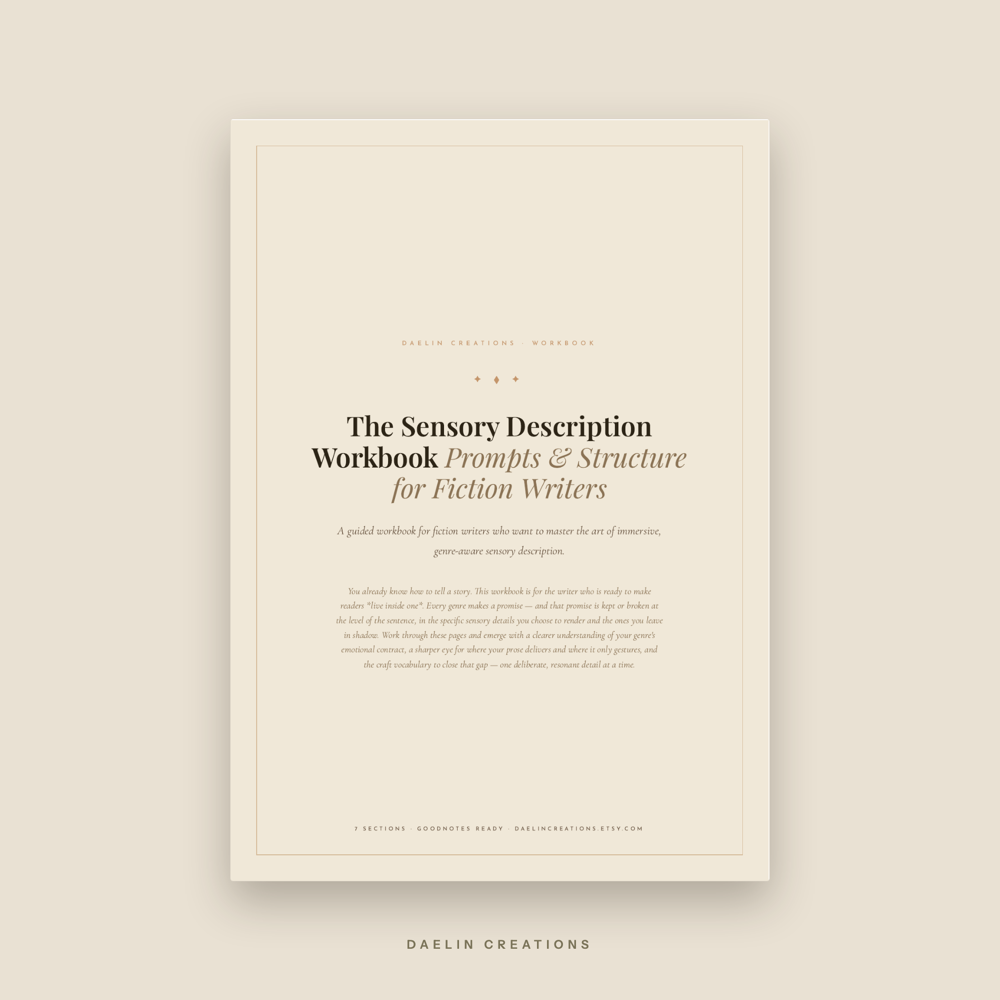
Sensory Description Workbook for Fiction Writers
This printable workbook is designed for fiction writers who are ready to move beyond surface-level description and into genre-aware, emotionally purposeful sensory craft. Across seven guided sections, you will name your genre contract, map your story's emotional architecture, and audit your manuscript chapter by chapter — all with the goal of ensuring your prose keeps every promise your genre makes to its readers.
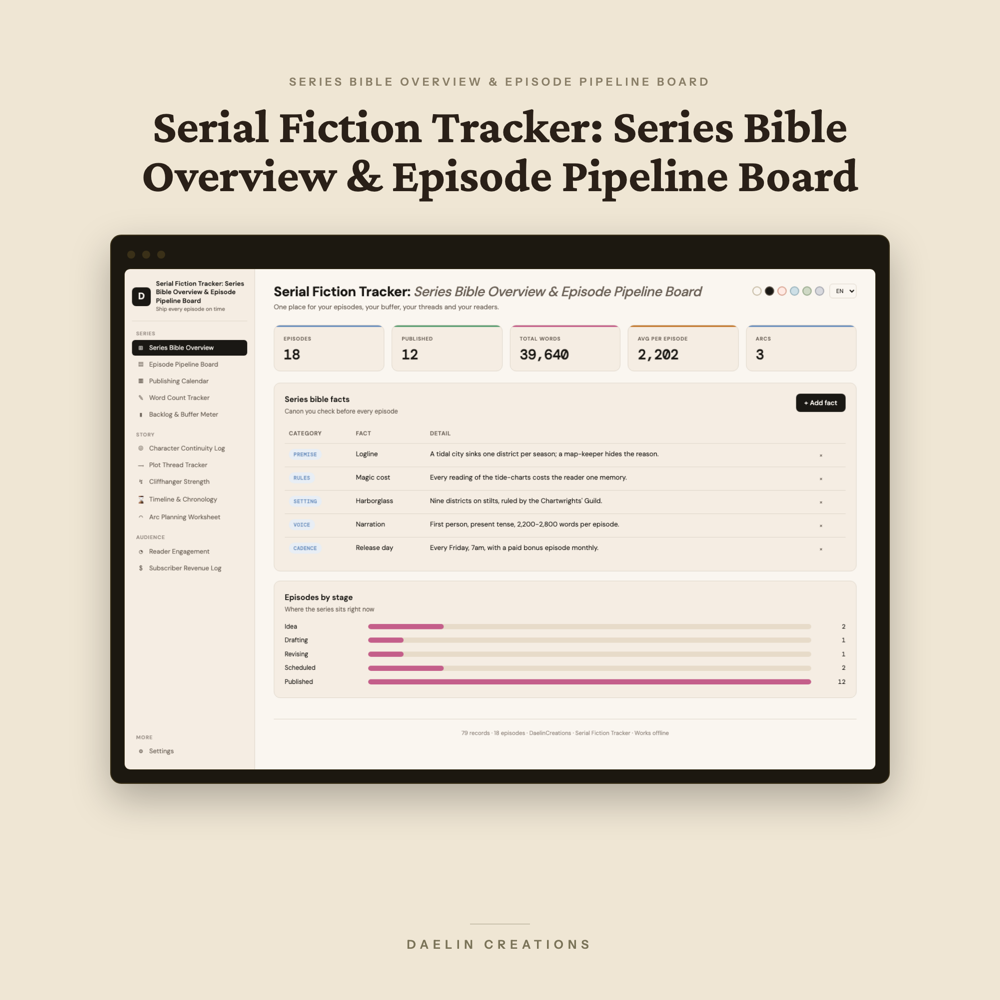
Serial Fiction Tracker: Series Bible Overview & Episode Pipeline Board
Stop losing the thread of a story you publish in pieces. Serial fiction runs on rhythm, and this interactive HTML dashboard is built for writers who ship episode after episode and need to know exactly where every arc, subplot, and buffer chapter stands before the next release date arrives.
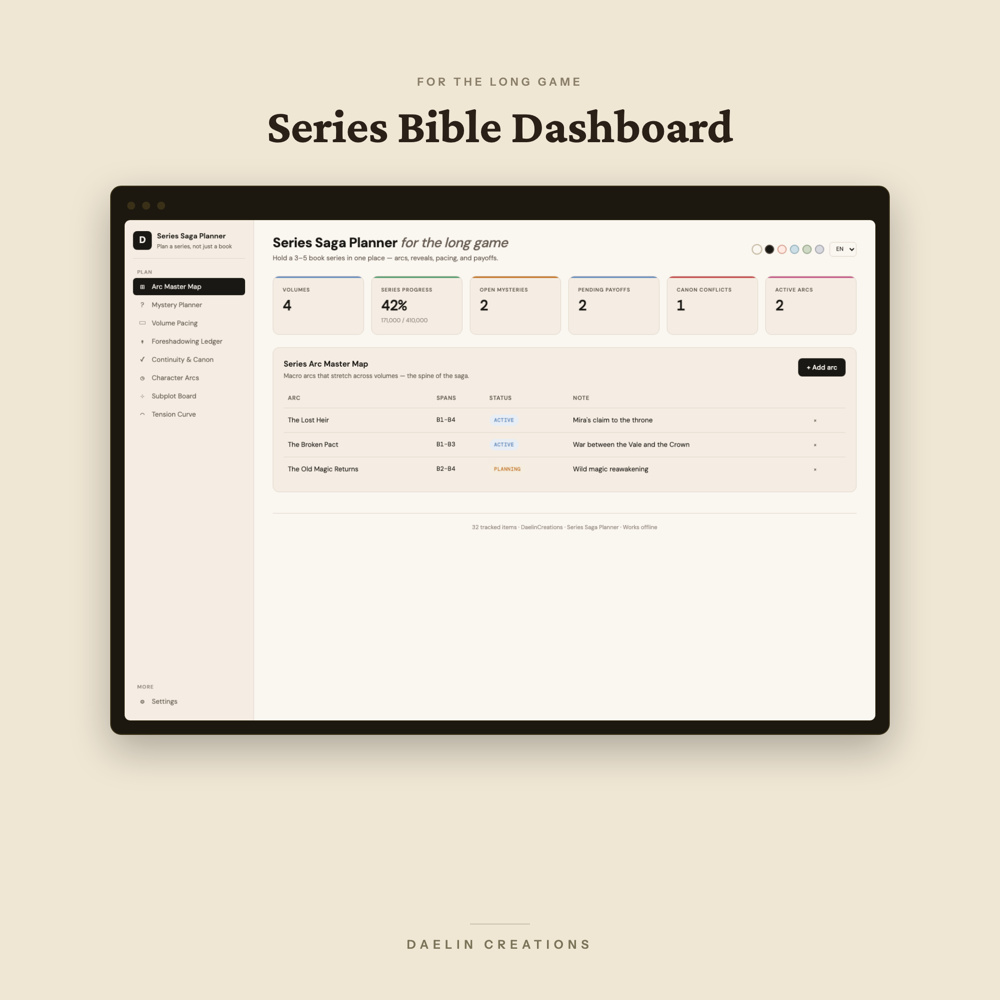
Series Bible Dashboard
Planning a 3-to-5-book saga is a completely different challenge from writing a standalone novel. This interactive HTML dashboard gives series authors a bird's-eye command center for every arc, mystery, and thread that spans your entire saga — all in one beautifully organized, offline file that opens in any browser.
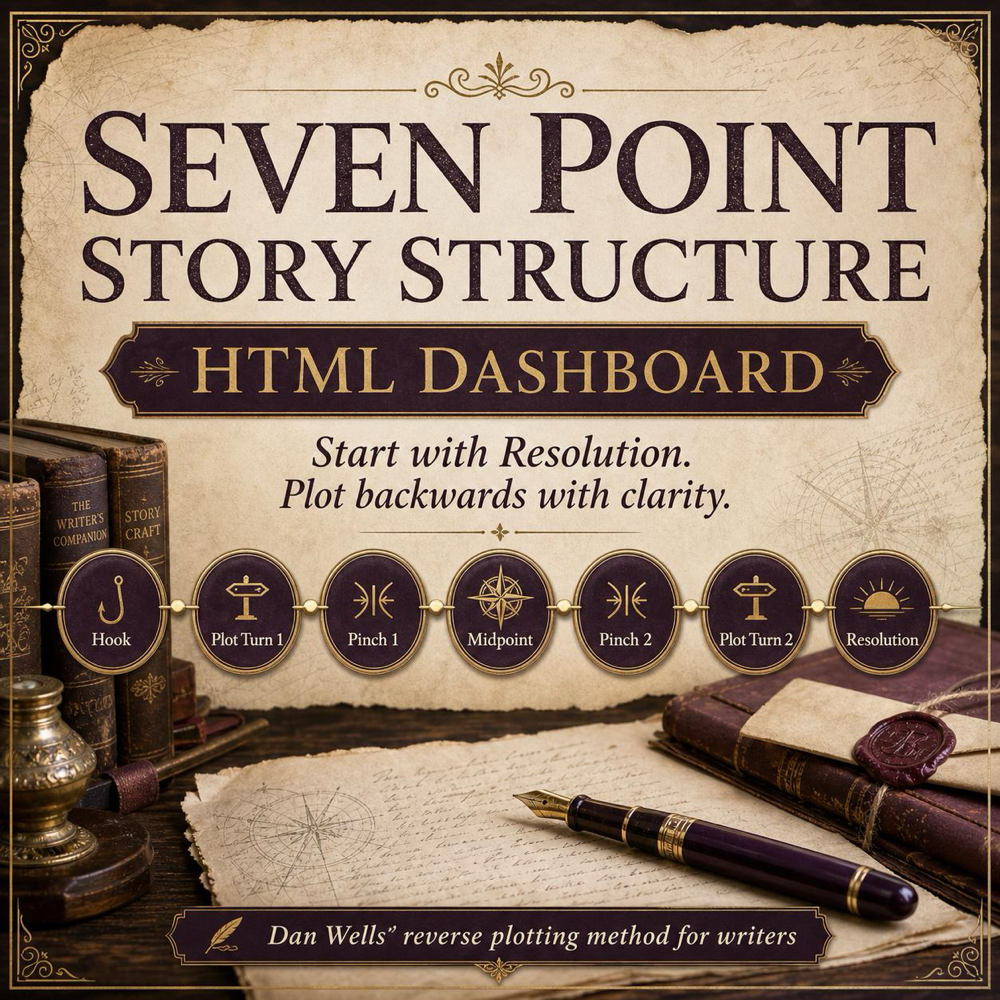
Seven Point Story Structure Planner – Reverse Plotting Tool (Digital Download)
Plan your novel with Dan Wells's Seven-Point Structure in one interactive, offline HTML dashboard — all 7 points with 28 guided questions, characters, worldbuilding, and a point calculator.
Shadows into the Night
Some stories begin in the dark — and never quite return to the light.
Show Don't Tell Fiction Writing Workbook — Craft Exercises for Writers
Stop telling your readers what to feel — start giving them evidence they can't ignore. This printable fiction writing workbook guides you through seven focused craft sections, from diagnosing weak telling at the sentence level to executing surgical revision passes across full scenes. Every exercise is grounded in your own work: you will bring your current draft and leave with specific, targeted revisions you can implement immediately.
Show Don't Tell Workbook for Fiction Writers
Break through the most common barrier in fiction writing — the gap between telling your reader what to feel and making them feel it. This beautifully designed printable workbook guides you through seven focused craft sections, each isolating a core show-don't-tell technique: embodied sensation, charged objects, subtext-laden dialogue, emotional setting, muscular verbs, and the advanced skill of strategic telling.
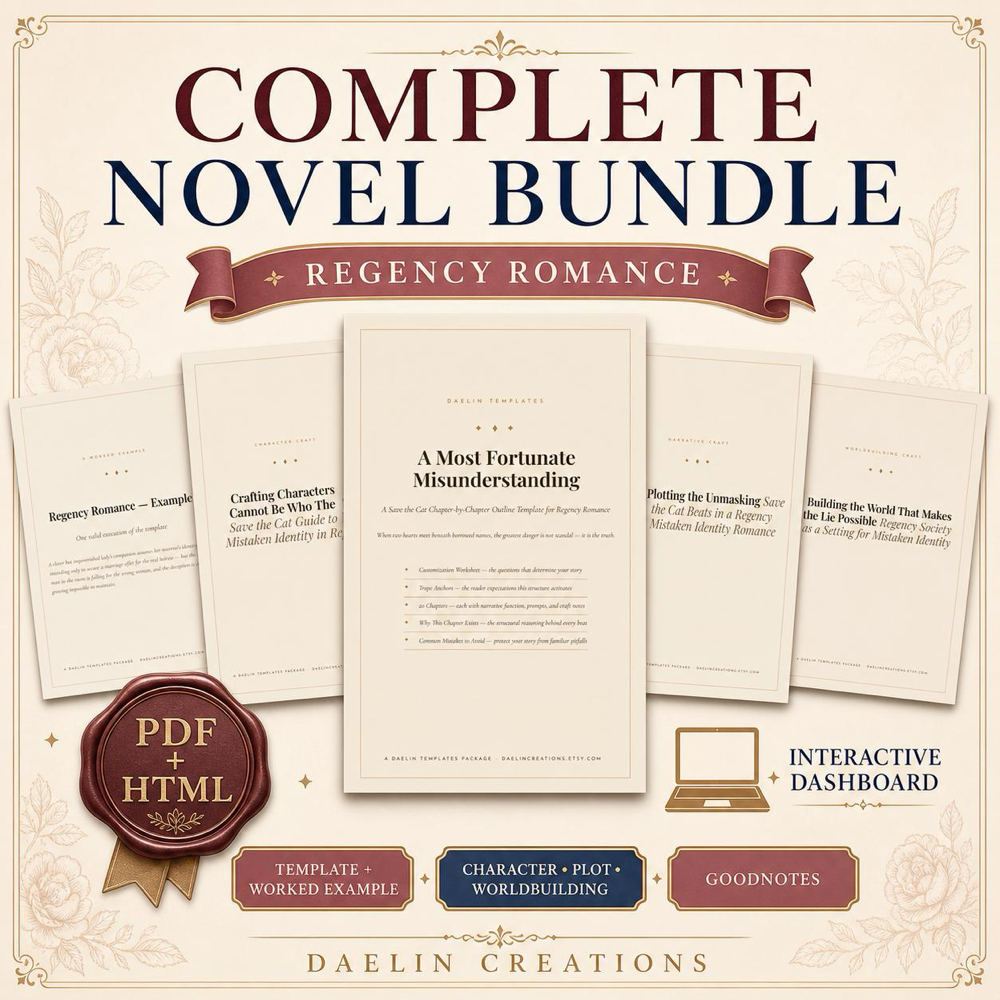
Small Town Romance Outline Kit
SMALL TOWN ROMANCE OUTLINE — SAVE THE CAT EDITION (PDF + DASHBOARD)
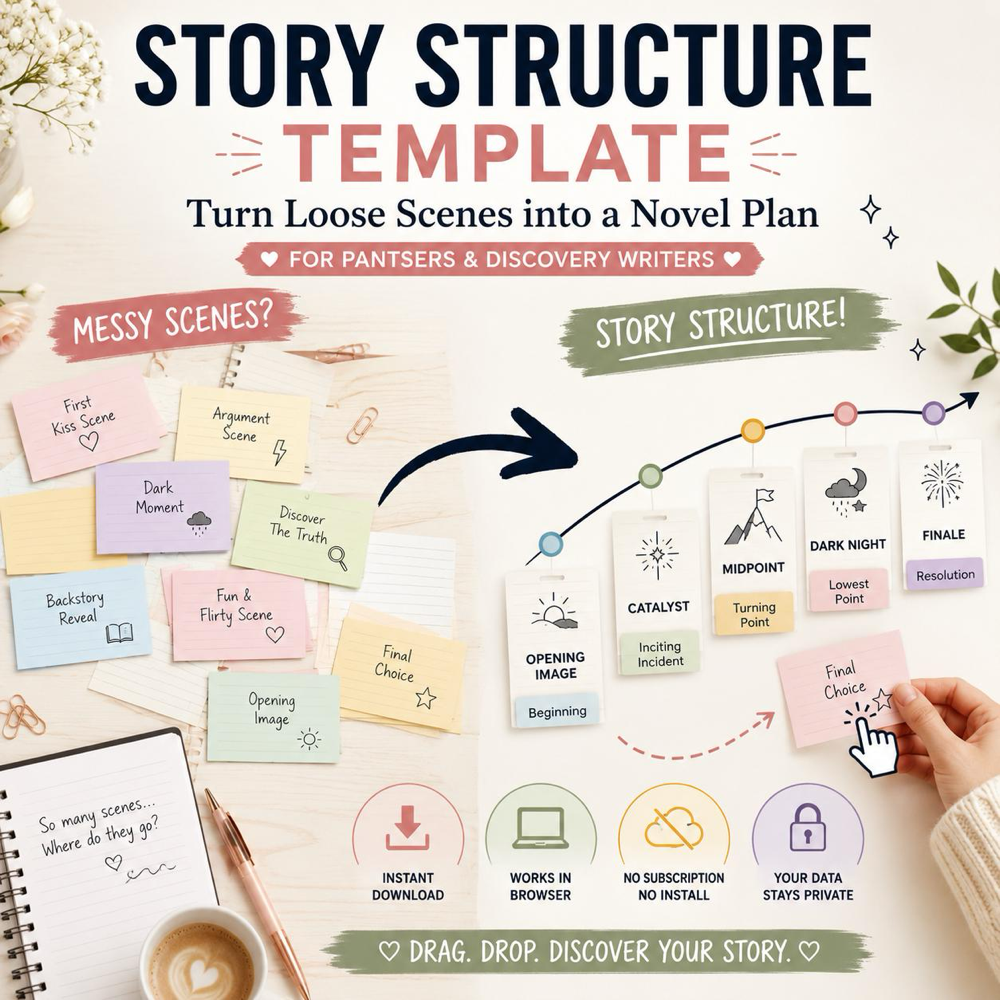
Story Structure Template
STORY STRUCTURE TEMPLATE FOR WRITERS WHO DON'T OUTLINE
Story Structure Term Guide for Beginners
Struggling to keep track of story structure terms? This beginner-friendly reference guide cuts through the jargon and gives you plain-English definitions for every major narrative concept — from inciting incident and midpoint to dark night of the soul and resolution.
Subtext & Emotional Depth Workbook for Fiction Writers
What does your story say without saying it? This printable fiction writing workbook — What Goes Unsaid: A Fiction Writer's Workbook on Subtext and Emotional Depth — is a deep-craft companion for novelists, short story writers, and serious fiction writers ready to move beyond telling and into feeling.
Suspension of Disbelief Workbook
Make your readers believe the unbelievable — sentence by sentence, page by page. This printable craft workbook guides fiction writers through the precise, learnable techniques that build and sustain suspension of disbelief: from the implicit contract of your opening paragraph to the internal logic of your world's rules, from the voice that anchors reader trust to the emotional interiority that makes even impossible events feel inevitable.
The Atmosphere Workbook
If you write dark romance or atmospheric literary fiction and you have ever finished a chapter wondering why it works on paper but not in the body — this workbook was built for you. The Atmosphere Workbook is a structured, printable PDF practice guide that takes you from reading like a craftsperson to revising like one, with exercises grounded in the specific techniques that make dread, slow-burn tension, and dangerous intimacy work on the page.
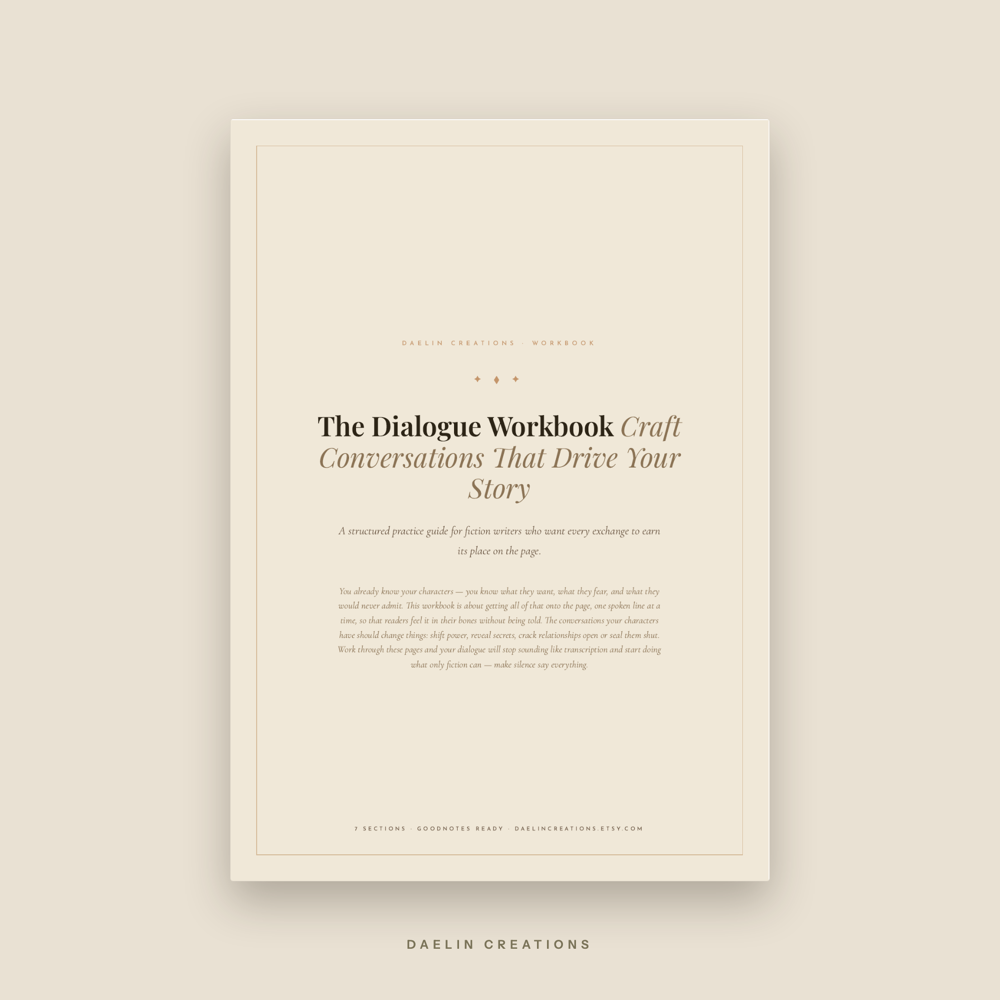
The Dialogue Workbook – Fiction Writing Craft Workbook PDF
Great dialogue does not just sound real — it works. Every line advances plot, reveals character, and shifts the emotional temperature of the room. This printable workbook gives fiction writers a structured, hands-on practice guide for crafting conversations that earn their place on the page.
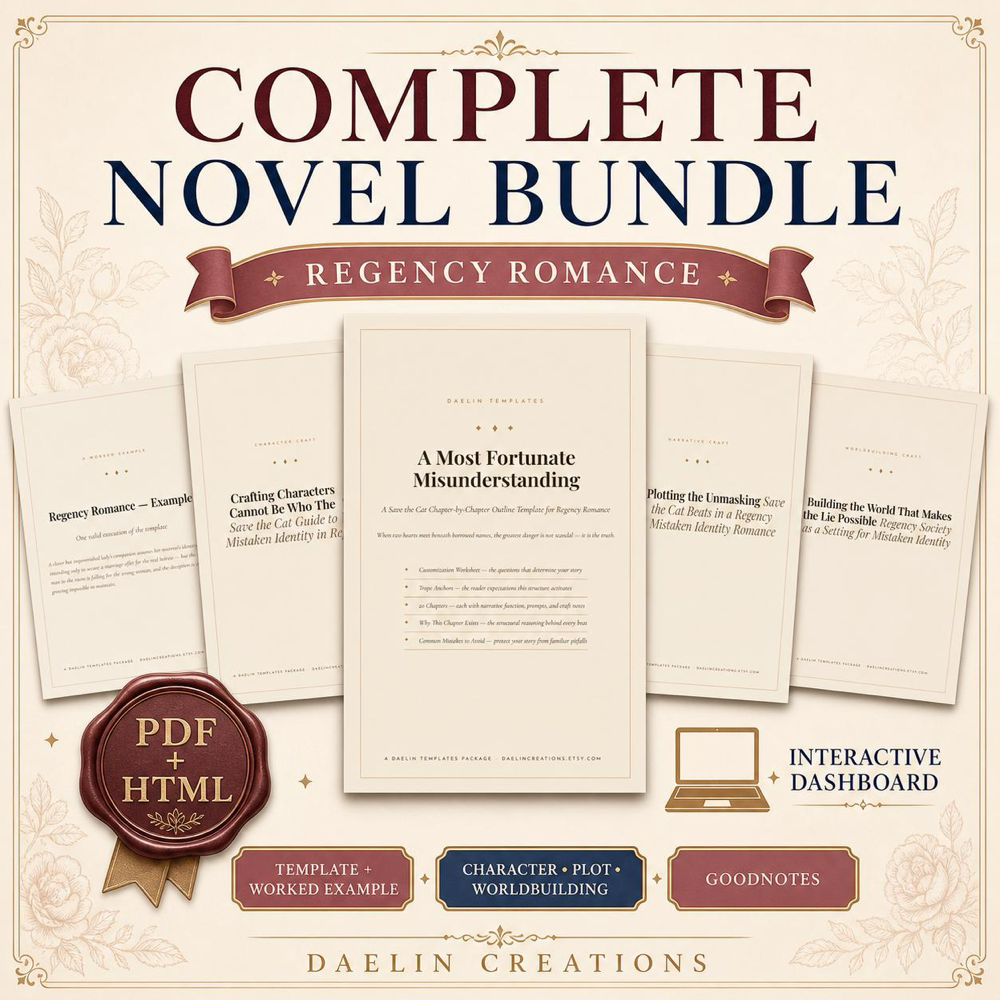
The Hollow
The Hollow
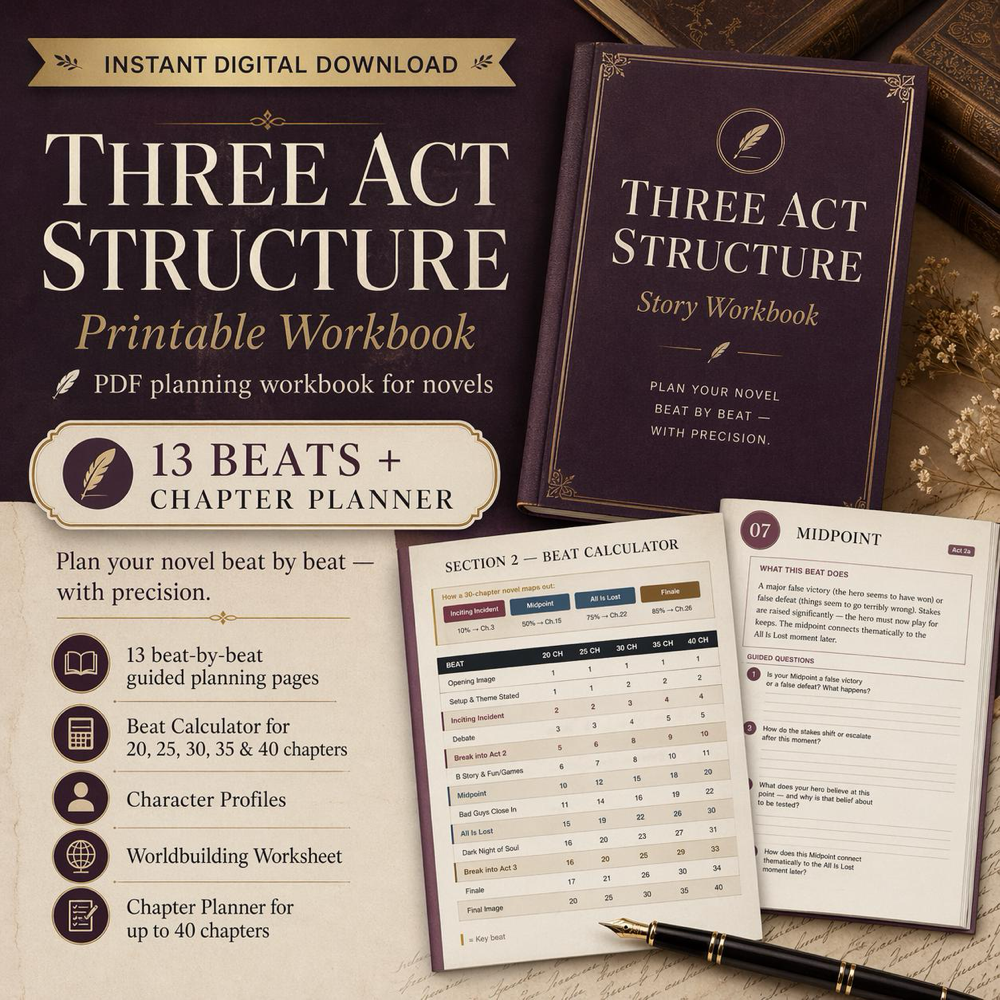
Three Act Structure Workbook – Novel Planning PDF (Digital Download)
Stop staring at a middle that isn't working. This printable Three Act Structure Workbook gives fiction writers a rigorous, hands-on system for engineering story architecture from the ground up — not as a formula to fill in, but as a precision diagnostic tool for stories already in progress.
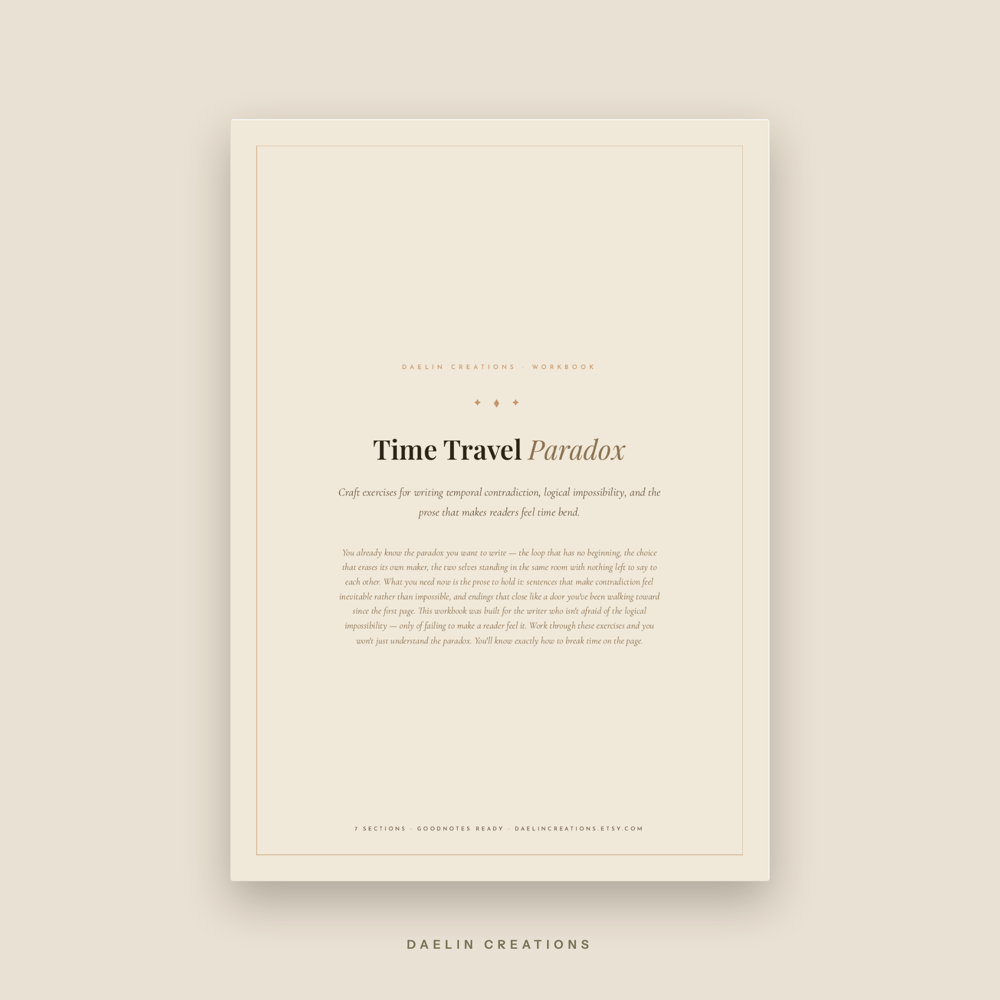
Time Travel Paradox Fiction Writing Workbook
If you're writing a time travel story and you've ever stared at a paradox and wondered how prose is supposed to hold something logically impossible — this workbook was made for you. The Time Travel Paradox Fiction Writing Workbook moves through seven craft-focused sections, from establishing the internal rules of your fictional world to writing the closed-loop ending that lands with the weight of inevitability. Every exercise is specific: you'll write a physics memo in your narrator's voice, render two versions of the same character as distinct people, and draft a single closing sentence of no more than twenty-five words that echoes the first image of your story. The workbook is designed to be worked through in order, with each section building on the last. Exercises include scene pairs, POV rewrites, dialogue constraints, and tense audits — practical tools grounded in literary craft. Formatted for A4 printing and fully compatible with GoodNotes and other digital annotation apps. Beautiful parchment-toned design with generous ruled lines. Instant digital download.
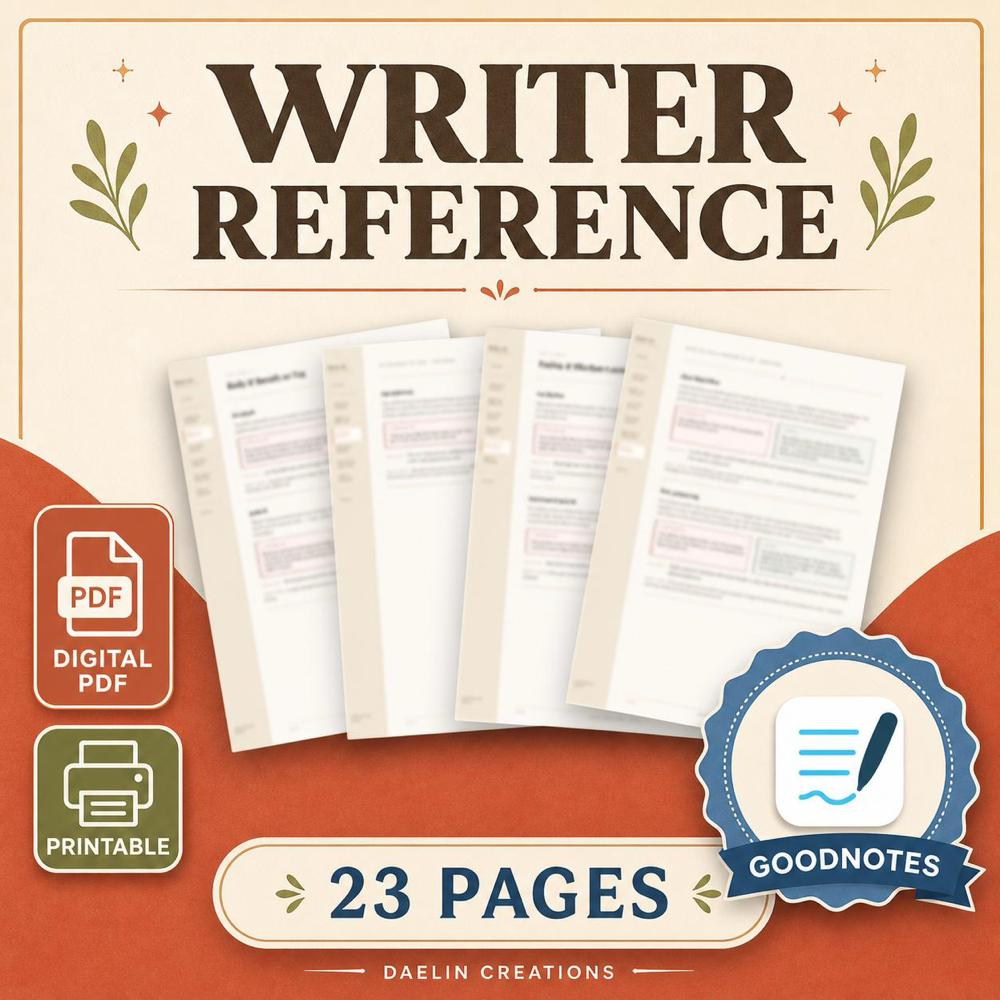
Transition Words for Writers, Pacing & Scene Transition Reference Guide, Fiction Writing Craft Tool, GoodNotes Author Resource
TRANSITION WORDS & PACING REFERENCE FOR FICTION WRITERS
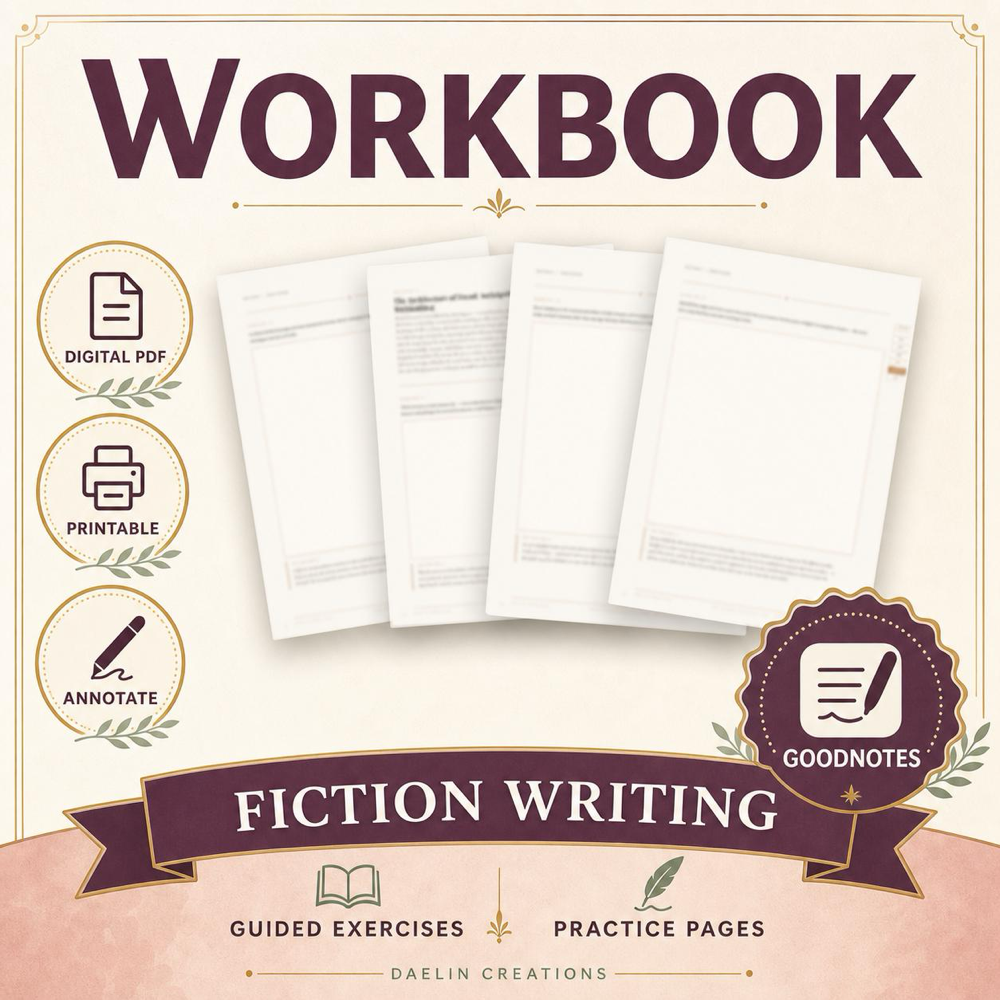
Trope Subversion Workbook
Every genre is a promise — and the most electrifying fiction is written by authors who understand that promise well enough to renegotiate it. Signal and Noise is a printable PDF workbook for fiction writers who are ready to move beyond accidental subversion and into intentional, reader-aware craft.
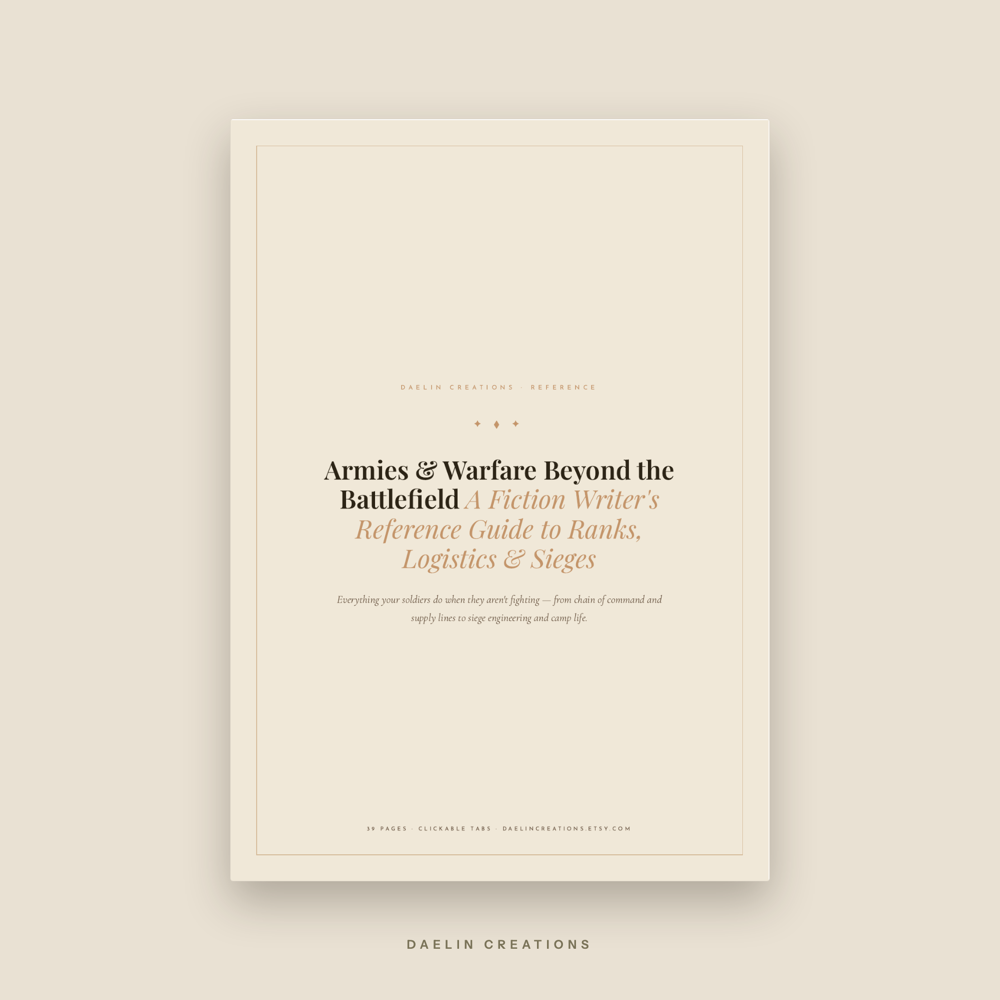
Armies & Warfare Beyond the Battlefield
Your army doesn't start on the battlefield — and neither should your research.
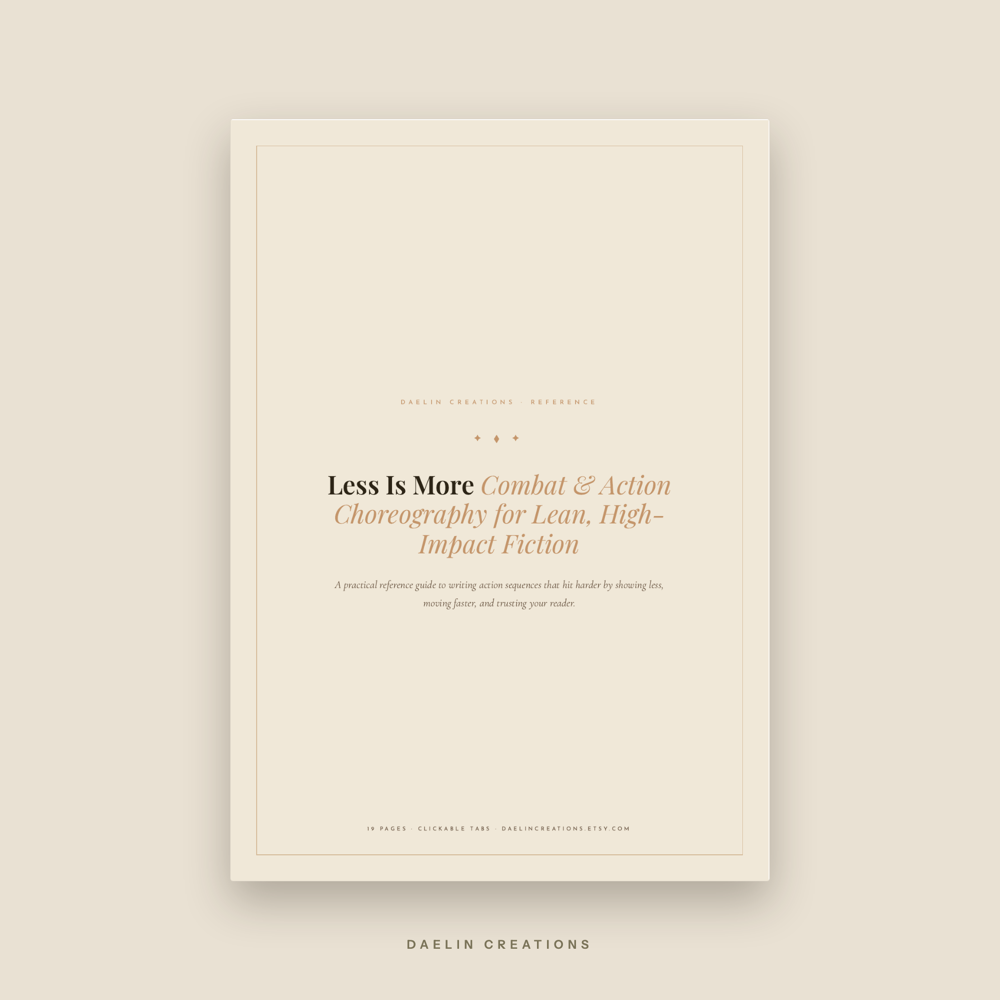
Combat & Action Choreography Writing Guide
Stop slowing your story down with over-choreographed fight scenes. **Less Is More: Combat & Action Choreography for Lean, High-Impact Fiction** is a practical craft reference for novelists, short story writers, and screenwriters who want their action sequences to hit harder — not run longer.
Comedy Writing Guide
Struggling to make your readers actually laugh — not just smile politely? This printable craft guide breaks down the mechanics of comedy writing in plain, actionable terms designed for fiction writers at every level.
Dialogue Red Flags Fix-It Reference Guide
Is your dialogue making readers cringe — or worse, skip ahead? This concise fix-it reference pinpoints the four dialogue mistakes that trip up beginners and experienced writers alike: the *as-you-know-Bob* info-dump, overworked or invisible dialogue tags, characters who all sound identical, and talking-heads scenes with no grounding in the physical world.
Dialogue Tags Quick Reference Guide
Struggling with when to use *said*, how to mix action beats, or why your dialogue feels flat? This printable quick-reference guide gives fiction writers instant, on-desk answers — no fluff, no long chapters to hunt through.
Dialogue Tags Quick-Reference Guide
Struggling with clunky dialogue tags, overused adverbs, or the eternal *he said / she whispered* debate? This printable quick-reference guide cuts through the noise and gives you clean, actionable rules you can apply the moment you return to your manuscript.
Figurative Language Library for Writers
This digital craft reference is for fiction writers who want to use figurative language with precision, not guesswork. Rather than offering a list of ready-made metaphors to copy, it teaches the underlying mechanics — how a single image shifts the emotional temperature of a scene and why.
Figurative Language Quick Reference
Every figure of speech you need — explained, illustrated, and ready to use.
Figurative Language Quick-Reference Guide for Fiction Writers
Tired of figurative language advice that drowns you in abstract examples you have to mentally translate into your own work? This quick-reference guide is different.
Historical Fiction Writing Guide
Your research is solid. Your dialogue still sounds like 2026. This reference guide fixes the gap between the two, one word at a time.
Literary Devices for Fiction Writers
Stop guessing why a sentence works — start knowing.
Literary Devices Reference Guide for Fiction Writers
Level up your prose with *Rhetorical Mastery* — a beautifully designed craft reference guide for serious fiction writers who want to wield literary and rhetorical devices with confidence and intention.
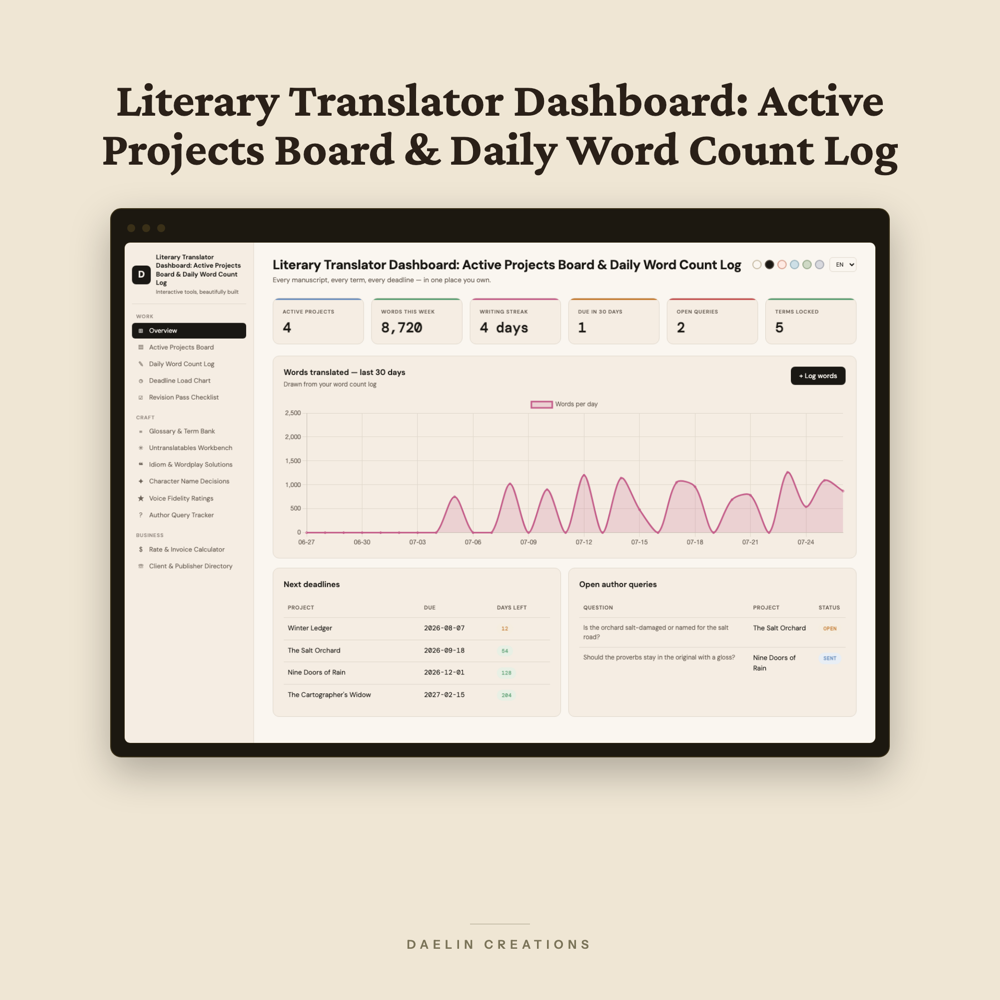
Literary Translator Dashboard: Active Projects Board & Daily Word Count Log with Glossary Term Bank, Untranslatables Workbench & Rate Invoice Calculator
For translators who carry a whole novel in two languages at once
Metaphor & Simile Craft Reference
Every metaphor you write is a quiet promise to your reader — *this image will earn its place*. But when comparisons land flat, sound borrowed, or collapse under scrutiny, they pull readers out of the story instead of deeper into it.
Period & Historical Detail
Writing historical fiction means making a thousand small decisions — what details to keep, what to cut, how much to explain without lecturing. This craft reference guide gives you a clear, practical framework for every one of those decisions.
Petal & Cipher
What this is
Point of View Mastery
Struggling with head-hopping, distant narration, or inconsistent POV voice? This printable reference guide walks fiction writers through the most common point-of-view mistakes — and shows exactly how to fix them.
Point of View Quick Reference Guide for Fiction Writers
Struggling to choose the right point of view — or keep it consistent once you do? This printable quick-reference guide cuts through the confusion with clear, immediately actionable rules, side-by-side wrong/right examples, and craft notes that cover the exceptions worth knowing.
Point of View Quick-Reference Guide for Fiction Writers
Struggling to keep your narrative voice consistent — or wondering why your scene feels distant even when the action is intense? This quick-reference guide cuts straight to the craft.
Poison & Herb Fiction Writer's Reference Guide
Stop guessing and start writing with confidence. **Poison & Herb: The Fiction Writer's Field Guide to Toxic Effects, Symptoms & Folkloric Cures** is a practical craft reference built for novelists, screenwriters, and storytellers who need accurate, vivid poisoning details without wading through medical textbooks.
Prose Rhythm & Sentence Variety
Does your prose feel flat, choppy, or relentlessly the same? This beautifully designed craft reference guide teaches fiction writers how to shape sentences that breathe — guiding readers forward without them ever noticing why they can't stop.
Prose Rhythm & Sentence Variety Quick Reference Guide
Tired of prose that reads flat on the page? This printable quick-reference guide gives advanced fiction writers an immediate, practical toolkit for sculpting sentence rhythm, varying structure, and controlling pace with intention.
Prose Rhythm & Sentence Variety Quick-Reference Guide
Does your prose feel flat, choppy, or monotonous — even when your story is strong? This beginner-friendly quick-reference guide breaks down prose rhythm and sentence variety into clear, immediately usable rules.
Religious Terminology Guide for Fiction Writers
Give your fictional priests, heretics, mystics, and believers the precise words that make readers believe in your world.
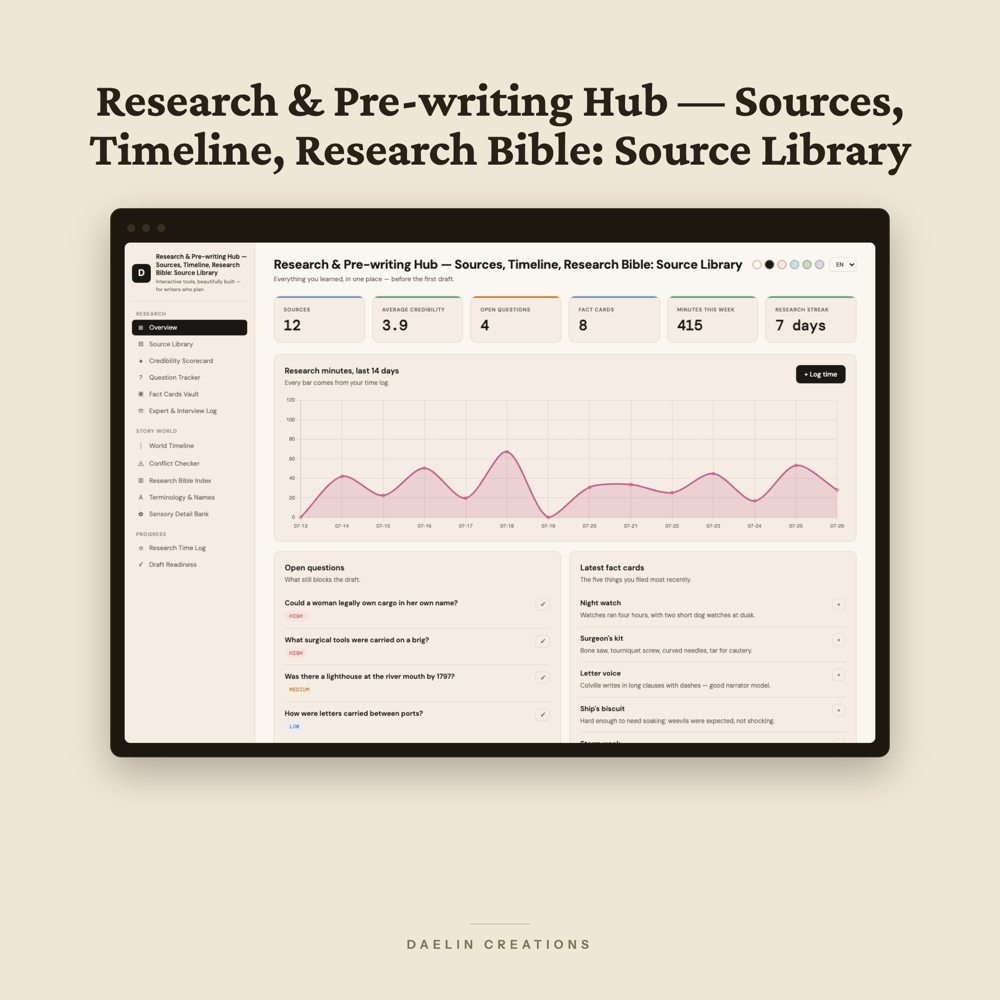
Research & Pre-writing Hub
Stop losing the good detail. You read the article, you found the perfect date, you wrote down the name of the tool the blacksmith used, and now it lives in four notebooks and a browser tab you already closed. This hub gives your research one home, scores how much you can trust each source, and tells you plainly when you have read enough to start drafting.
Scene Starter First Lines for Writers
You open a new scene. You know what needs to happen. You have no idea how to begin.
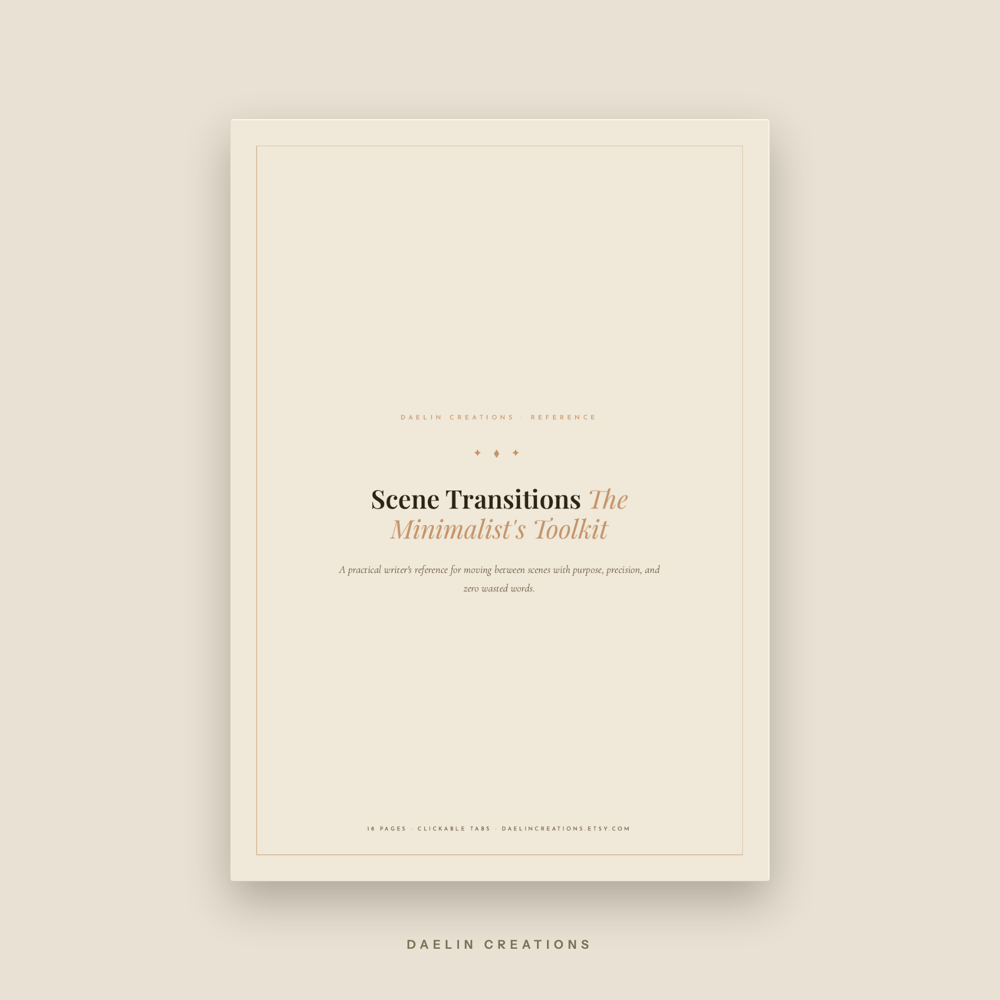
Scene Transitions Writer's Reference Guide — Printable Craft Toolkit for
Struggling with clunky scene breaks, awkward time jumps, or transitions that over-explain? This minimalist reference guide gives fiction writers a clear, immediately usable toolkit for moving between scenes with confidence and control.
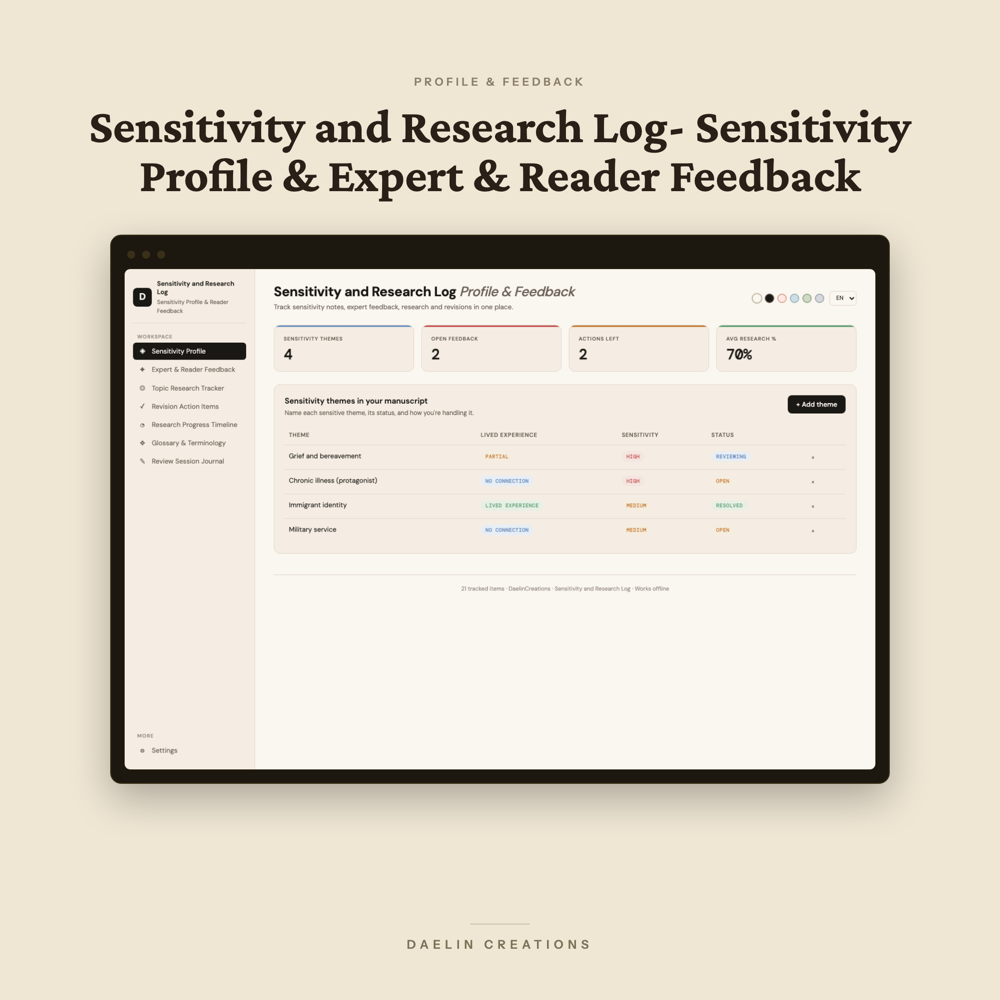
Sensitivity and Research Log: Sensitivity Profile & Expert & Reader Feedback
Track every layer of your sensitivity and research process — from first consultation to final revision — in one organized, private HTML dashboard built for fiction writers who take representation seriously.
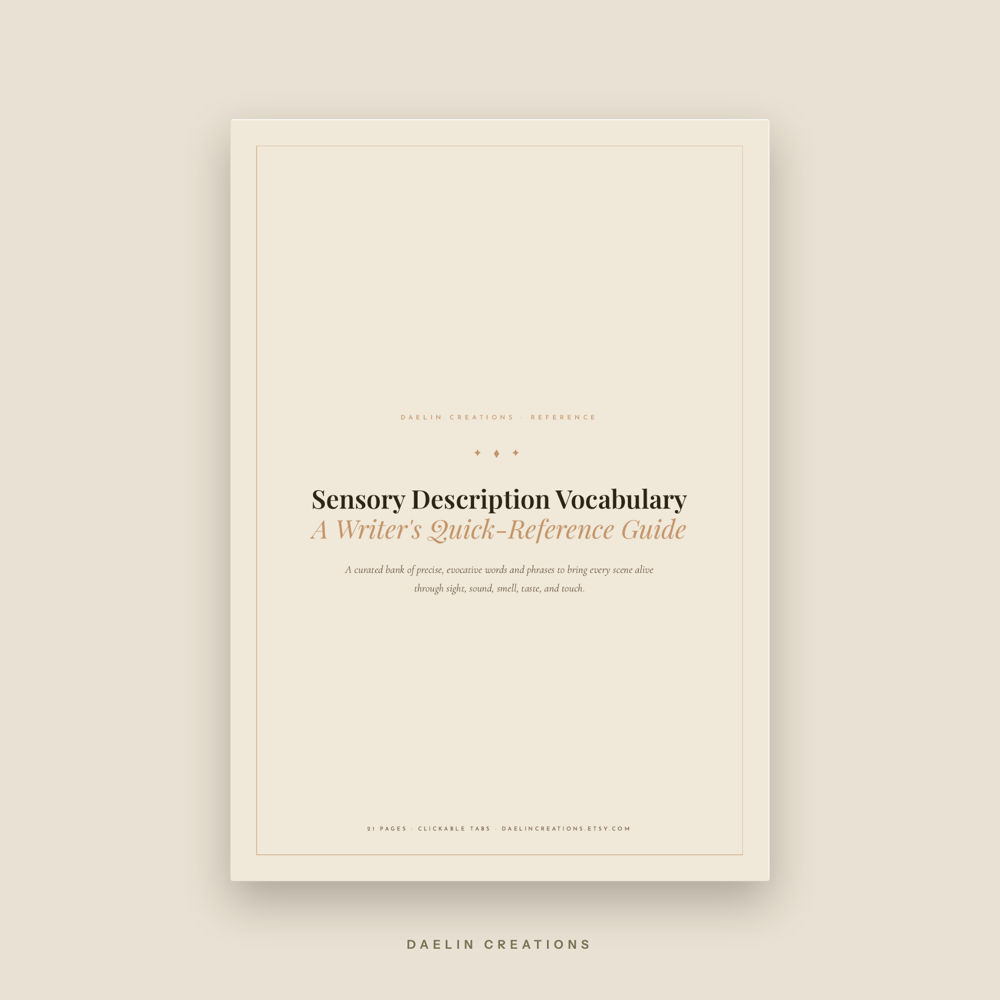
Sensory Description Vocabulary Guide
Tired of reaching for the same tired adjectives every time you write a scene? This quick-reference guide gives fiction writers an instant bank of precise, evocative vocabulary organised by all five senses — sight, sound, smell, taste, and touch — with entries sorted by mood and intensity so you can find exactly the right word at exactly the right moment.
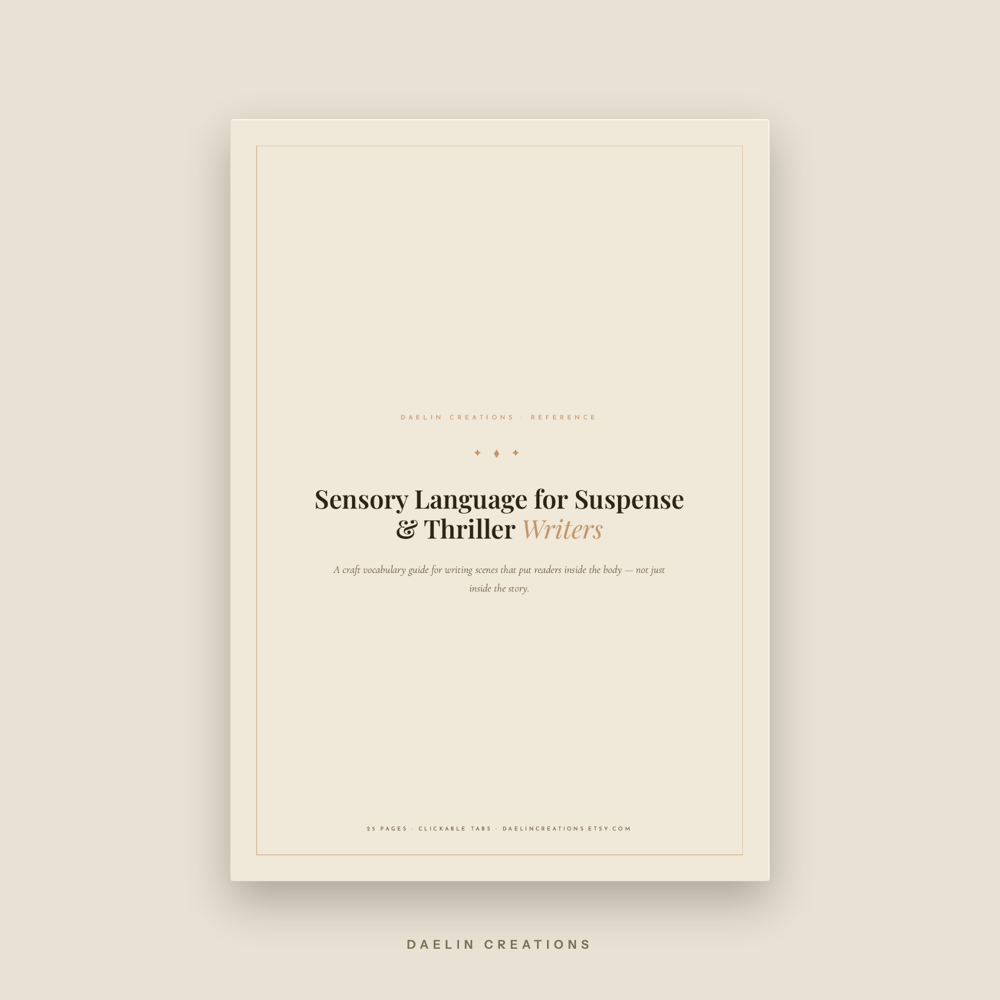
Sensory Language for Suspense & Thriller Writers
Does your suspense scene feel flat on the page — technically correct but emotionally absent? This printable craft vocabulary guide is built for thriller and suspense writers who want their readers *inside* the body of every scene, not just watching from a distance.
Sensory Writing Vocabulary Guide
Stop reaching for the same tired adjectives. **Sensory Precision** is a writer's field guide to the exact vocabulary that makes fiction visceral — the words that land in the body, not just the mind.
Sentence Variety Quick Reference
Does your prose feel flat, choppy, or breathless — but you can't quite pinpoint why? **Sentence Variety: The Advanced Writer's Quick Reference** is a practical, beautifully designed craft guide that teaches you to control the rhythm of your writing at the sentence level.
Subtext & Implication
Stop telling your readers what to feel — and start trusting them to feel it.
Travel & Distance Writer's Reference Guide
Does your hero cross a mountain range before lunch? Does your cavalry arrive suspiciously on cue? This printable reference guide helps fiction writers get travel and distance right — from a messenger's daily mileage to the weight of a soldier's pack after three days on the road.
Dark Romance Writing Workbook
If you write dark romance and you know something is missing — that the dread you feel when you plan a scene isn't quite surviving onto the page — this workbook was built for you. The Long Game is a structured craft companion that teaches you to build atmosphere deliberately: to use sensory language as an instrument of dread, to charge two-person scenes with subtext and proximity, to pace the slow burn as a rhythmic structure rather than a flat line of sustained tension.

Flip the Script — Fiction Writer's Workbook for Subverting Tropes
Ready to stop being held hostage by your own genre? Flip the Script is a 7-section printable workbook for fiction writers who want to subvert familiar tropes through deliberate, structural craft — not surface-level cleverness.
Flip the Script: Slow Burn Romance Writing Workbook
Master the art of the long wait with this beautifully designed printable workbook for slow burn romance writers. Flip the Script guides you through every layer of the genre contract — from naming what your readers truly come for, to mapping the emotional temperature of your romance arc, to auditing your manuscript chapter by chapter against its own promises.
Genre Conventions Workbook for Fiction Writers
Does your story keep the promises your genre makes? This beautifully designed printable workbook walks fiction writers through the essential conventions of every major genre — romance, thriller, mystery, fantasy, science fiction, and horror — so you never accidentally break an unspoken promise to the reader who trusted you with their time.
Genre Voice Reference Guide for Writers
Does your prose feel off-genre — even when your plot is exactly right? This reference guide helps fiction writers match their vocabulary, sentence rhythm, and narrative register to the genre they're writing, with clear, side-by-side examples showing the difference in practice.
Regency Ball Reference Guide for Romance Writers
Stop mid-scene searches for good. This compact writer's reference covers everything you need to write a Regency ballroom with period-accurate confidence — from the opening cotillion to the supper set and the loaded politics of a second waltz.
Romance Tropes Glossary — Writer's Quick Reference Guide
Every romance writer needs a go-to reference for the tropes that shape the genre — and this glossary delivers exactly that.
Romance Writing Guide · Intimacy Across Genres · Heat Levels, Scene Rules & Reader Expectations for Fiction Writers
Does your scene belong on the page — or behind a closed door? Every romance subgenre carries its own unwritten contract with readers, and breaking it can cost you reviews, readership, and hard-earned trust.
Slow Burn Romance Writing Workbook — Fiction Writer Guided Workbook PDF for
This guided workbook is built for fiction writers who are serious about mastering the craft of slow burn romance. Whether you are drafting your first novel or revising your fifth, these structured exercises walk you through every layer of the genre contract — from naming your promise to your reader, to mapping the emotional temperature of your central relationship, to auditing your manuscript chapter by chapter against the conventions of the form.
Unsaid — Sensory Description Workbook for Dark Romance Fiction Writers
If you have ever finished a dark romance that unsettled you — that made your pulse quicken and your body register something real — and wondered how the author did it, this workbook was made for you. Unsaid is a structured craft companion for fiction writers who want to build genuine atmosphere, dread, and slow-burn tension in their manuscripts, not through formula but through deliberate, specific practice.
Victorian Floriography Reference Guide for Fiction Writers
Give your Victorian fiction the botanical authenticity it deserves.
AI & Robotics Vocabulary Guide for Writers
WRITE MACHINES THAT FEEL REAL
Alchemy Reference Guide for Fantasy Writers
Stop reaching for a browser tab mid-scene. This printable PDF reference guide gives fantasy writers an instant desk companion for all things alchemical — classical symbols, reagent vocabulary, transmutation terminology, elemental correspondences, and the Latin phrases your alchemist would actually use.
Alternate Universe Writing Guide, AU Worldbuilding Reference for Fiction Writers, Divergence Point Planner, Printable PDF for Novelists
What this guide is
Architecture & Geography Quick-Reference Guide for Fiction Writers
Does your fictional city feel like a stage set — flat, unconvincing, somehow *off*? This quick-reference guide is the fix every fiction writer needs on their desk.
Architecture & Setting Reference Guide for Fiction Writers
Stop letting your settings sit flat on the page. This quick-reference guide gives fiction writers instant, actionable rules for writing architecture and setting with confidence — whether you're building a fantasy city from scratch or grounding a contemporary novel in a real neighborhood.
Atmosphere Architecture Workbook for Fiction Writers
Most writing advice tells you to 'add atmosphere' the way you'd add seasoning to a finished dish. This workbook takes a completely different approach — it treats atmosphere as a structural layer of your scene: auditable, revisable, and entirely within your control.
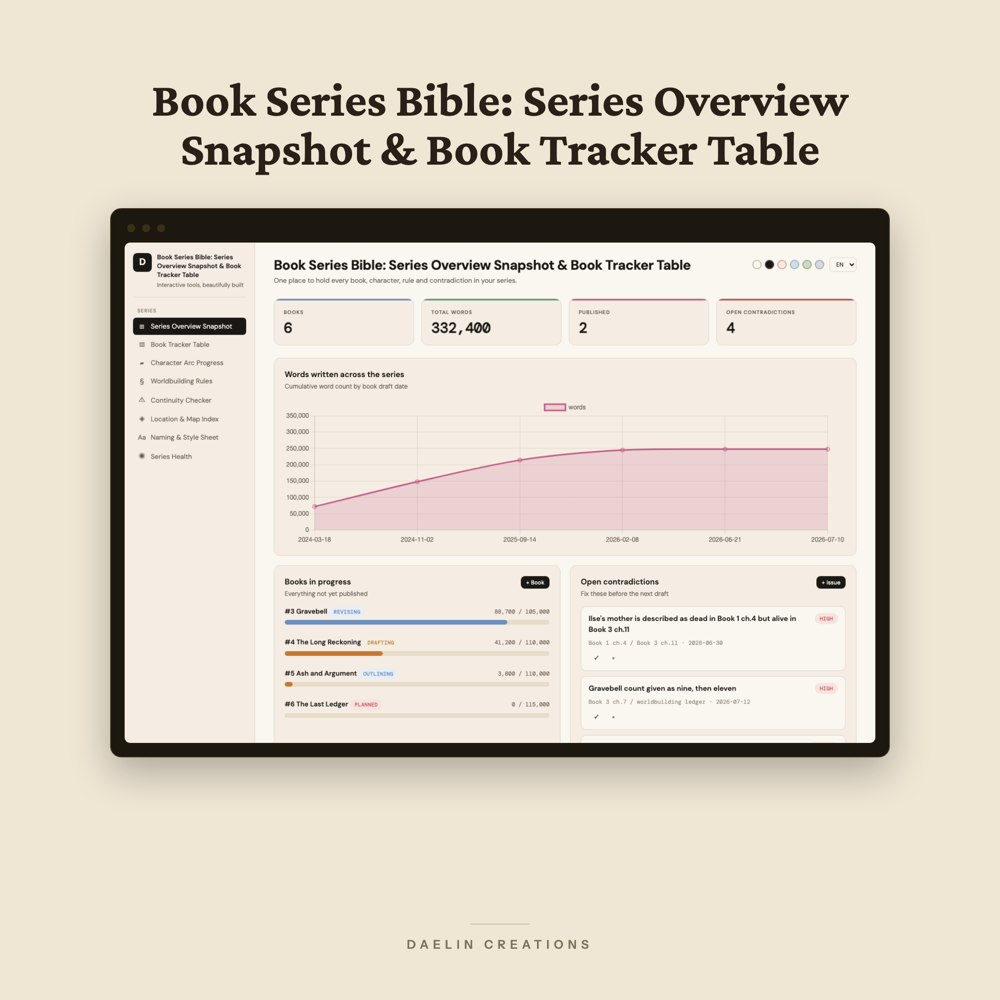
Book Series Bible: Series Overview Snapshot & Book Tracker Table
Stop rereading book one to remember whether the northern city was spelled Kaervan or Kaervahn. This interactive HTML dashboard keeps every rule, name, arc and unresolved thread of your multi book series in one place, so drafting book three feels as clear as drafting book one.
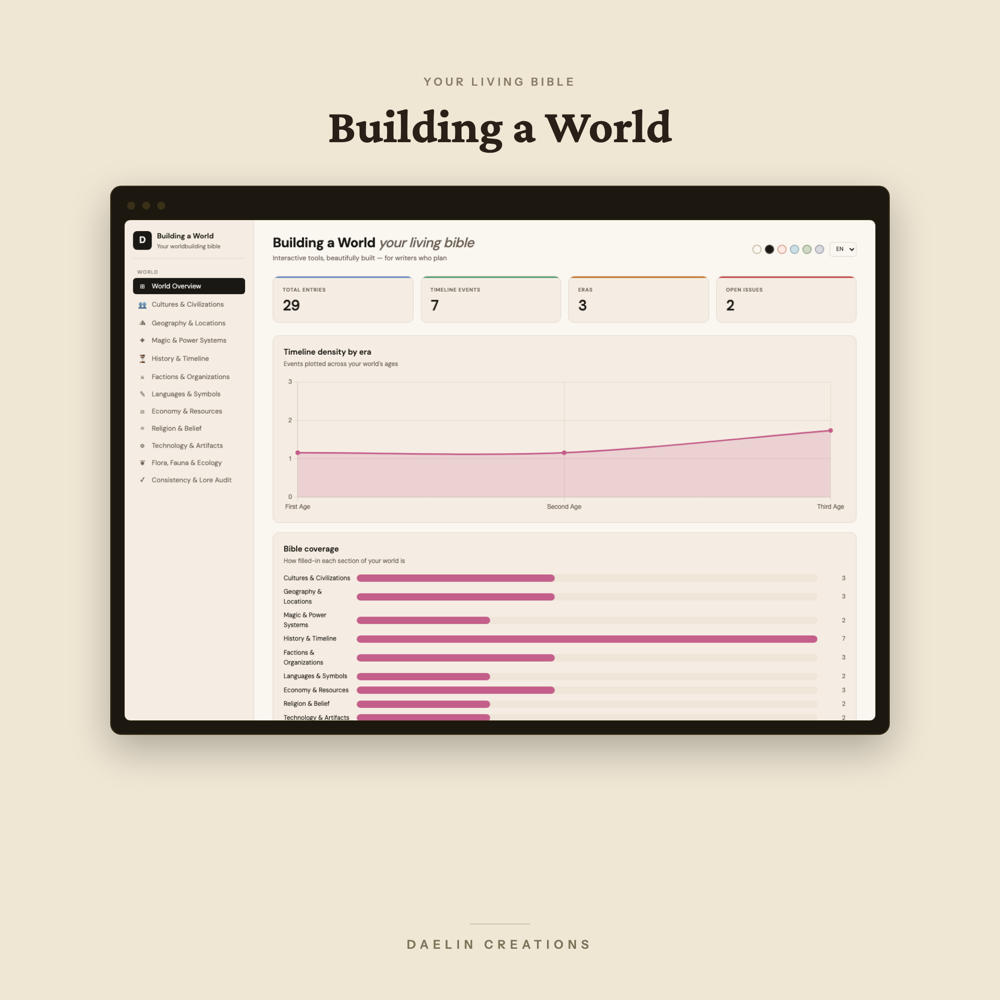
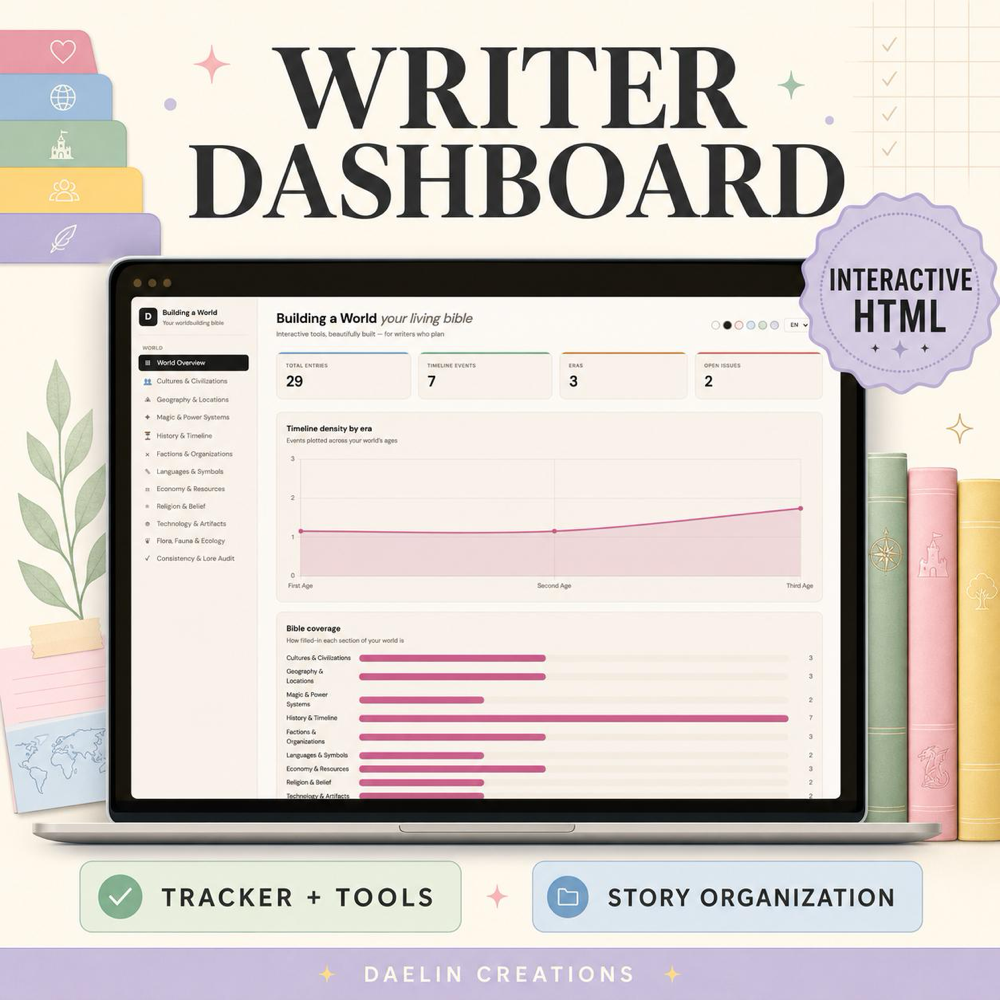
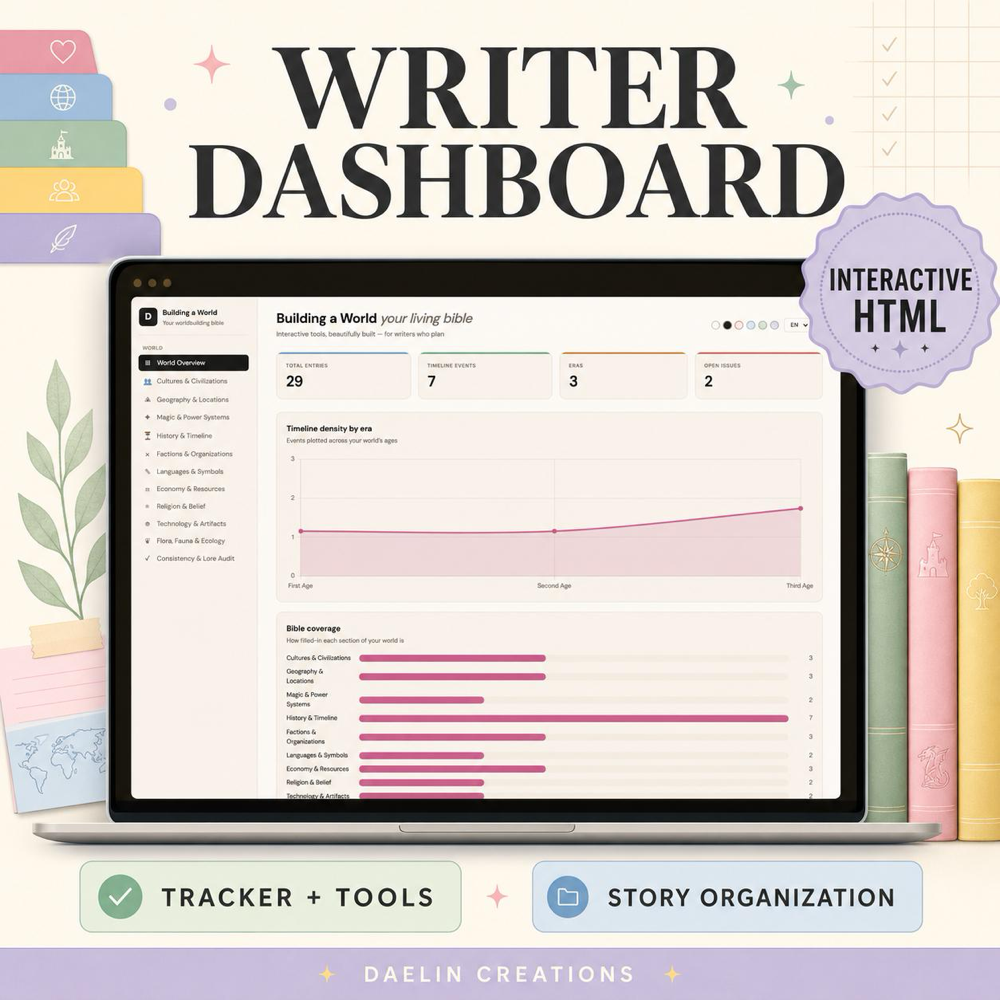
Building a World
Stop losing track of your world's rules, cultures, and contradictions — **Building a World** is an interactive HTML dashboard that holds every layer of your fictional world in one place, with a built-in lore audit so your worldbuilding stays consistent from chapter one to the final draft.
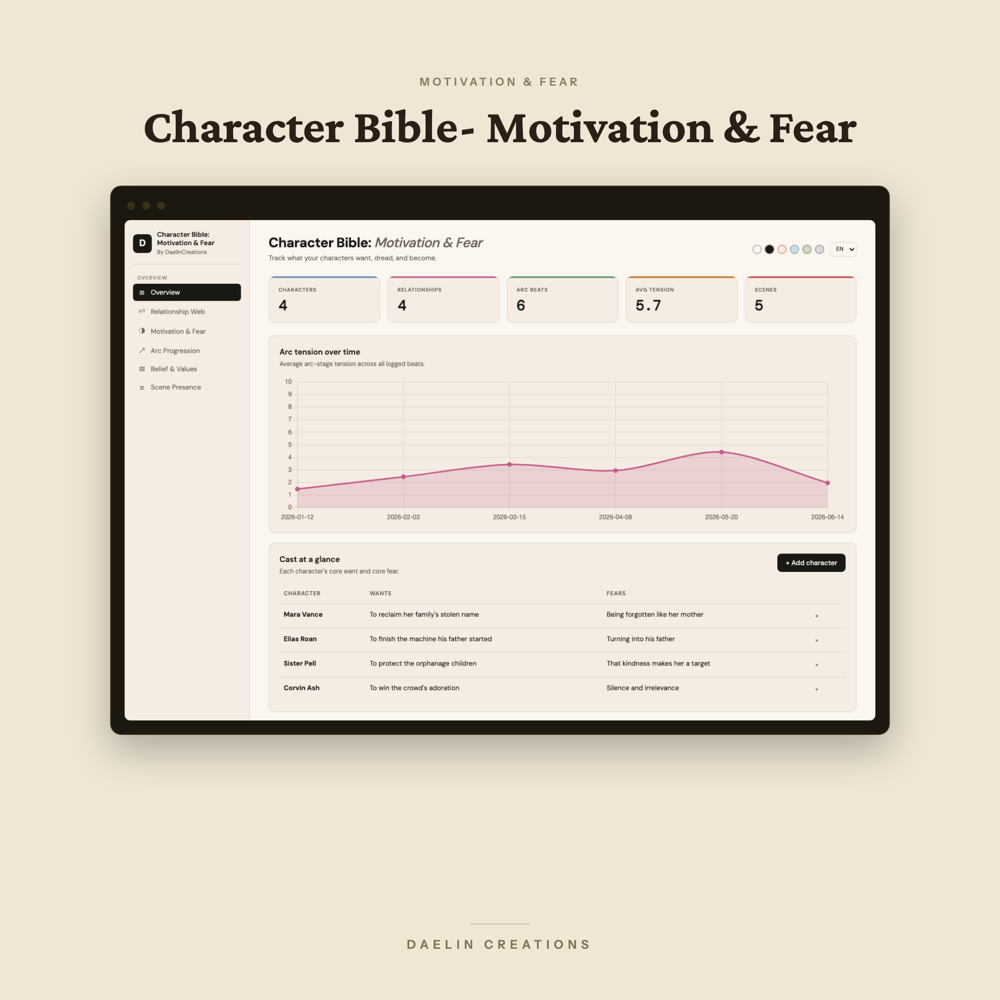
Character Bible Dashboard
Build deeper, more consistent characters — all in one interactive dashboard you open in any browser, no subscriptions, no account needed.
Character Map
An interactive character map and relationship chart for novelists — a living node graph of your cast and the bonds between them. Part character bible, part novel planner, built for writers who keep the romance, the betrayal and the secret debt all tangled together in one head and need a place to lay it down.
Color & Light Writer's Vocabulary Guide
Struggling to describe light without reaching for the same five words? This printable reference guide gives fiction writers a precise, atmospheric vocabulary for color and light — organized for real drafting sessions, not just theory.
Court Titles & Forms of Address for Romance Writers
Does your duke keep getting the wrong salutation? Does your heroine address an earl with a title that makes Regency readers wince? *Titles of the Heart* is the reference guide historical and fantasy romance writers reach for mid-scene — organized by rank, built for speed, and designed to feel as elegant as the world you're writing.
Dreams Visions & Prophecies Craft Guide
Struggling to write dream sequences that don't feel clichéd? Prophecies that surprise your readers instead of telegraphing the plot? This beginner-friendly craft guide walks you through every technique you need to make altered-state scenes feel earned, strange, and inevitable.
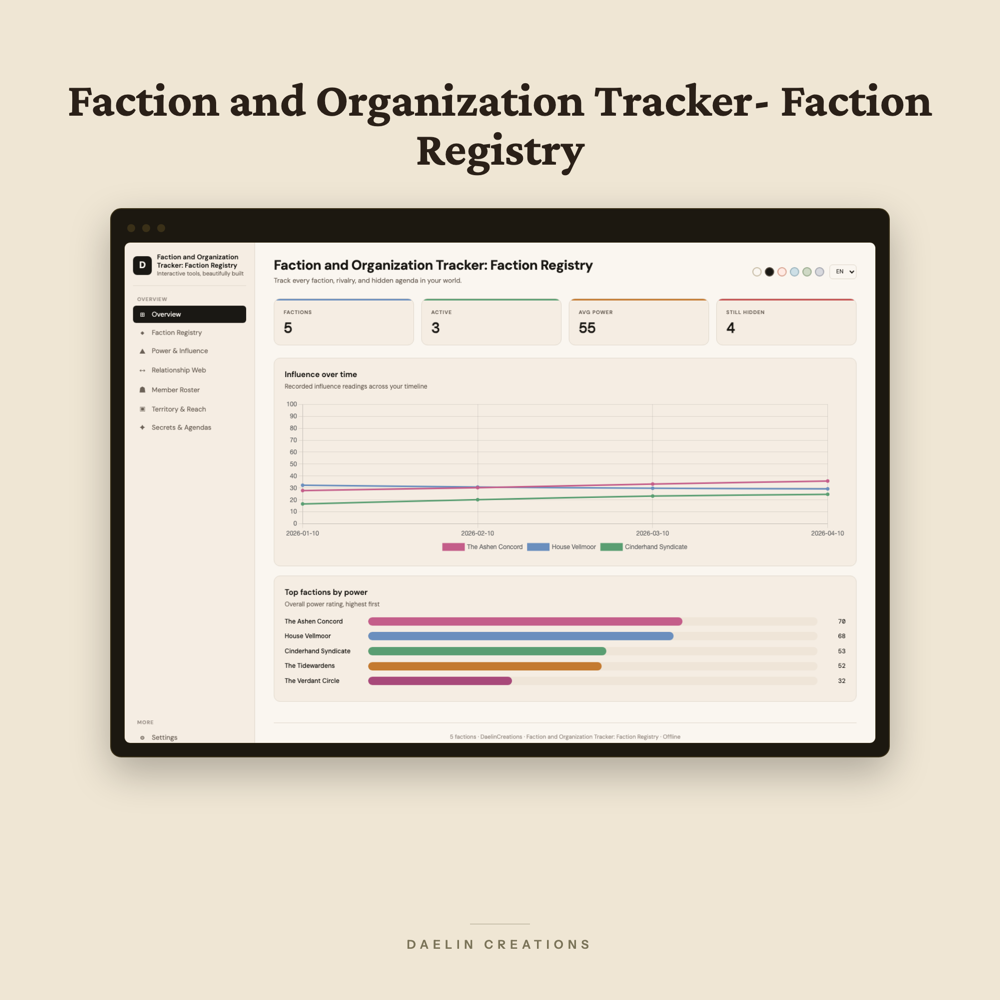
Faction and Organization Tracker: Faction Registry
Map every faction in your story — their power, their secrets, their rivals, and the territory they'd kill to keep. This is the political layer of your worldbuilding, all in one offline HTML dashboard.
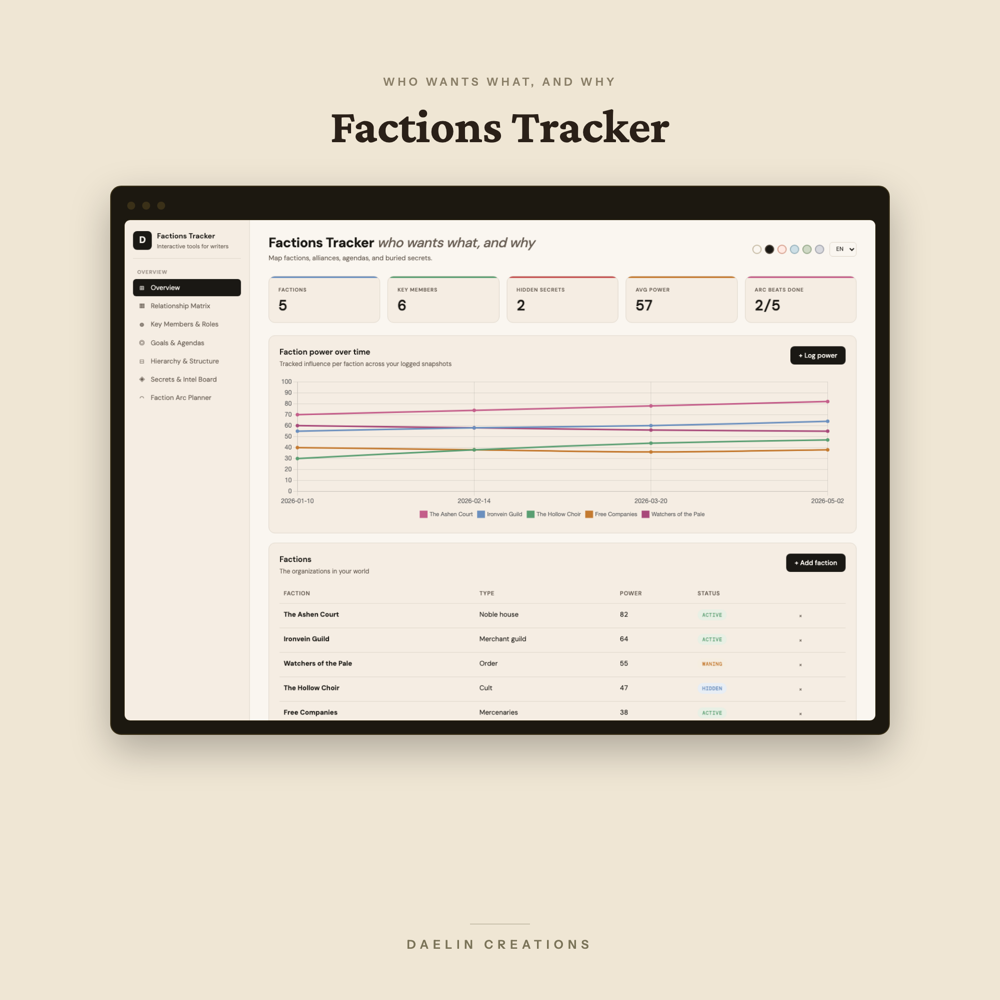
Factions Tracker
Stop losing track of who hates whom, who reports to whom, and which faction is secretly pulling strings — this Factions Tracker maps every power dynamic in your story so your political plot never contradicts itself.
Fae Rules & Lore
Does your faerie magic feel arbitrary — or worse, forgettable? **Fae Laws & Lore: The Fantasy Writer's Field Guide** gives you the hidden logic that makes the Fair Folk genuinely dangerous on the page.
Fantasy Castle Anatomy Writer's Field Guide
Stop guessing where the portcullis ends and the barbican begins. **Fantasy Castle Anatomy: A Writer's Field Guide** gives fiction writers a room-by-room, stone-by-stone reference they can actually use mid-draft.
Fantasy Economics Writer's Reference Guide
Does your fictional economy feel like a backdrop instead of a living world? This writer's reference guide gives you the craft tools to build currencies, trade networks, and market cultures that drive plot and reveal character — without a degree in economics.
Fantasy Landscapes Writer's Guide
Stop letting your landscapes just sit there.
Fantasy Magic System Reference Guide
Struggling to keep your magic system consistent — or not sure where to start building one? This writer's reference guide cuts through the confusion with clear, practical terminology every fantasy author needs.
Fantasy Profanity Builder
Does your fictional world sound modern the moment someone swears? This printable reference guide fixes that.
Fantasy Worldbuilding Lexicon
Build richer, more consistent fantasy worlds with this craft-focused vocabulary reference guide — designed for fiction writers who want to move beyond vague intuition and write with purposeful precision.
Fantasy Worldbuilding Workbook for Fiction Writers
Most fantasy worldbuilding advice tells you to build more — more history, more maps, more magic systems. This workbook tells you to build *deeper*. The Long Game is a printable PDF craft workbook designed for fiction writers who want their fantasy worlds to feel genuinely lived-in: voiced, pressurized, and alive on the page.
Fantasy Worldbuilding Workbook for Fiction Writers
Build a fantasy world readers can feel, not just admire.
Fiction Writing Workbook PDF
*The Hidden Layer* is a printable PDF workbook for fiction writers who want to move beyond surface-level storytelling and engineer meaning into the architecture of their scenes. Across seven structured sections, you will work through the core mechanisms of subtextual craft — from the two-story frame that underlies every scene to the silence throughline that carries an entire character arc.
Figurative Language for Fantasy Writers
Struggling to make your fantasy world *feel* alive on the page? This printable reference guide teaches you how to wield figurative language — metaphor, simile, symbolism, personification, and more — with precision and power.
Found Documents Writing Guide
WHAT THIS IS
Genre Architecture Workbook
Do you know every structural promise your genre makes to readers — and whether your manuscript keeps them all? Genre Architecture is a printable PDF workbook for fiction writers who want to move beyond craft instinct and into precise, confident structural decision-making.
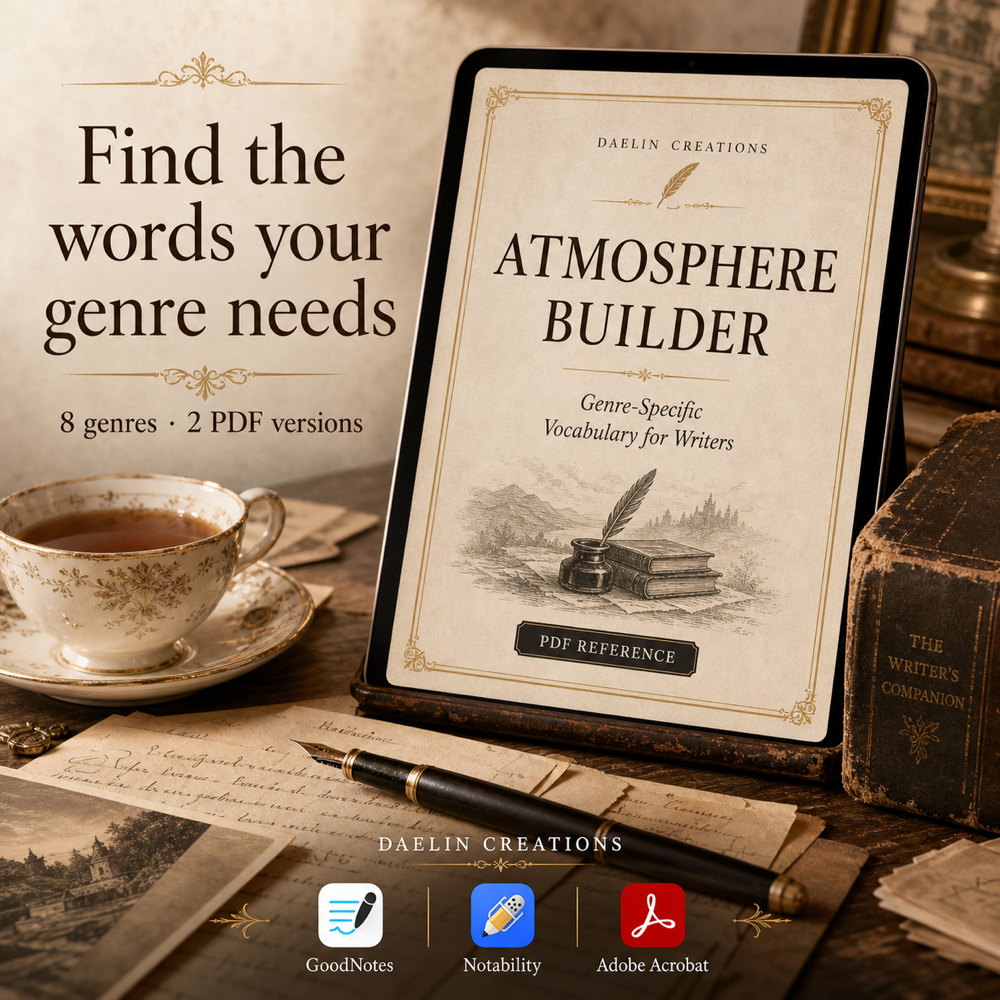
Genre Vocabulary Guide for Writers
You know the feeling: the scene is right but the *words* are off. The dark romance reads like a thriller. The cozy mystery sounds literary. The fantasy world feels generic. You can't quite name what's missing — but the atmosphere isn't there.
God-Building Reference Guide for Fiction Writers
Build pantheons that feel ancient, theologies that feel lived-in, and gods your readers will actually believe in.
Heraldry for Romance Writers
Give your noble houses the centuries-deep credibility readers crave.
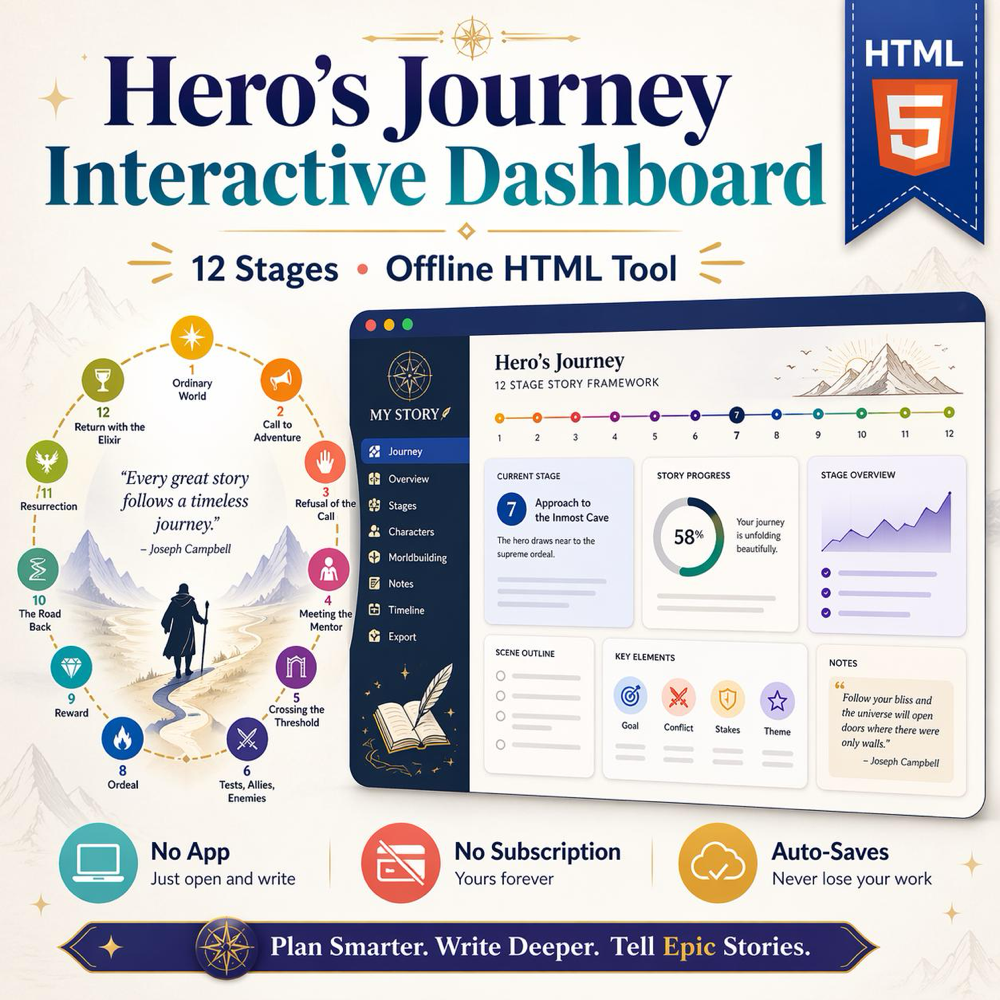
Hero's Journey Novel Planner – 12 Stage Interactive Dashboard (HTML Tool)
Plan your novel with the Hero's Journey in one interactive, offline HTML dashboard — all 12 stages with 48 guided questions, characters, worldbuilding, and a stage calculator.
Historical Fiction Writer's Reference Guide
Stop breaking your reader's immersion with a single misplaced detail. **The Historical Fiction Writer's Detail Companion** is a practical, beautifully formatted printable reference guide designed to keep your story grounded — from the texture of a market stall to the etiquette of a court introduction.
Historical Kitchens
Does your historical fiction feel like a costume drama — visually period-correct but somehow hollow? The missing layer is almost always food.
Magic System Workbook for Fiction Writers
Build a magic system your readers will believe in completely — from the first spark of an idea to the climactic scene where everything comes together.
Medieval Daily Life for Fantasy Writers
Stop losing hours to research rabbit holes every time your fantasy hero needs to eat breakfast or barter at a market stall. **Medieval Daily Life for Fantasy Writers** is a printable reference guide designed to give you exactly the grounding detail you need — fast, practical, and built for storytelling.
Mythological Creature Bestiary
Bring your mythological creatures to life with cultural depth and narrative precision.
Nature & Landscape Writer's Reference Guide
Struggling to make your outdoor scenes feel real rather than decorative? This **Writer's Visual Reference Guide** gives fiction writers a precise, practical toolkit for describing the natural world — forests, coasts, deserts, mountains, wetlands, and beyond.
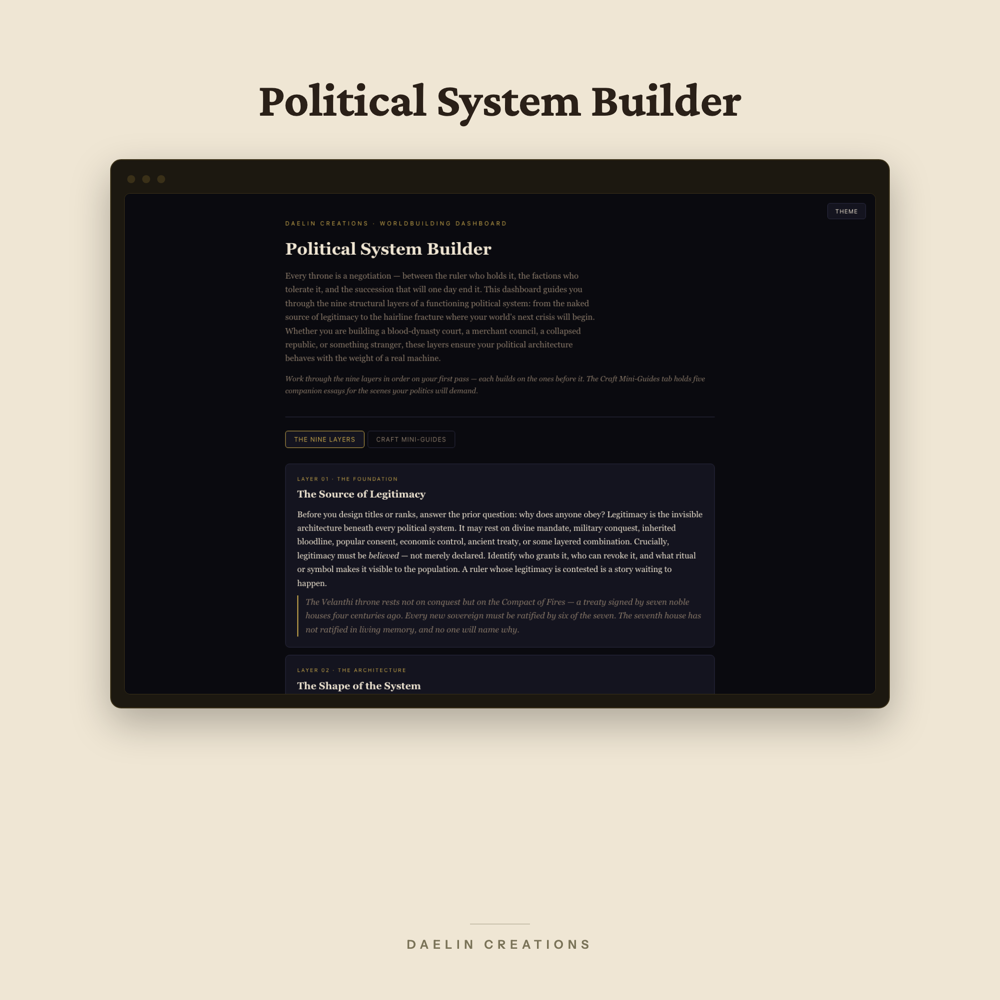
Political System Builder
Every throne is a negotiation — and now you have the blueprint for it.
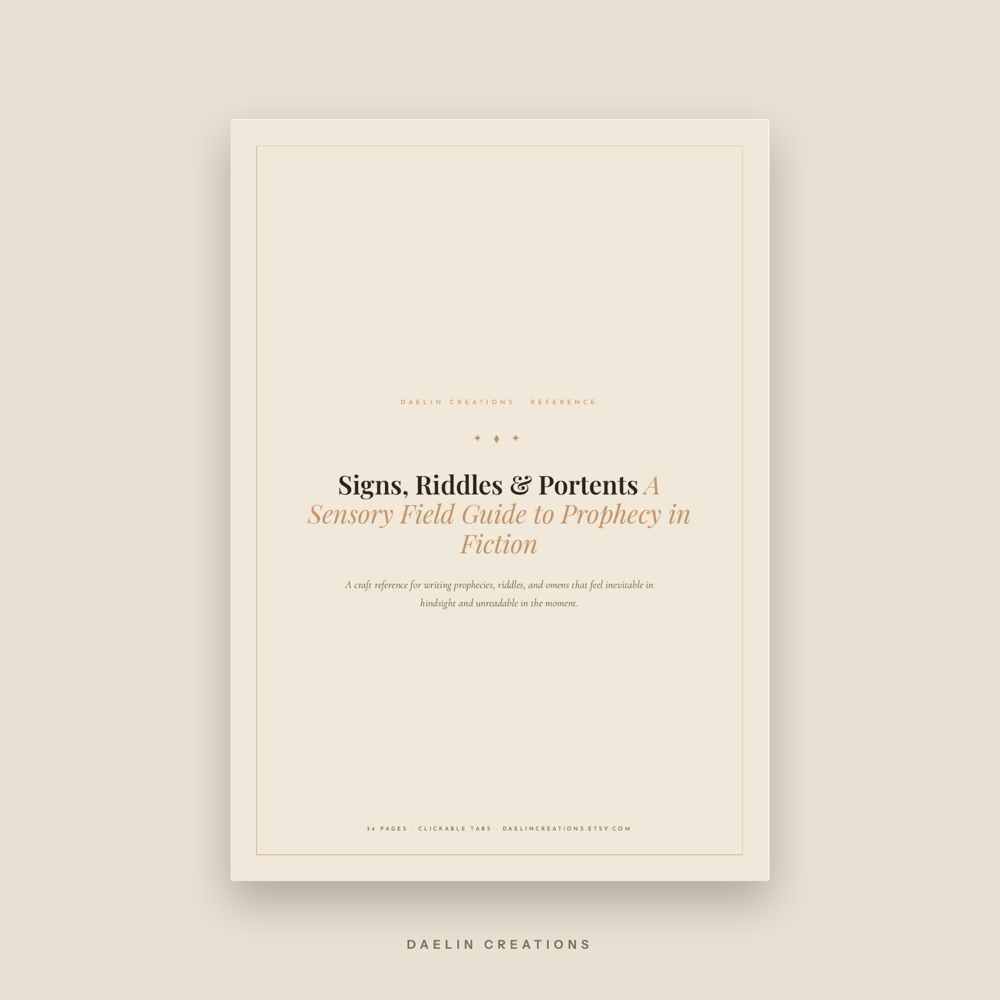
Prophecy Writing Guide for Fiction Writers
Write prophecies your readers cannot solve and cannot forget
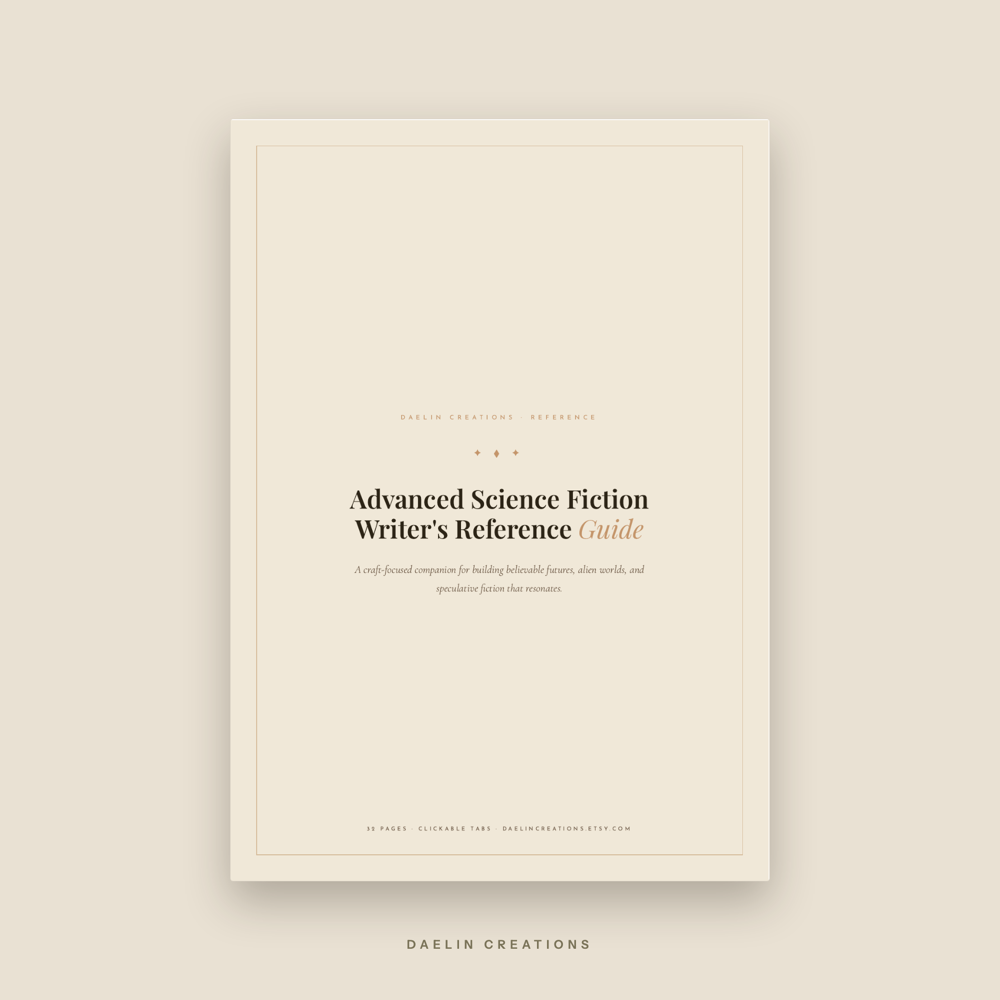
Science Fiction Writer's Reference Guide
Struggling to make your speculative world feel real without drowning readers in exposition? This Advanced Science Fiction Writer's Reference Guide is a practical, craft-focused companion built for writers who are ready to move beyond the basics.
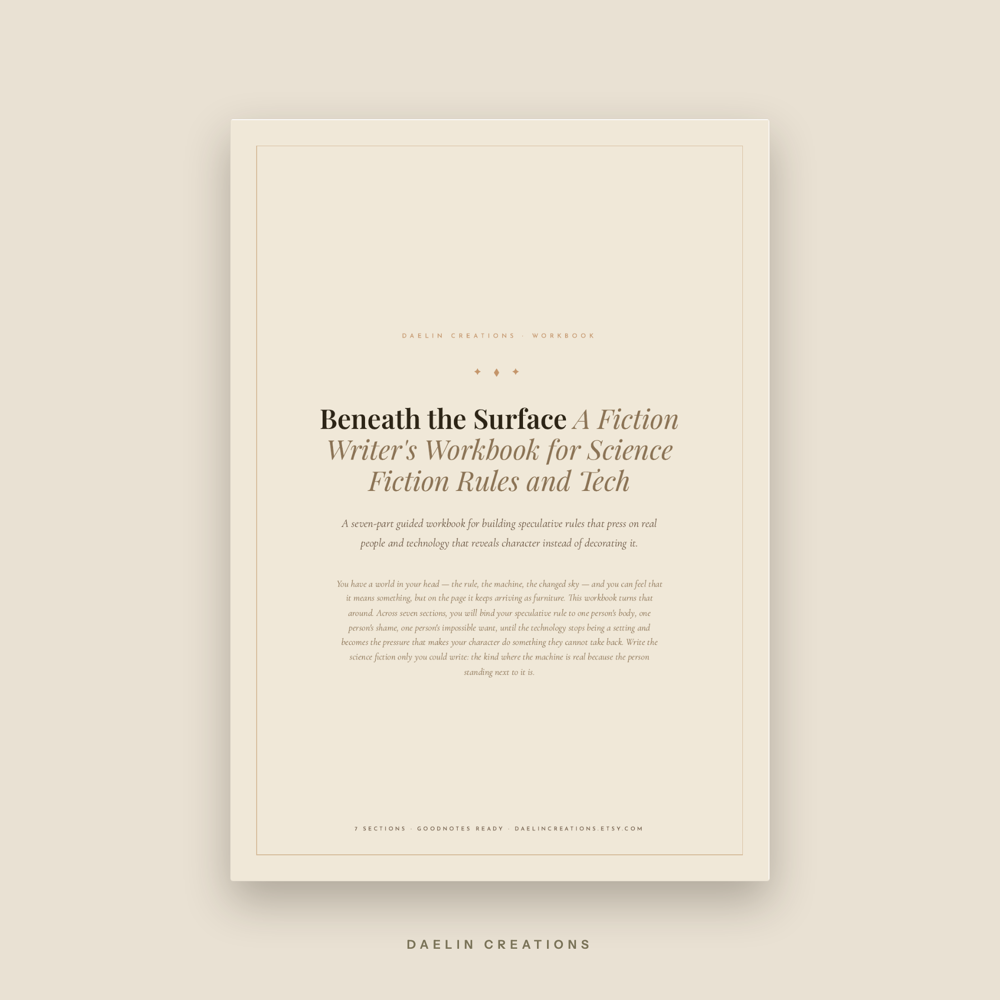
Science Fiction Writing Workbook Printable PDF Sci-Fi Worldbuilding and Character Development Prompts for Novelists
Build a speculative world that presses on real people
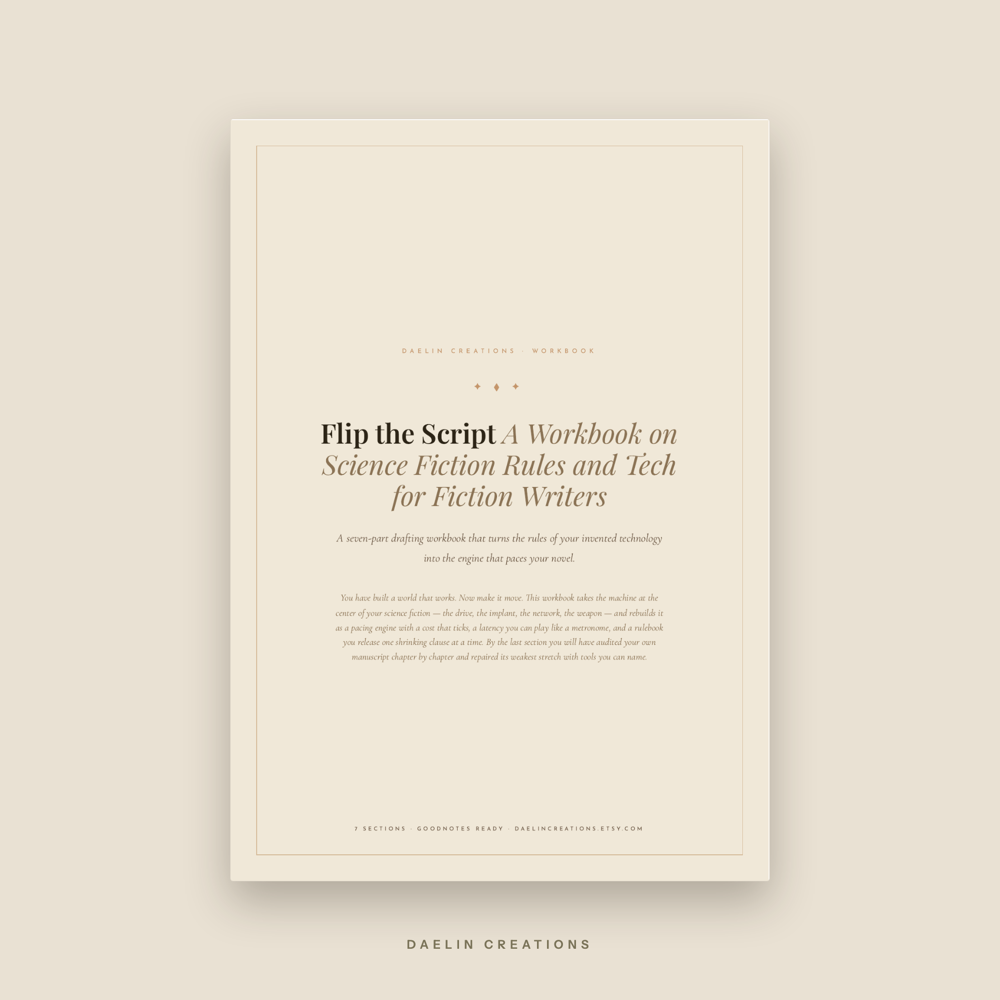
Science Fiction Writing Workbook Printable PDF Sci-Fi Worldbuilding Rules Tech Pacing Exercises for Fiction Writers Novel Planner
Flip the Script is a seven-section workbook for writers who have built a world that works and now need it to move. It treats invented technology as a pacing instrument rather than set dressing, and every exercise is written to be done with a real draft open beside you.
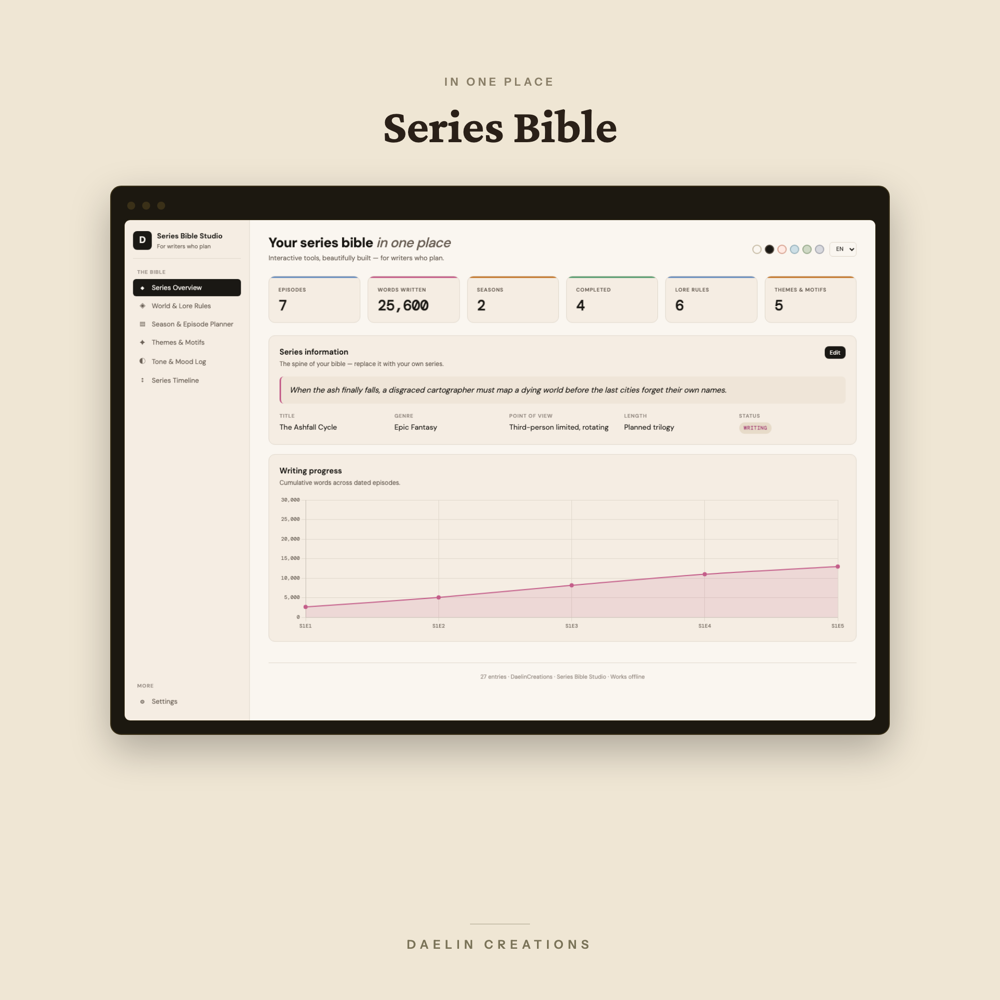
Series Bible Dashboard
Keep your entire book series in one place — no more scattered notes, lost character sheets, or continuity headaches.
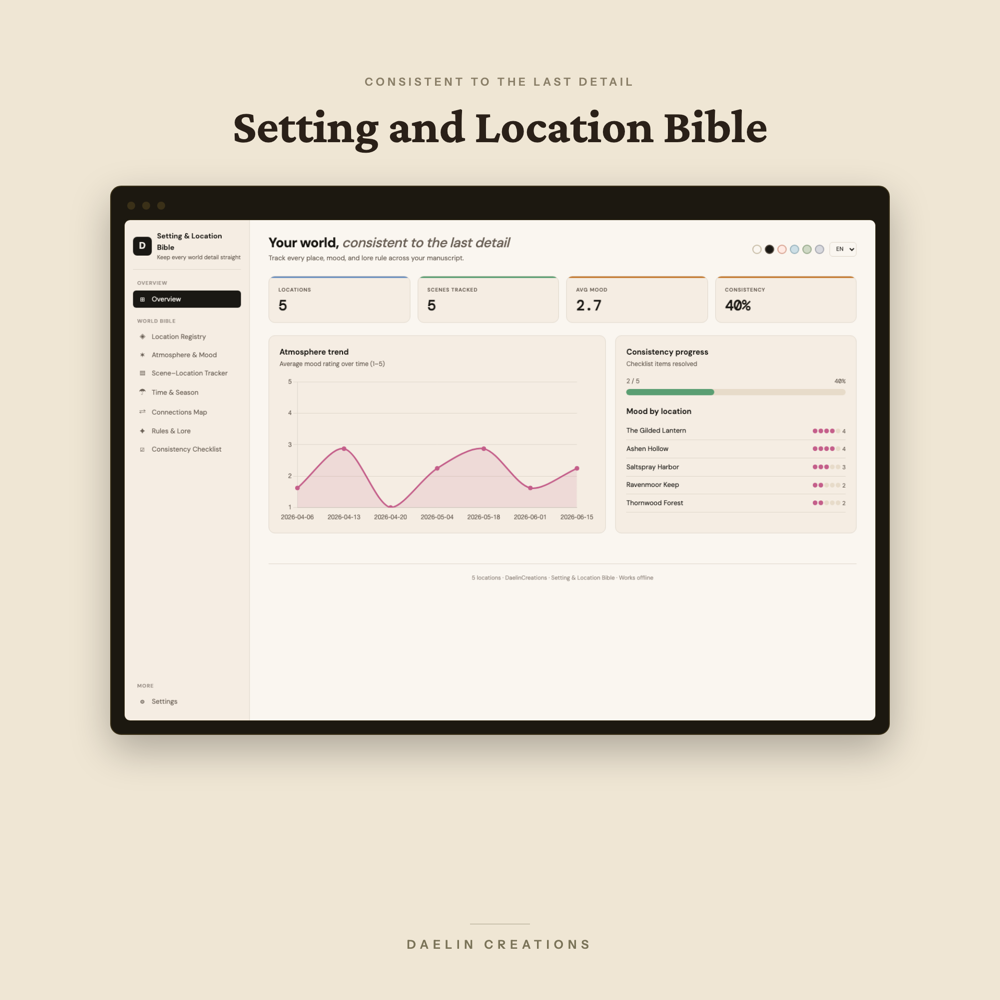
Setting & Location Bible
Build worlds that feel real — one location at a time.
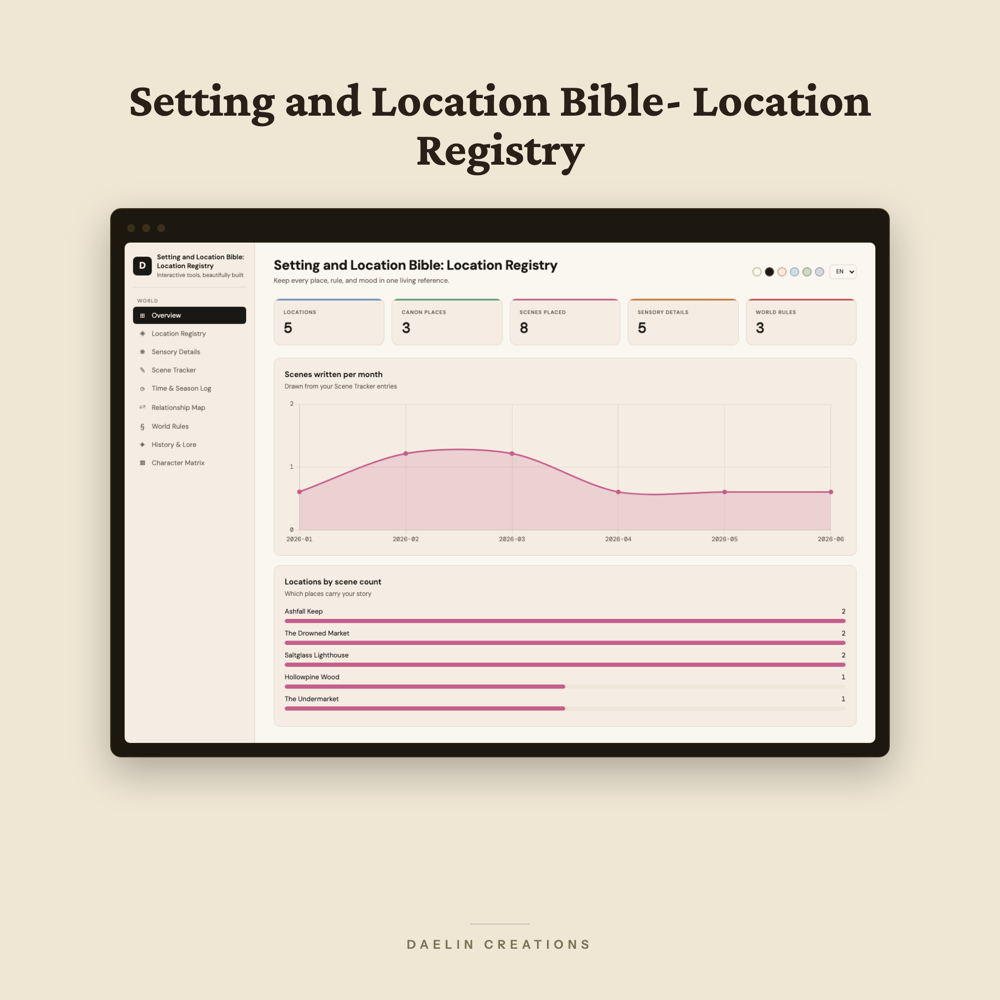
Setting and Location Bible: Location Registry
Stop losing track of which scene happens where — this interactive Setting and Location Bible gives your story's world a permanent, searchable home, from the sensory texture of each place to the history, rules, and relationships that make it feel real.
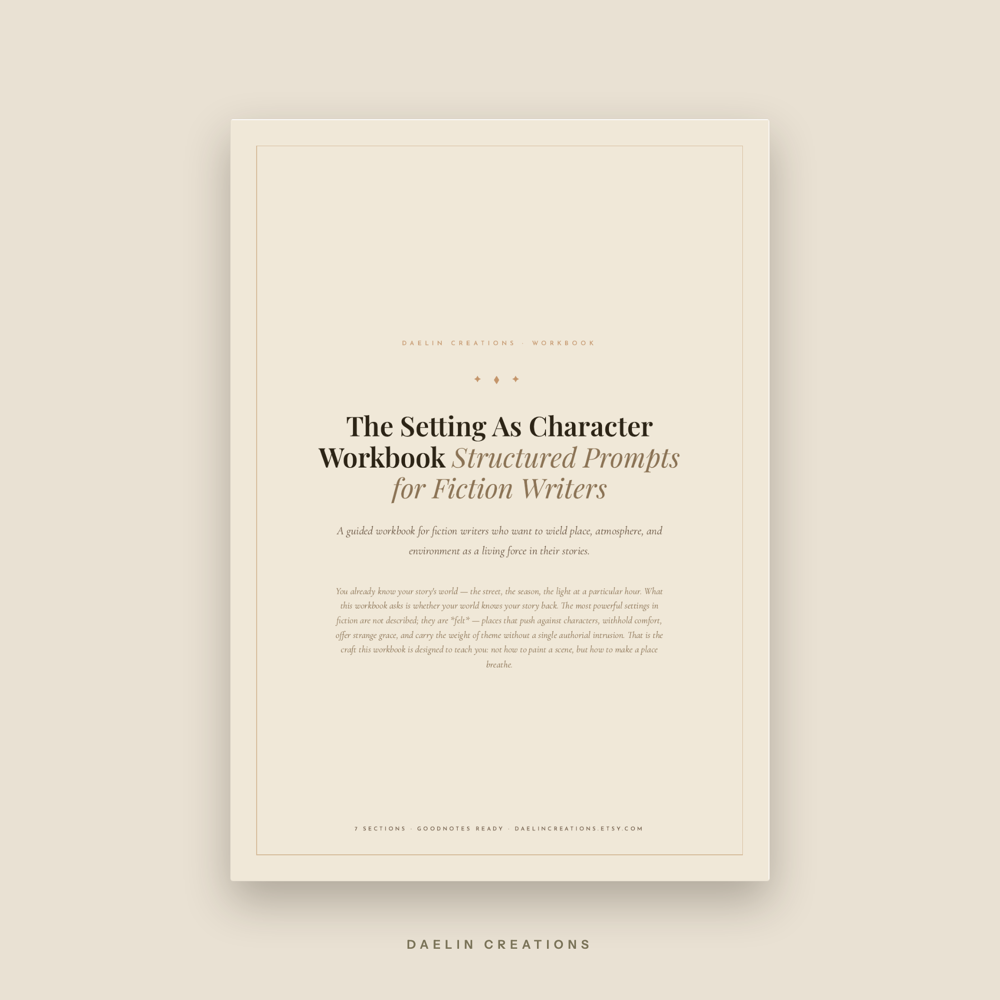
Setting As Character Workbook
Stop letting your settings sit in the background — and stop letting your tropes run on autopilot. This beautifully designed printable workbook guides fiction writers through seven structured sections of craft-focused prompts, from identifying the emotional promise of your central trope all the way through a final genre-savvy revision pass.
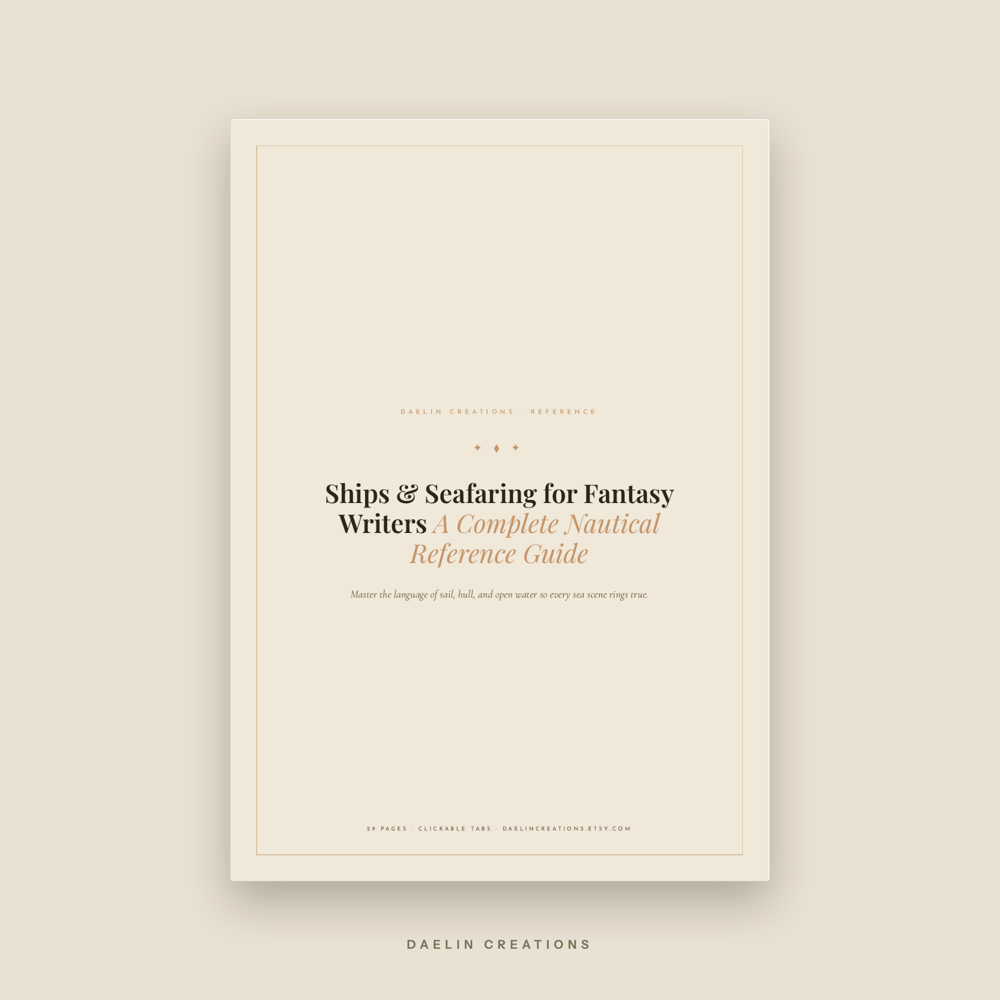
Ships & Seafaring for Fantasy Writers
Never second-guess a sail name, a crew rank, or a sea maneuver again. **Ships & Seafaring for Fantasy Writers** is a practical nautical reference guide designed specifically for fiction writers — no sailing experience required.
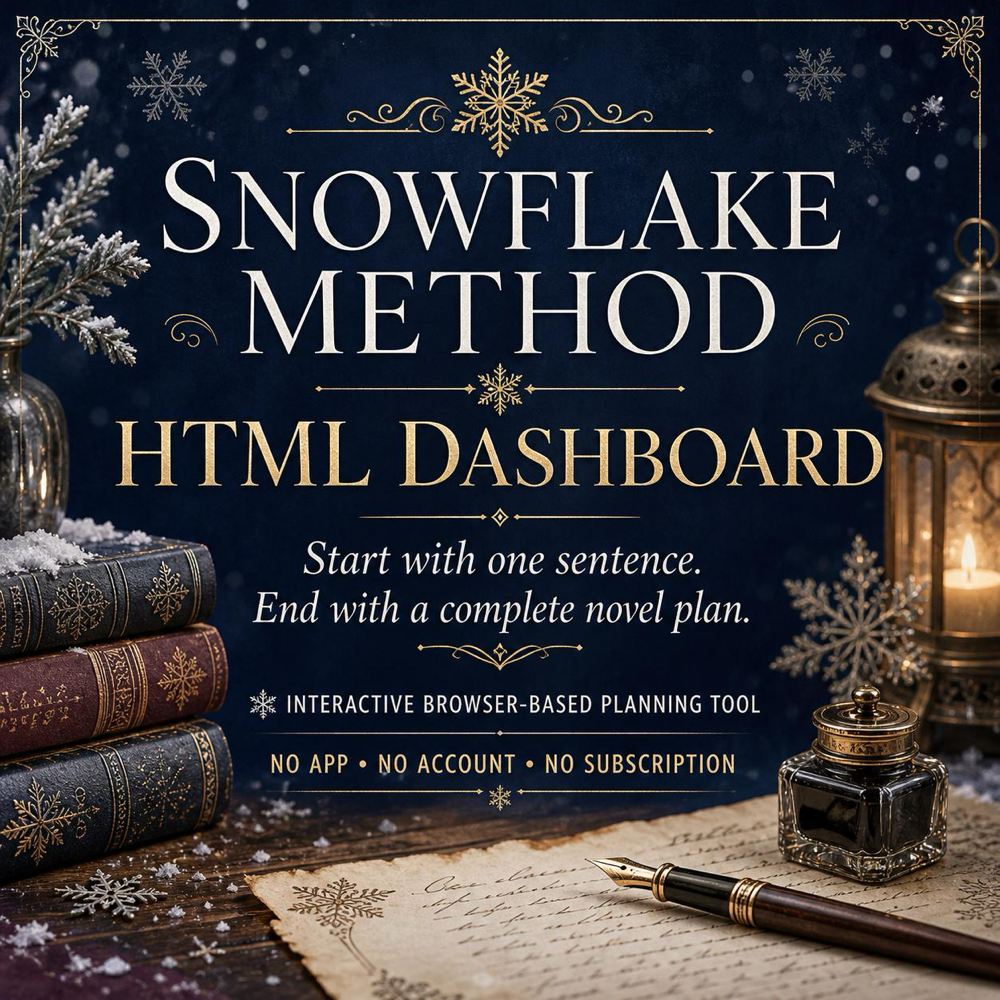
Snowflake Method Novel Outline Planner, Interactive HTML Dashboard, Story Planning Tool
One sentence becomes a paragraph, becomes a page, becomes a novel
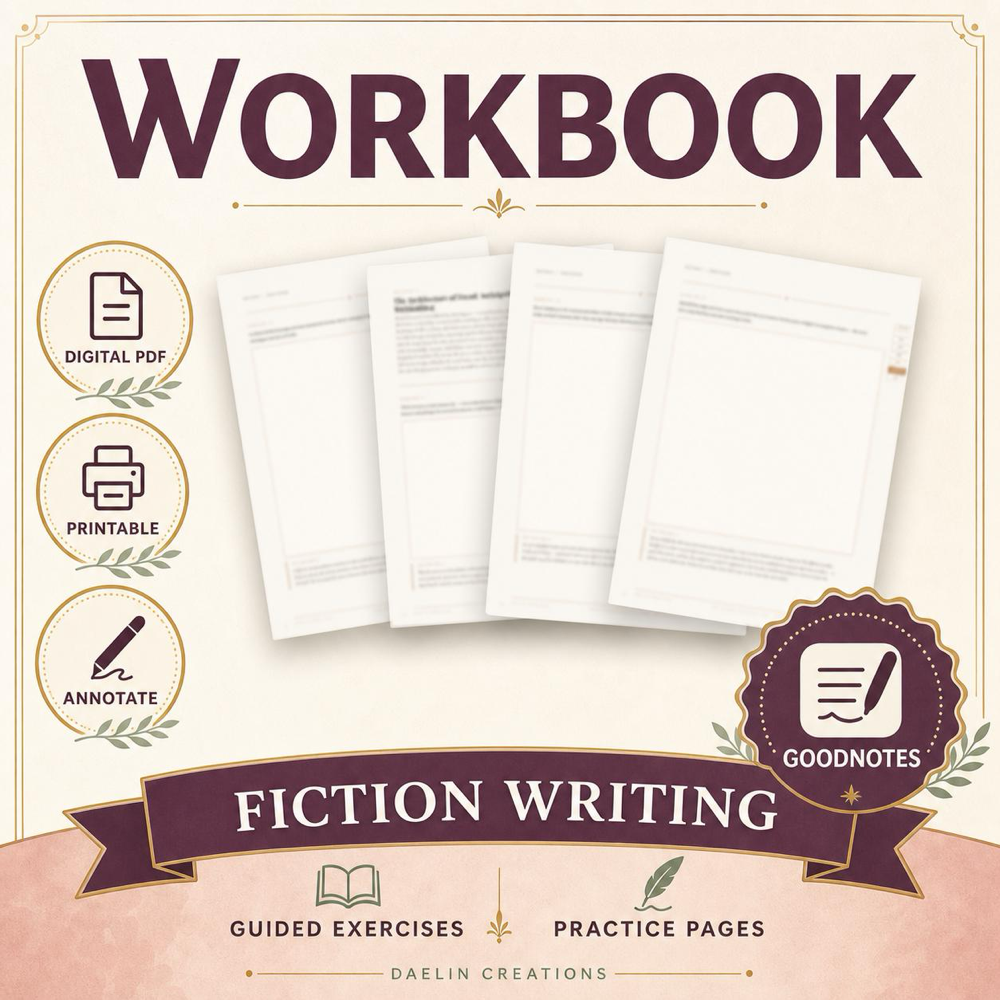
Spirituality & Faith
Writing spirituality in fiction is one of the most technically demanding challenges a novelist faces — and one of the most emotionally rewarding when done well. This printable workbook gives you a structured, beautifully designed space to develop characters whose faith, doubt, longing, and ritual feel lived-in and emotionally true.
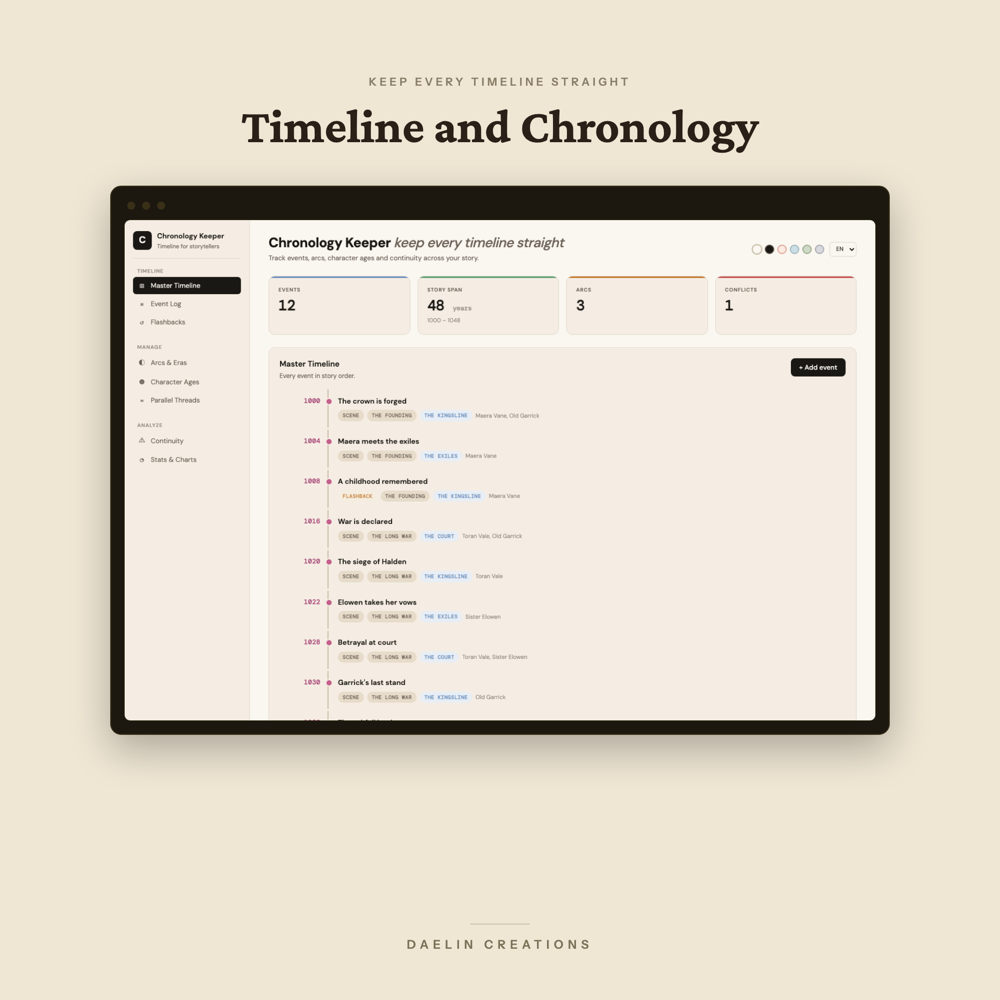
Story Timeline & Chronology Dashboard
Keep every event, date, and era in your story perfectly in order — without losing the thread.
Suspension of Disbelief
Every story asks readers to believe the impossible — and the difference between a story that pulls them in and one that loses them is craft.
Symbolism Library for Fiction Writers
Stop reaching for the raven and hoping for the best. The Symbolist's Codex is a genre-organized reference guide for fiction writers who want to use classical symbols with intention — not habit.
The Bloom Story Structure Planner
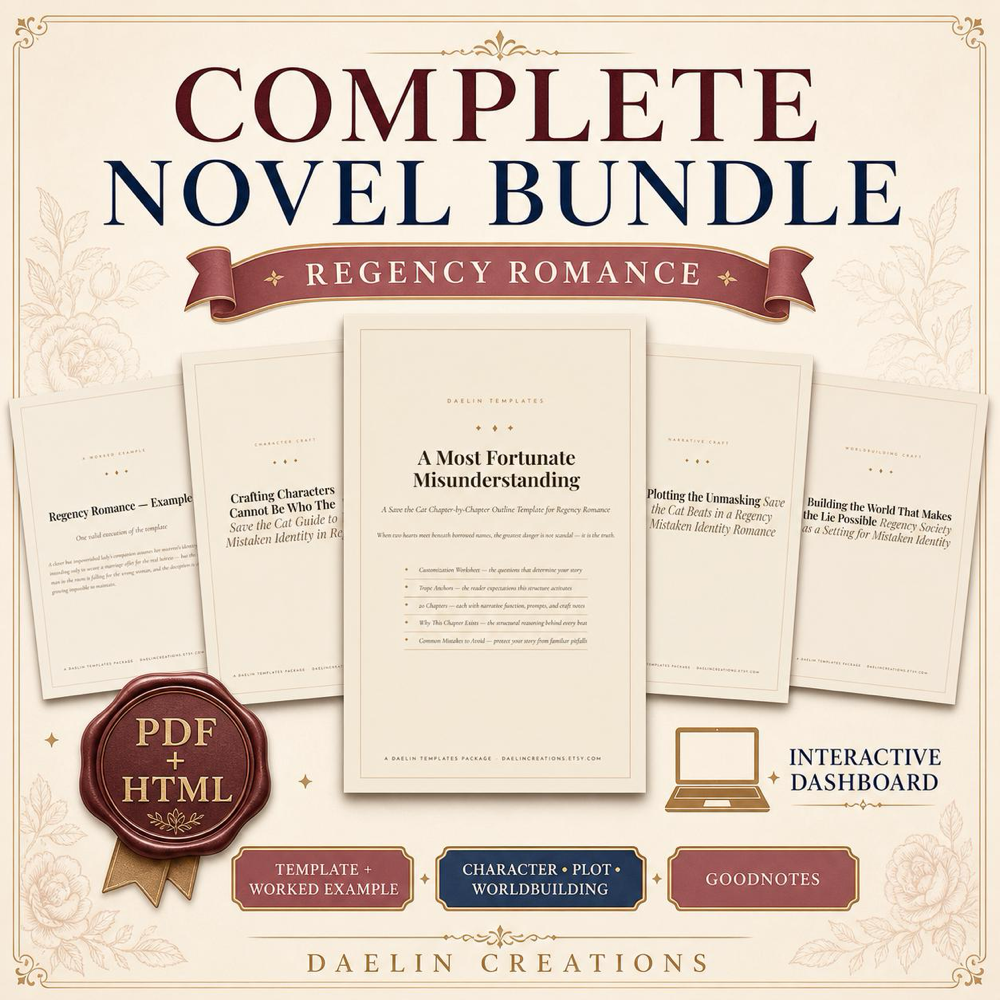
THE BLOOM — A Story Structure Planner for Dark Romance Writers
The Hidden Layer: Fantasy Worldbuilding Workbook for Fiction Writers
Build a fantasy world that argues something
The Multiple Timelines Workbook
Build alternate worlds your readers can actually tell apart.
The Writer's Palate
Every meal scene is a missed opportunity — until now. **The Writer's Palate** is a printable craft reference guide designed to help fiction writers use food, flavor, and cooking as powerful storytelling tools rather than filler detail.
Traditions Through the Senses
Give your fictional traditions the weight and texture of something truly inherited.
Vampire Lore Reference Guide for Writers
Writing vampire fiction? This printable reference guide gives you every major traditional vampire convention — clearly stated, instantly usable, and illustrated with wrong/right examples drawn from the same fictional scene so the contrast is always concrete.
Villain Craft
Your antagonist should be the most compelling character in the room — and this guide shows you exactly how to make that happen.
Weather & Atmosphere Writing Guide
Struggling to make the weather in your scenes feel alive instead of decorative? This printable quick-reference guide gives fiction writers immediate, practical rules for writing rain, fog, heat, wind, snow, and storms that genuinely serve story — deepening tension, revealing character, and grounding readers in a world that breathes.
Werewolf Lore & Conventions Reference Guide
Know the rules before you rewrite them.
Worldbuilder's Lexicon
Build richer, more immersive worlds — one precise word at a time.
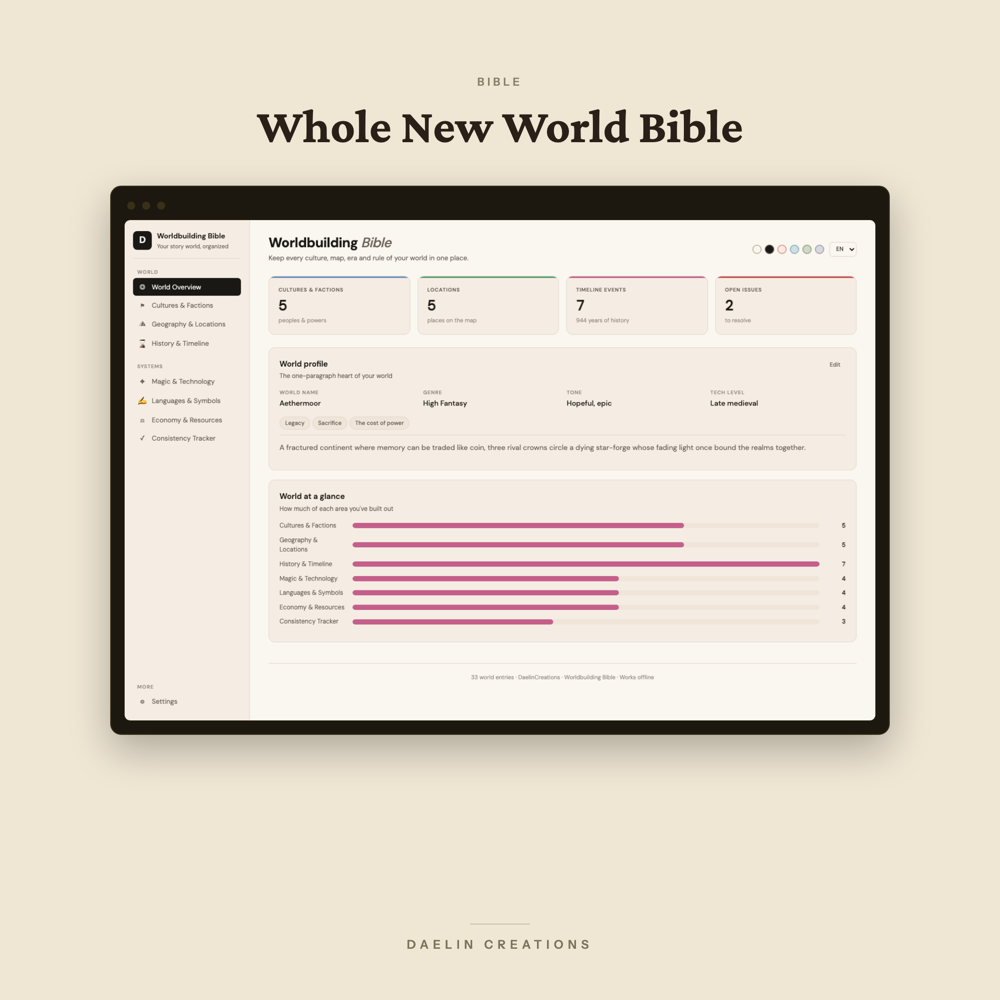
Worldbuilding Bible Dashboard
Stop losing your lore in scattered notebooks and endless docs. This Worldbuilding Bible Dashboard gives you one beautiful, offline HTML file to hold every corner of your fictional world — organized, searchable, and always ready.
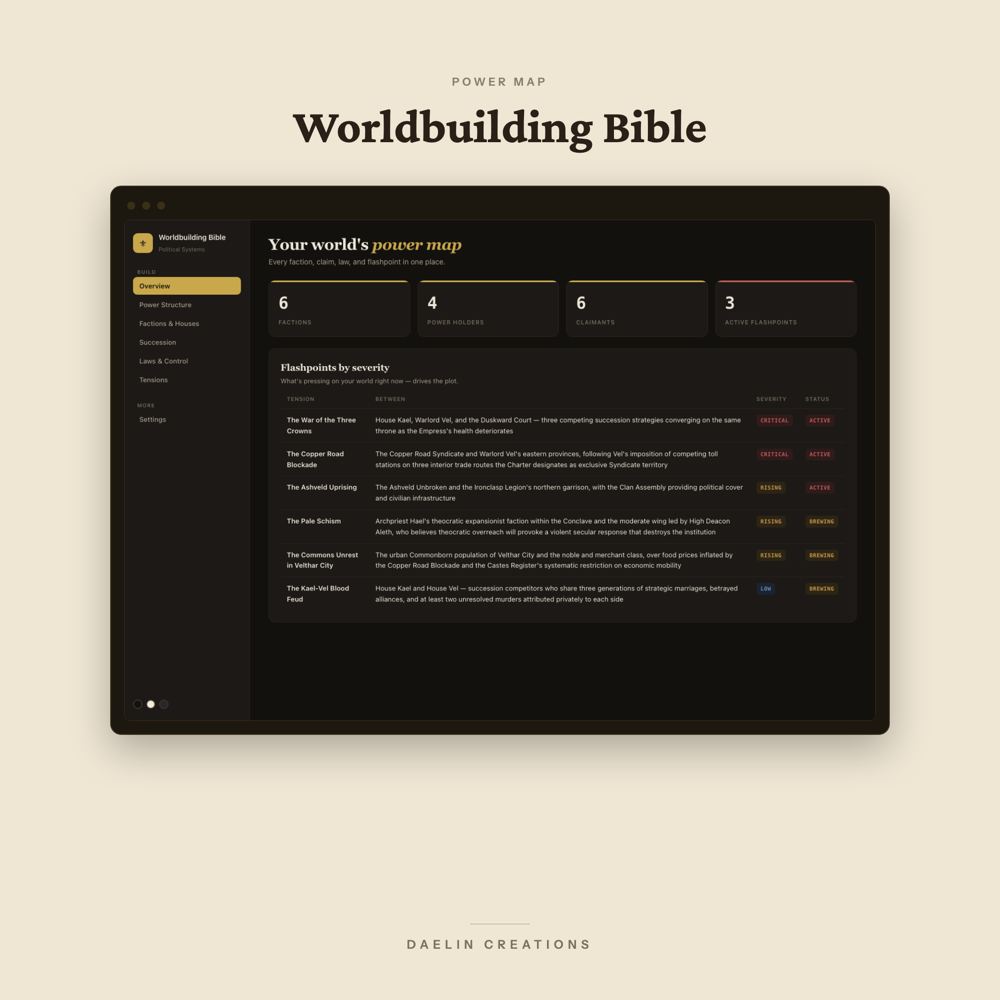
Worldbuilding Bible Political Systems Dashboard
Every political system is a story waiting to erupt. This interactive Worldbuilding Bible dashboard gives fiction writers a structured, atmospheric workspace to design the full architecture of power in their fictional world — before the first crack appears on the page.
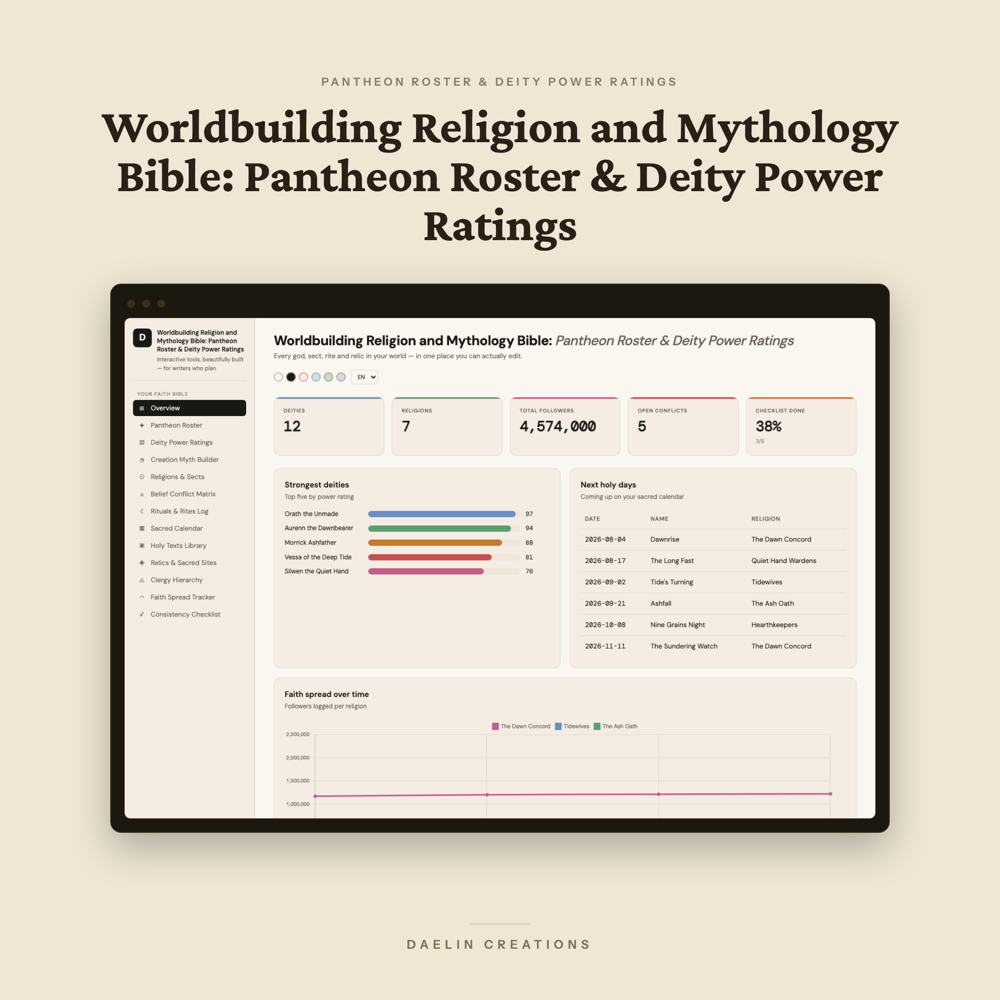
Worldbuilding Religion and Mythology Bible: Pantheon Roster & Deity Power Ratings
Stop inventing gods one scene at a time and losing track of who they were three chapters ago. This interactive HTML dashboard gives your invented faiths a single home, from the first creation myth to the sect wars it eventually causes.
Writer's Field Guide to Injuries & Medical Detail
Stop Googling symptoms mid-scene — this desk reference puts accurate, emotionally resonant injury detail at your fingertips.
Writer's Naming Codex
**Every name is a promise to your reader.** This craft reference guide helps fiction writers build names that feel earned — from the sounds that make a villain menacing to the surname patterns that make a family tree feel real.
Writer's Symbolism Lexicon
Give your prose a second layer of meaning — the one readers feel before they understand it.
Writing the Past
Struggling to make your historical world feel real without drowning your story in footnotes? **Writing the Past** is a compact, beautifully designed reference guide built for fiction writers who want their period details to be accurate, atmospheric, and invisible on the page.
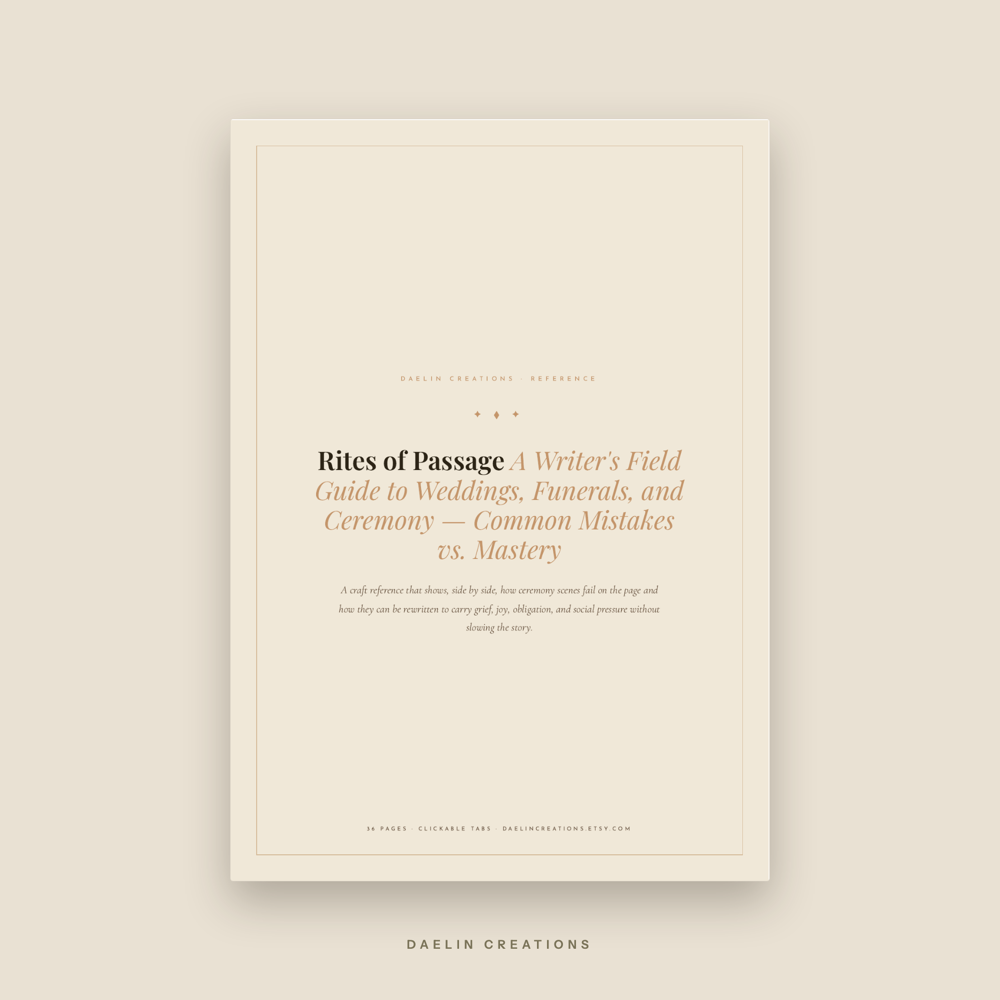
Writing Weddings & Funerals Guide
Ceremony scenes should be the emotional peak of a novel. Too often they read like a schedule of events: the vows happen, the coffin lowers, and the reader feels nothing. This guide fixes that, scene by scene.
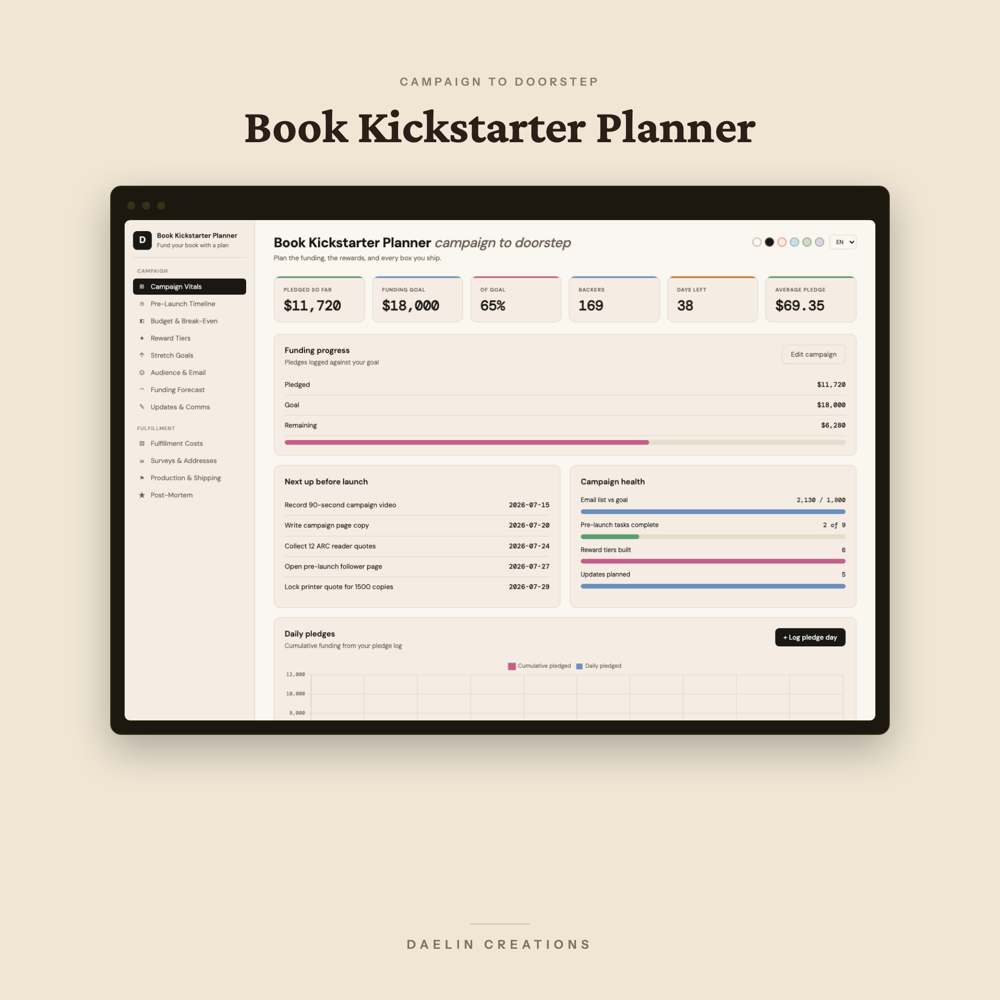
Book Kickstarter Planner
Run your book campaign like a publisher, not a guess
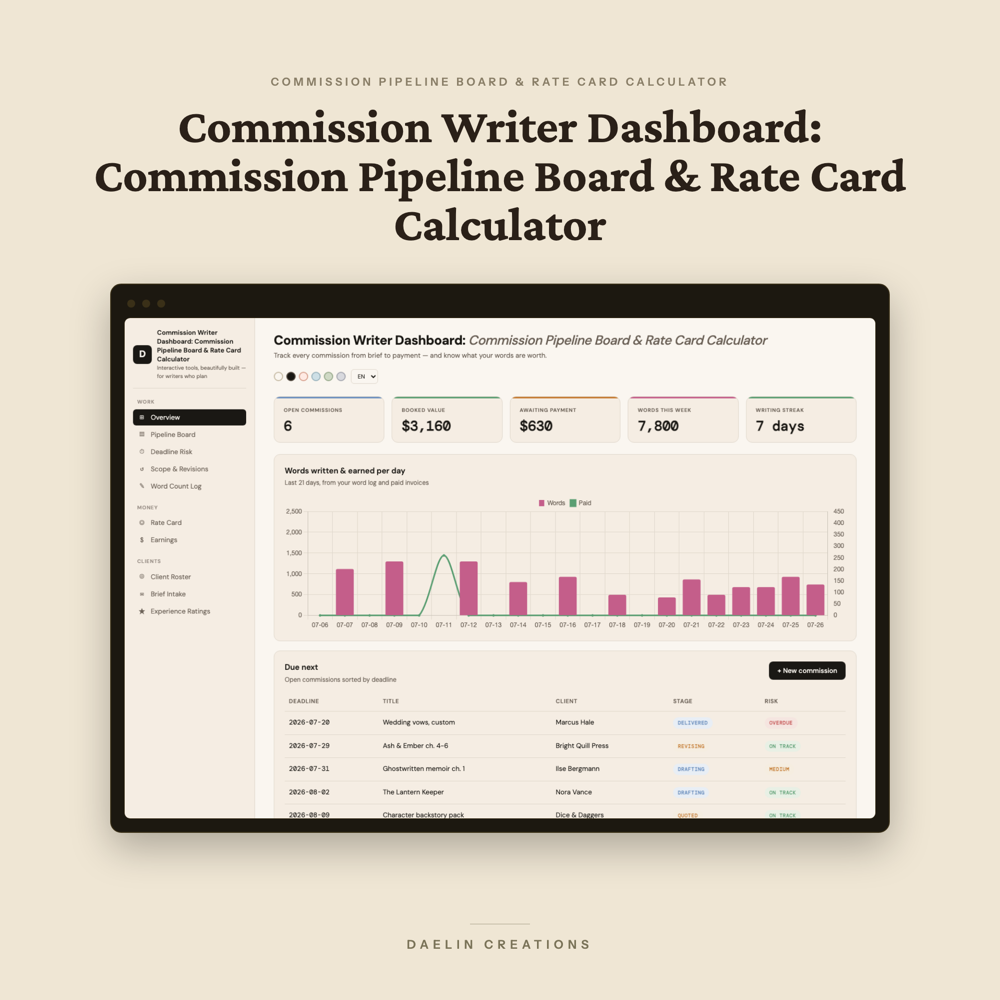
Commission Writer Dashboard: Commission Pipeline Board & Rate Card Calculator
Stop guessing what a commission is really worth. This dashboard turns a messy inbox of requests, half-agreed word counts and "just one more small change" into a pipeline you can actually see, price and finish on time.
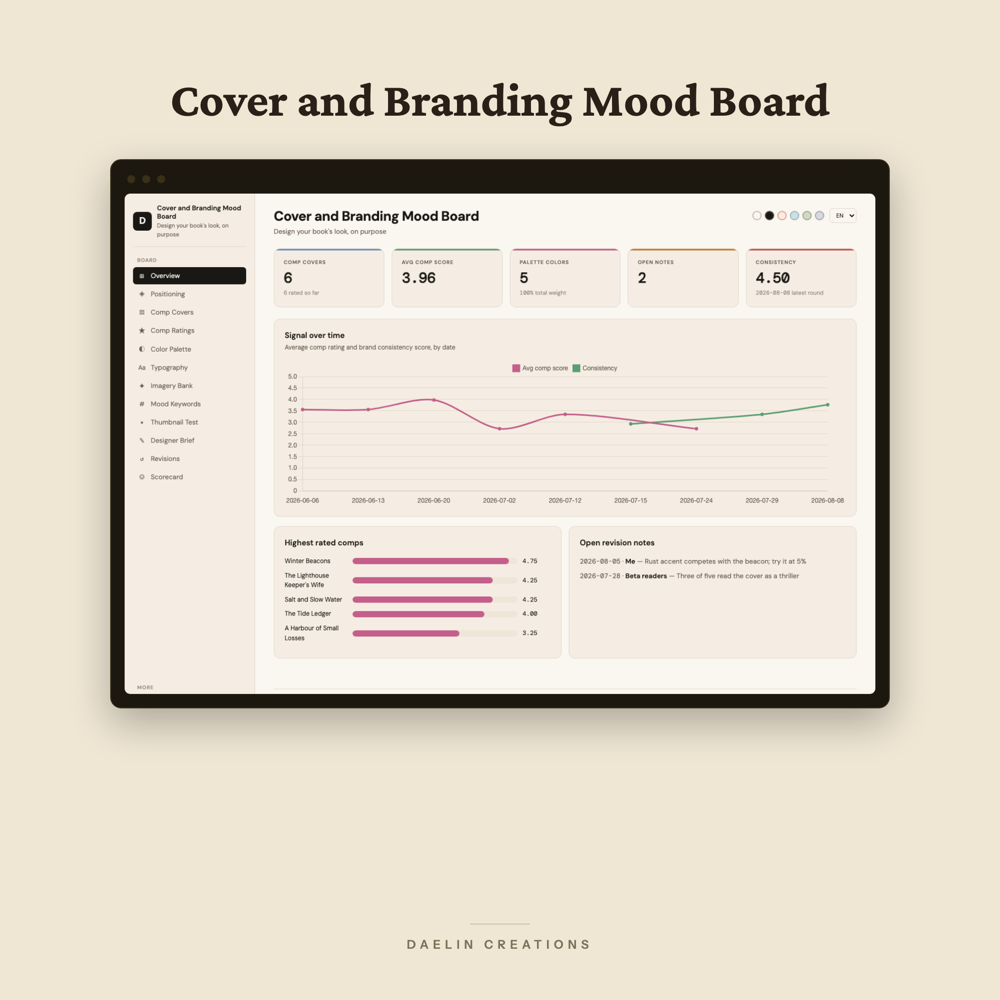
Cover and Branding Mood Board
Stop sending your cover designer a vague pile of screenshots and hoping for the best. This interactive HTML dashboard turns "I want it to feel like this" into a specific, defensible brief: rated comp covers, a locked color palette with usage percentages, tested type pairings, a symbol bank, and a legibility check at thumbnail size before you ever pay for a design round.
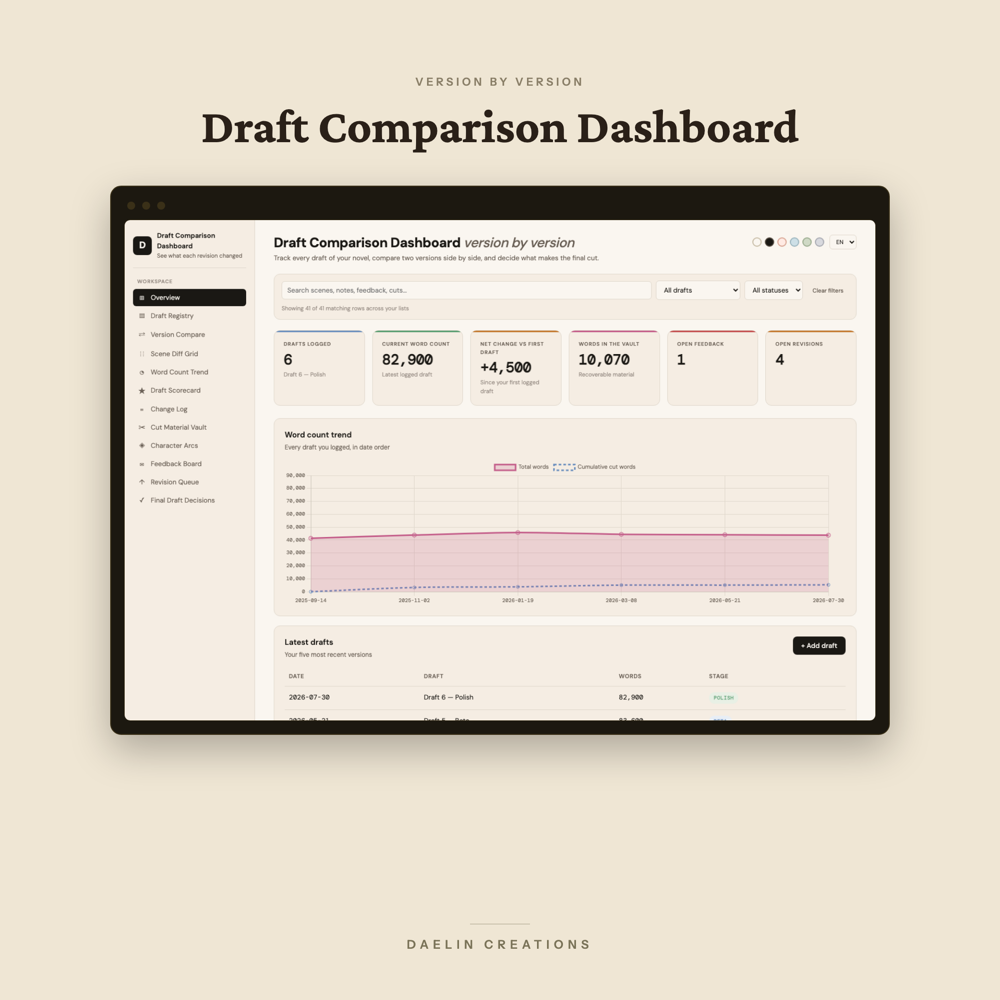
Draft Comparison Dashboard - Interactive HTML Revision Tracker for Writers, Version Diff Grid, Cut Material Vault & Novel Editing Tool
Stop guessing which draft is actually better
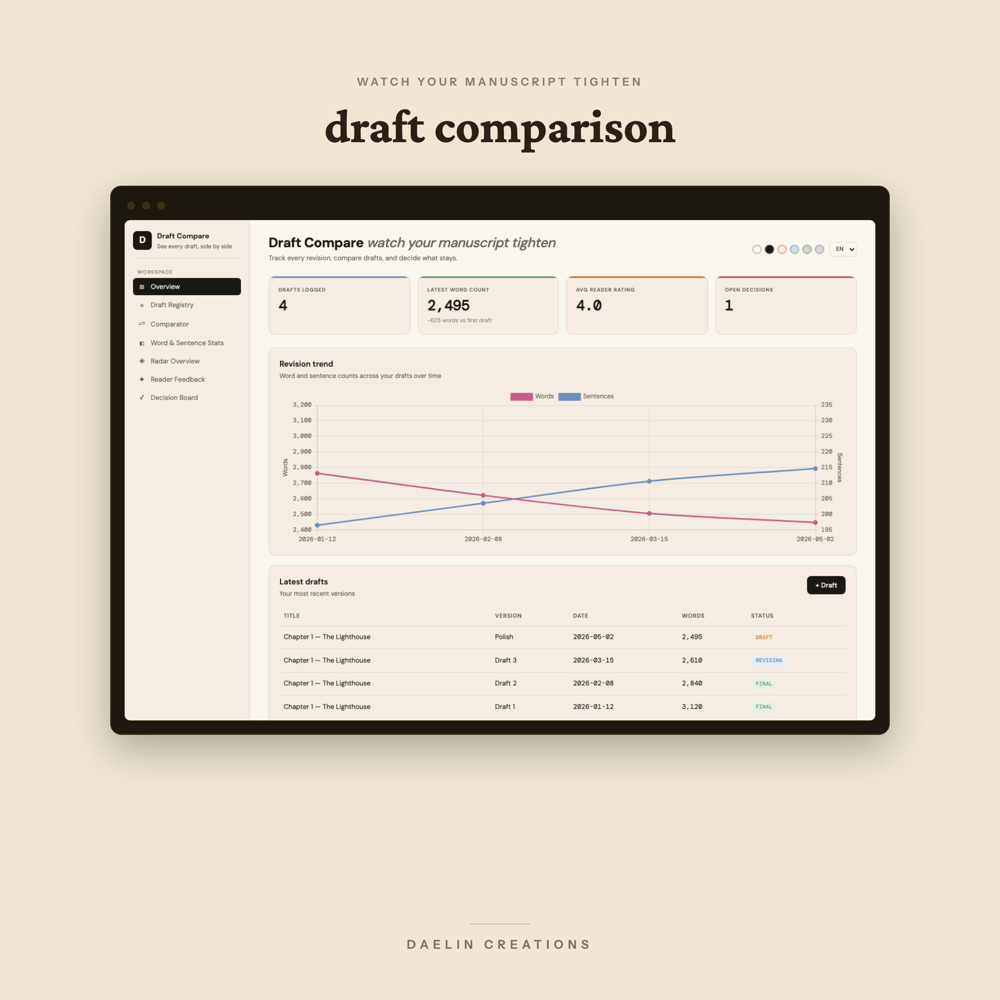
Draft Comparison Dashboard for Writers
Stop losing track of what changed between drafts. The Draft Comparison Dashboard gives fiction writers a clear, structured way to compare manuscript versions — so you can revise with confidence and never second-guess a cut again.
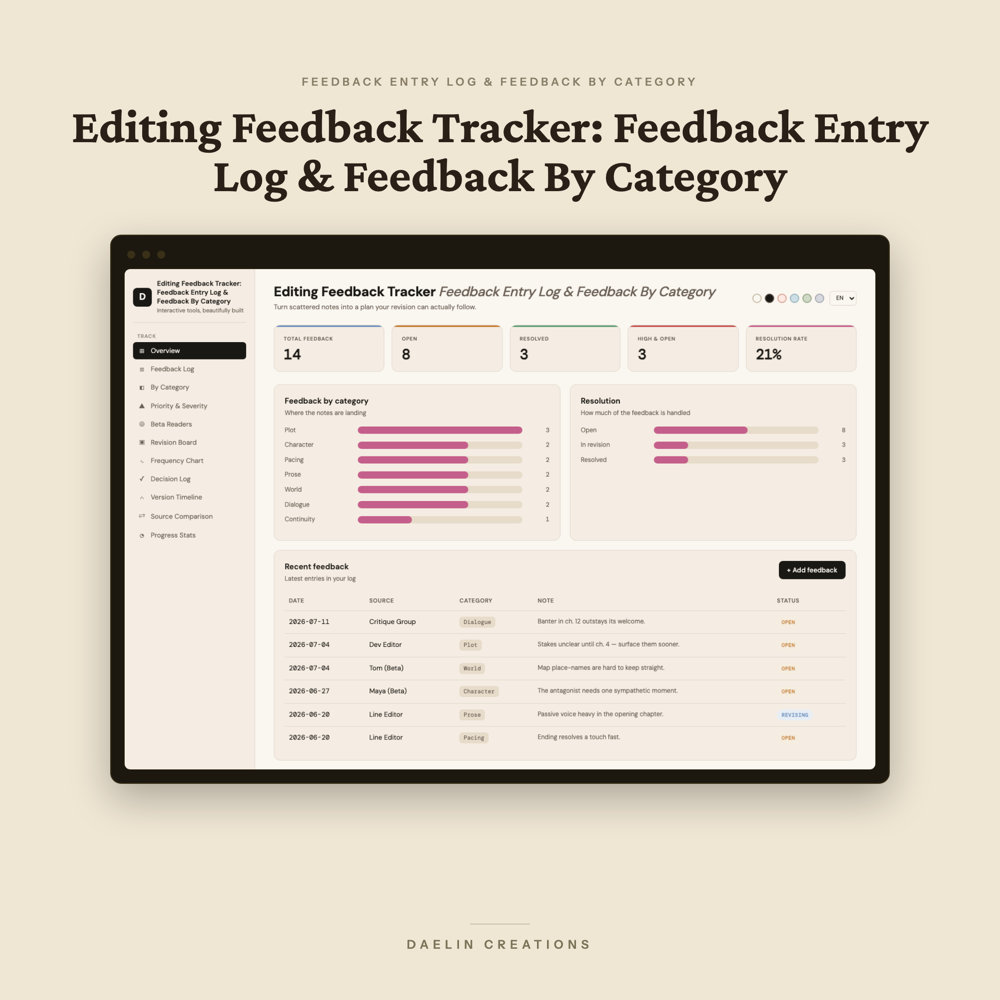
Editing Feedback Tracker: Feedback Entry Log & Feedback By Category
Stop losing track of which beta reader said what — this dashboard turns a flood of editing notes into a clear, structured revision plan you can actually act on.
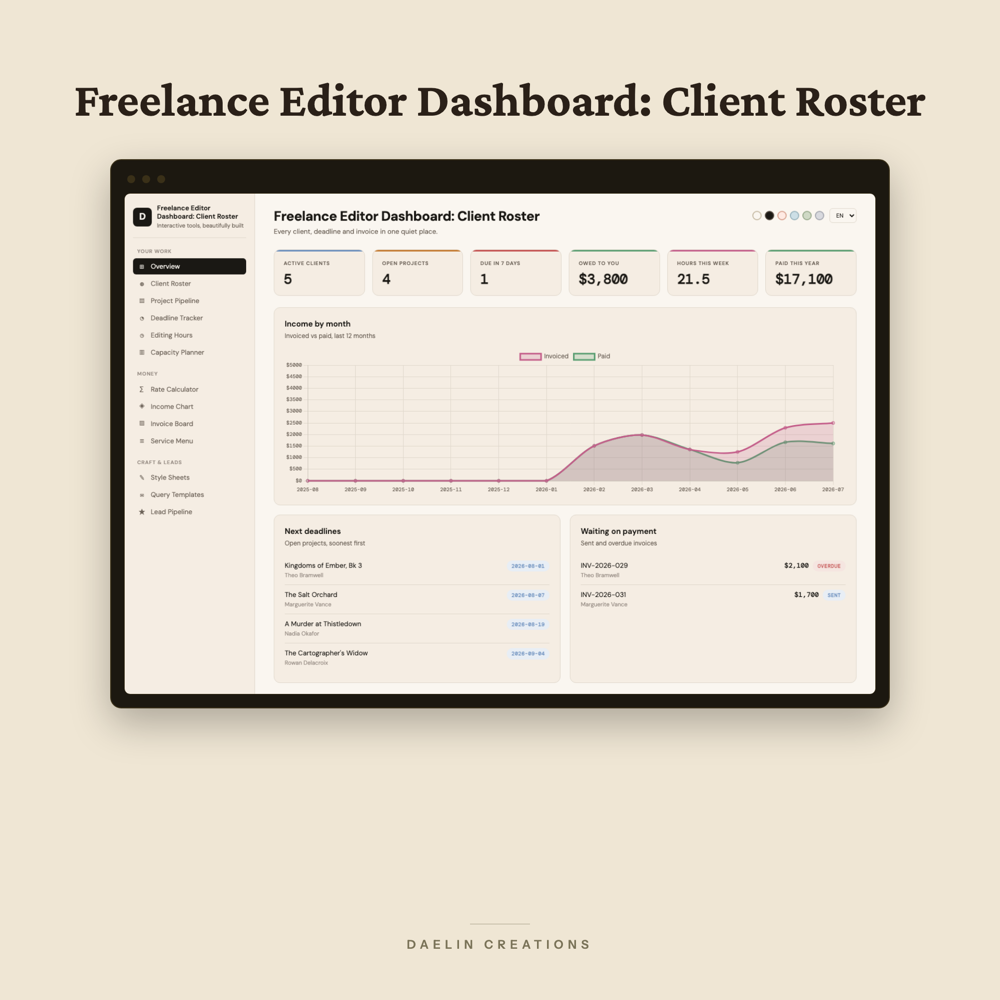
Freelance Editor Dashboard: Client Roster, Project Pipeline & Rate Calculator
RUN YOUR EDITING BUSINESS FROM ONE SCREEN
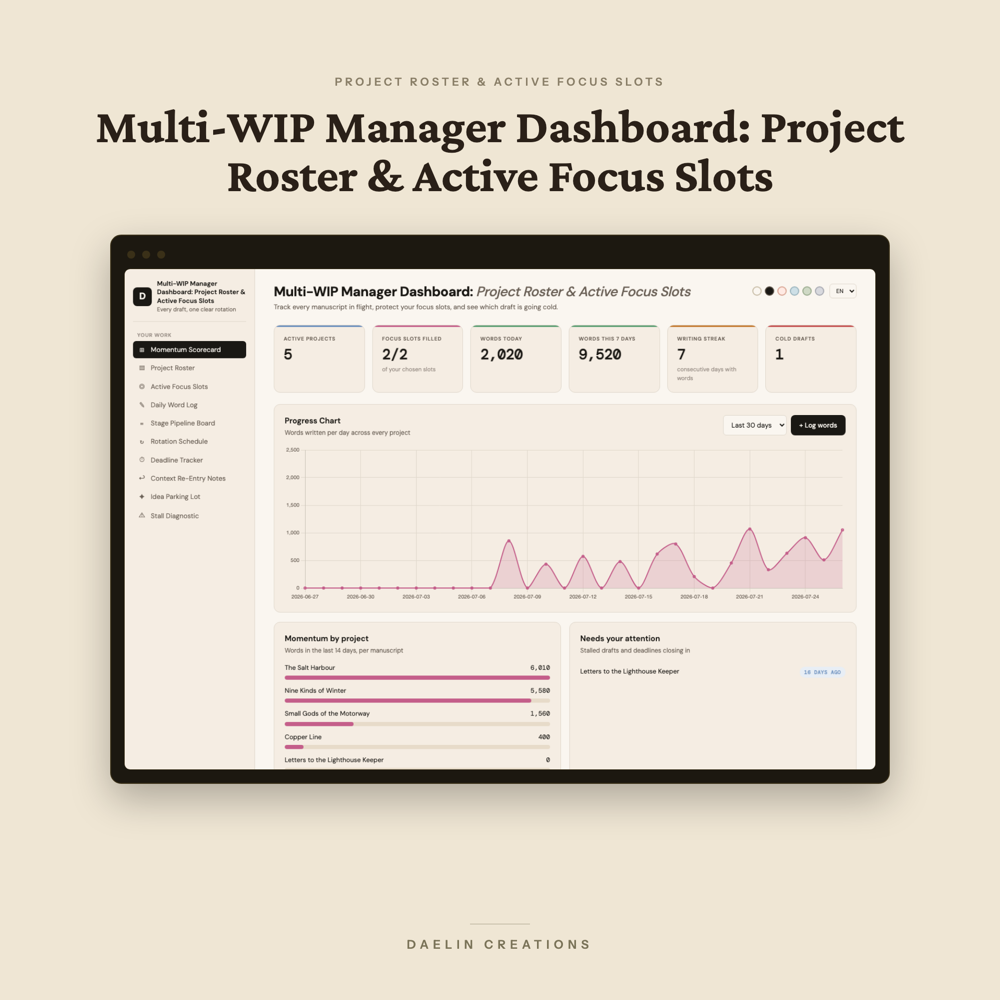
Multi-WIP Manager Dashboard: Project Roster & Active Focus Slots
Six half-finished manuscripts and no idea which one deserves today. This dashboard fixes the real problem with juggling multiple works in progress: not a lack of ideas, but a lack of a system for deciding where your hours go and how to get back into a draft you last touched three weeks ago.
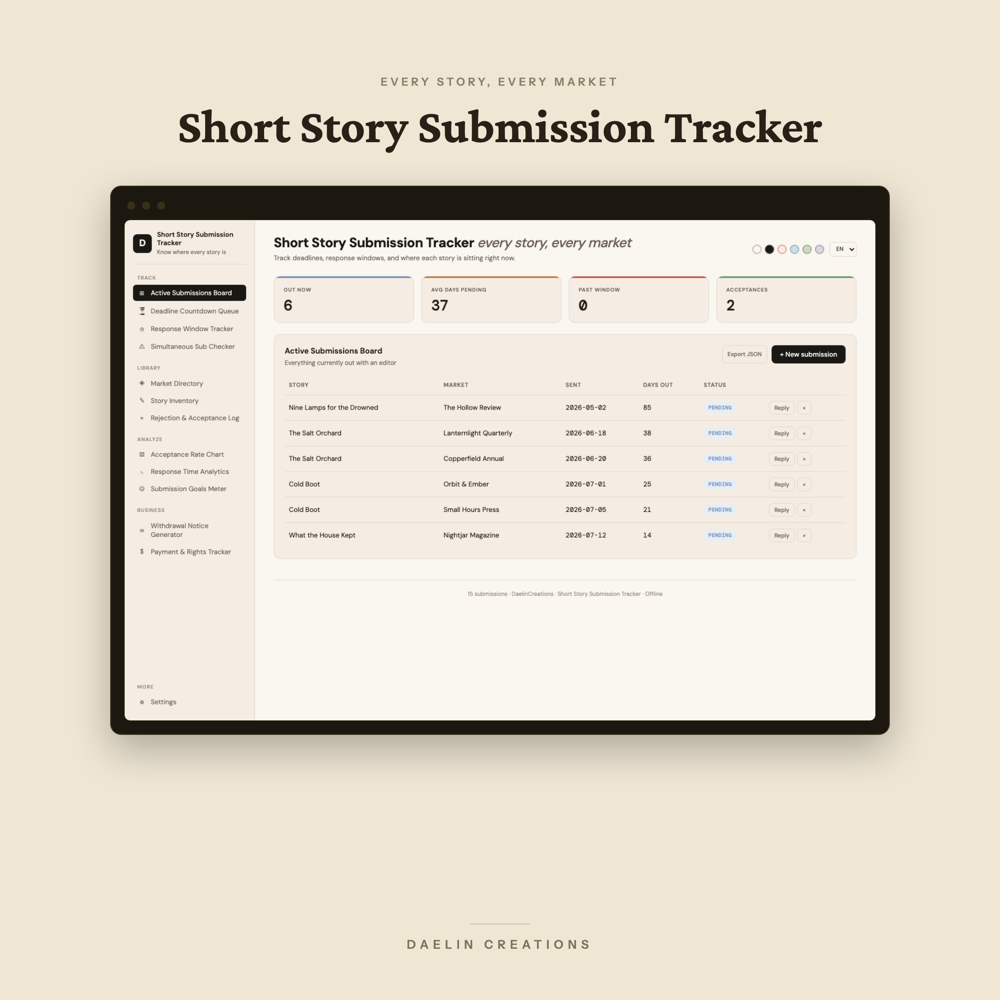
Short Story Submission Tracker
STOP LOSING TRACK OF WHERE YOUR STORIES ARE
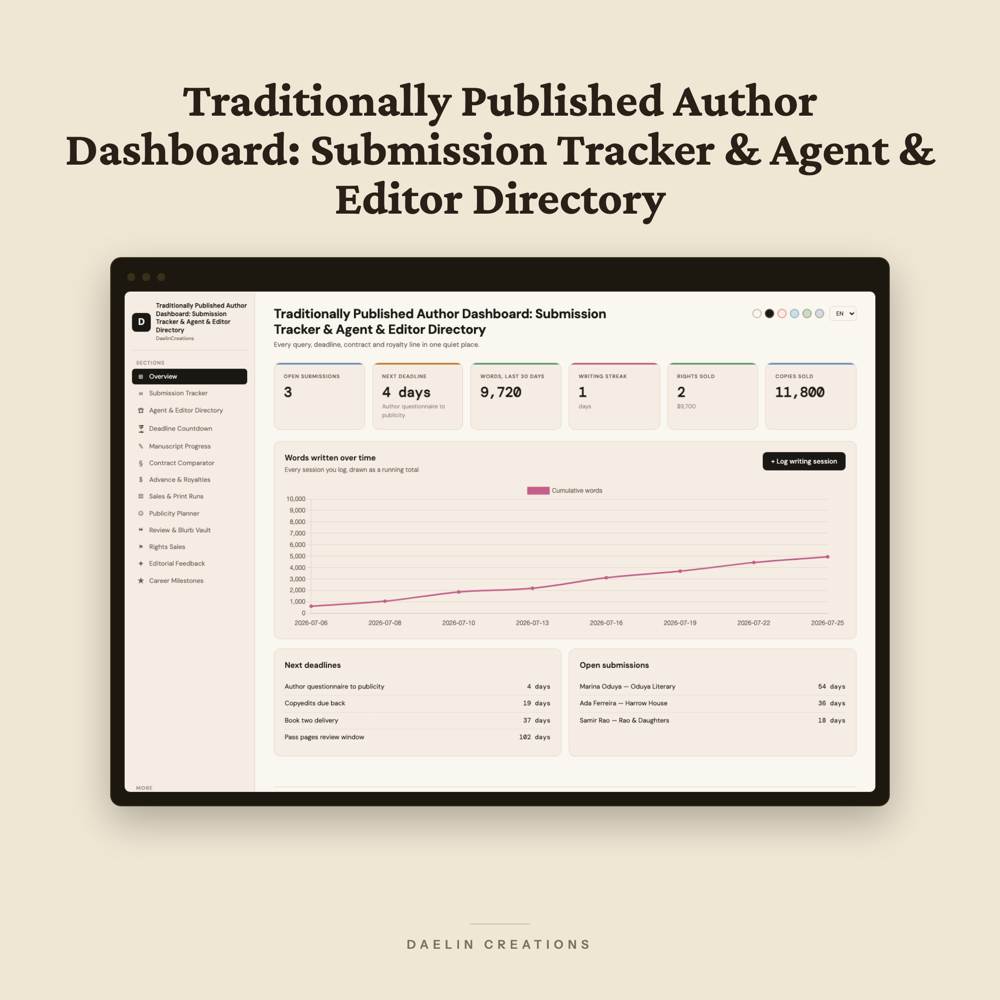
Traditionally Published Author Dashboard: Submission Tracker & Agent & Editor Directory, Query Log, Deadline Countdown, Advance & Royalty Calculator, Rights Sales & Publicity Planner
Built for the writer who already has a manuscript and now has to run it like a business.